Rail
Add train travel to the travel platform you already run. Guru TechnoLabs integrates third-party rail supplier APIs into your website, booking engine, agent portal and back office, so your customers and agents can search trains, compare fares, reserve seats, pay, receive e-tickets and manage changes in one place.








Rail API integration is the process of connecting a travel business's website, booking engine or agent portal to a third-party rail supplier API. Once connected, customers or agents can search trains, see schedules and fares, check seat availability, book and pay, receive tickets, and cancel or change bookings without leaving your platform.
The rail supplier API provides the inventory: routes, timetables, fares, seats and ticketing. The integration is the work on your side. It covers mapping the supplier's data to your platform, building the booking flow, connecting payments, storing bookings in your records and handling after-sales. Rail supplier APIs come from rail aggregators, GDSs, rail pass distributors and some railway operators' partner programmes, and most issue credentials only after a commercial agreement.
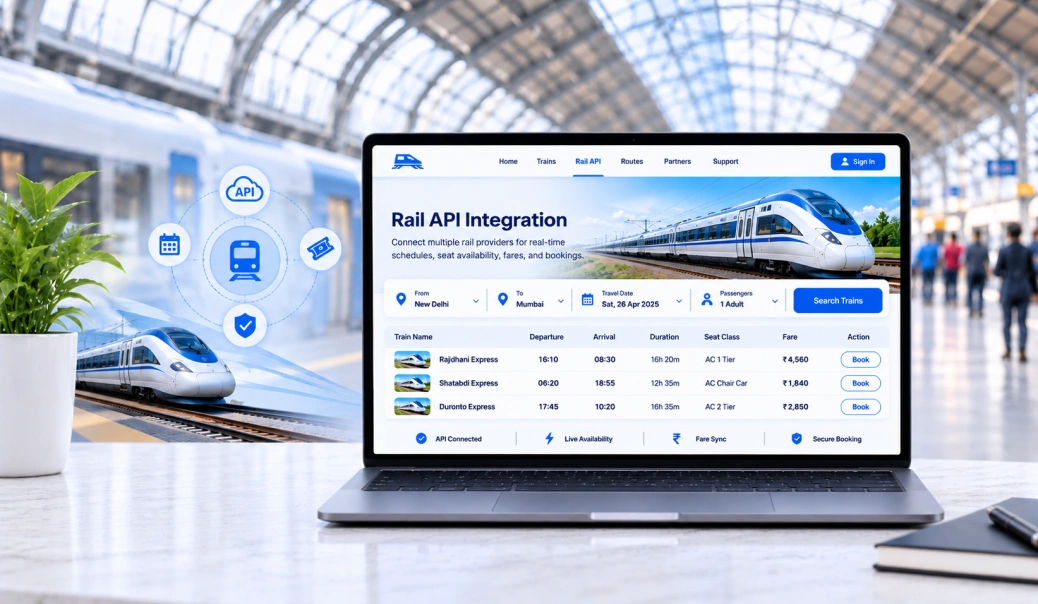
Rail API integration fits travel businesses that already sell trips and want train journeys inside the same search, booking and back-office flow.
On many short-haul routes, a train competes directly with a flight. Integrating a rail supplier API lets your customers compare trains with the flights you already sell through your flight API integration, book either in one checkout, and add a rail leg to a hotel stay. Rail becomes another bookable product rather than a referral link to someone else's site.
Corporate travellers increasingly expect rail as an option for business trips. With rail connected through an API, train bookings sit in the same trip record as flights and hotels. That keeps travel policy checks, approvals, invoicing and spend reporting in one system instead of split across a separate rail portal.
Tour operators selling multi-city trips often book trains by hand on supplier websites, then retype the details into their itineraries and invoices. A rail supplier API brings live fares into quoting and package building, issues tickets with the booking, and keeps rail legs in the same record as hotels, transfers and tours, including the rail legs of departures run through your group travel management system.
If you distribute travel through agents and sub-agents, rail can be added to your B2B travel portal with your own markups, commissions and credit limits applied. Agents search and book trains in the same tool they already use for flights and hotels, instead of logging into a separate rail system.
No single rail supplier API covers every operator and market, so most travel businesses combine two or more rail sources alongside the flight and hotel suppliers already connected through their travel API integration. We help you choose the right supplier mix for your routes and sales channels, then integrate it. Access to each supplier API depends on a commercial agreement between your business and that supplier; we support the onboarding and the technical work.
Rail aggregators connect to many railway operators and expose them through one supplier API, so you integrate once instead of operator by operator. This is the most common starting point for travel businesses adding rail.
Rail supplier API:
National operators such as Deutsche Bahn, SNCF, Trenitalia, Renfe, Eurostar and Amtrak run their own reservation systems. Few offer open, self-serve booking APIs. Access usually comes through a reseller or distributor programme, a licensed agent scheme, or indirectly through an aggregator or GDS. Eurostar, for example, offers an API for rail distributors, OTAs and technology providers, while Amtrak does not publish a developer API and sells through agent booking sites, GDSs and corporate booking tools. A direct operator connection makes sense when one operator carries most of your rail volume and you qualify for its programme.
If you already connect to Amadeus, Sabre or Travelport through a GDS integration, rail may be available through the same connection. Amadeus distributes rail content from operators including Deutsche Bahn, SNCF and Trenitalia. Sabre Rail includes Trainline Partner Solutions content from operators such as Trenitalia, Italo, SBB and Deutsche Bahn, offered outside those operators' home markets. Travelport also carries rail content. Booking through a GDS keeps the rail segment in the same PNR as the flight, which suits TMCs and agencies working from a GDS. Coverage and booking rules differ by GDS and market, so we check them against your routes first.
Eurail and Interrail passes give travellers flexible travel across many European countries, and Eurail offers an API so distributors can sell and issue passes online. Many high-speed and night trains also require a seat reservation for pass holders, which can be sold through Rail Europe's API. A pass integration covers the pass catalogue, traveller age bands, mobile pass issue and the matching seat reservations.
We build the complete rail booking journey, from station search to refunds. What each step can do depends on the supplier API, so we build to what each supplier supports and add a fallback where it does not.
Customers search by station or city with autocomplete and see direct and connecting trains with departure and arrival times, journey duration, number of changes and the operating carrier. We map station codes across suppliers (UIC, IATA and each supplier's own IDs), so one station appears once in your results, however many suppliers serve it.
Your platform shows each supplier's fare types with their conditions, such as flexible, semi-flexible or non-refundable, along with passenger types, ages and supported railcards or discount cards. Search results can be cached to keep pages fast, while price and availability are re-checked with the supplier API before the customer pays.
Where the supplier offers them, travellers can choose first or standard class, seat preferences or a seat from a coach map, and sleeper berths or couchettes on night trains. The integration also handles mandatory seat reservations on high-speed services and reservations for rail pass holders.
The booking flow collects the passenger details each supplier requires, takes payment through your existing payment gateway, confirms the booking and issues the ticket. Depending on the carrier, tickets arrive as PDF e-tickets, mobile tickets with barcodes, or collection references. The supplier's booking reference is stored with your own trip record, and confirmation emails go out from your brand.
Refund and change conditions are shown before booking, so customers know what they are buying. Where the rail supplier API supports it, cancellations, exchanges and refund calculations run through the API. Where it does not, or a ticket type cannot be changed online, the request is routed to a back-office workflow with status tracking, so your team handles it in one place.
Journeys with several legs or operators can be booked together where the supplier supports multi-operator bookings, or combined from different supplier APIs into one itinerary on your side. Rail options can also appear next to flights in the same search for air-rail comparisons and connections.
You do not need a new booking platform to sell trains. We add rail supplier APIs as a module inside the systems you already run, so live bookings, customer data and existing supplier connections stay untouched.
Several rail suppliers offer more than one way to connect. The right choice depends on how central rail is to your business and how much control you need.
Rail is harder to integrate than most travel products because every carrier sets its own rules for fares, tickets and changes. These are the problems we handle so your team and customers do not have to.
Rail supplier APIs use different formats (REST with JSON, SOAP with XML, or GraphQL), different authentication, different booking steps and different error codes. We build a normalisation layer between the suppliers and your platform, so your booking engine works with one consistent rail data model. Adding another supplier later means adding one connector, not rewriting your booking flow. We also design for OSDM, the open rail sales and distribution API standard published by UIC, which a growing number of rail suppliers support.
The same station can carry different identifiers at different suppliers, and fare names and conditions vary by carrier. We maintain station mapping across UIC, IATA and supplier codes, and translate each supplier's fare conditions into consistent labels so customers can compare options fairly. The supplier's exact terms are kept with every booking for after-sales and disputes.
Some carriers issue PDF e-tickets, some only mobile tickets, and some require collection. Some allow exchanges and refunds through the API; others do not, or not for every fare. We configure delivery and after-sales rules per supplier and per ticket type, route anything the API cannot handle to your staff, and reconcile ticket and refund status with the supplier so your records stay accurate.
Every rail integration follows the same eight steps, from choosing suppliers to supporting the platform after launch.
We review your target routes and markets, expected rail volume, sales channels (B2C, B2B or corporate) and current platform, then shortlist the rail supplier APIs that cover them.
The commercial agreement is between your business and the supplier. We prepare the technical questions to ask, help with the partner application, and work through any accreditation or compliance steps the supplier requires.
Once access is granted, we review the supplier's API documentation and test environment, confirm booking flows, rate limits and certification requirements, and agree the final scope with you.
We build station mapping, fare and ticket-type models and the normalisation layer that connects each supplier API to your platform's data structure.
We build train search, fare and seat selection, passenger details, payment, booking and ticket issue inside your website, booking engine or agent portal.
We implement cancellations, exchanges and refunds, ticket delivery by format, customer notifications, and the back-office screens your team uses to manage rail bookings.
We test every flow end to end in the sandbox, including failures and edge cases, then complete the supplier's certification process where one is required.
After switching to production, we monitor bookings and errors, update the integration when suppliers release new API versions, and add operators or suppliers as your rail business grows.
Guru TechnoLabs has spent more than 10 years building custom software for travel businesses, including an OTA platform on Sabre APIs, a booking system integrated with the Amadeus API, and a multi-supplier hotel API integration that kept inventory in sync across suppliers. We bring that integration experience to rail.

We recommend rail supplier APIs on fit for your routes and channels, not on a commercial tie-in.
Rail is added to the booking engine, agent portal and back office you already run.
Cancellations, exchanges, refunds and ticket delivery are scoped from day one.
We maintain the integration as supplier APIs change and add suppliers as you expand.
We have fulfilled the demands of clients working in different industries. For more details, check what our clients say about us.

Israel
We worked with Liron Feigenbaum on a UI/UX and mobile app development proje...

United States
Hi, my name is Tiami. I was looking for an overseas company and found Guru ...

United Kingdom
Hi, I am Doski. I work with Guru TechnoLabs' team and I am very happy...

Australia
We commissioned and adopt a website from Guru TechnoLabs. Website require...
The free rail APIs are mostly data APIs: timetables, live running and disruption feeds such as National Rail’s Darwin service in Great Britain or GTFS timetable files published by operators. They do not sell tickets. Rail supplier APIs that book and issue tickets are commercial products. You need an agreement with the supplier, and terms such as commissions, booking fees or margins vary by supplier.
You apply to the supplier’s B2B or partner team, agree commercial terms, and then receive API credentials, documentation and usually a test environment. Most suppliers require certification testing before you go live, and some markets or GDS channels have their own accreditation rules. We help with the technical side of onboarding and certification.
Yes. Once your business has an agreement with Trainline Partner Solutions or Rail Europe, we can integrate their supplier API into your platform. Trainline does not publish its API documentation openly; integration details are shared with approved partners once the commercial agreement is in place.
No. Amtrak does not publish a developer API for third-party booking. Travel agents sell Amtrak through RailAgent booking sites, GDSs and corporate booking tools, and international agents and tour operators use Amtrak’s RailAgent channel. Options through GDS connections also change over time; Travelport, for example, stopped onboarding new Amtrak online content on its Universal API connection in February 2025. We check the current routes to Amtrak content before recommending one.
No. After-sales support depends on the supplier, the carrier and the fare type. Some rail supplier APIs, such as Distribusion’s, support exchanges and cancellations through the API, while others offer limited changes, and non-refundable fares cannot be refunded at all. We automate after-sales where the API allows it and route everything else to a staff workflow.
Yes. We add rail as a module to your current booking engine, agent portal and back office, so you keep your existing platform, customer data and supplier connections.
Most rail supplier APIs provide a test environment once you have an agreement. Some suppliers do not offer self-serve sandbox access before that. For OSDM-based integrations, public sandboxes exist for learning the standard, including ones from Distribusion and Benerail.
Share your business needs or project requirements with us & we will get back to you quickly.



