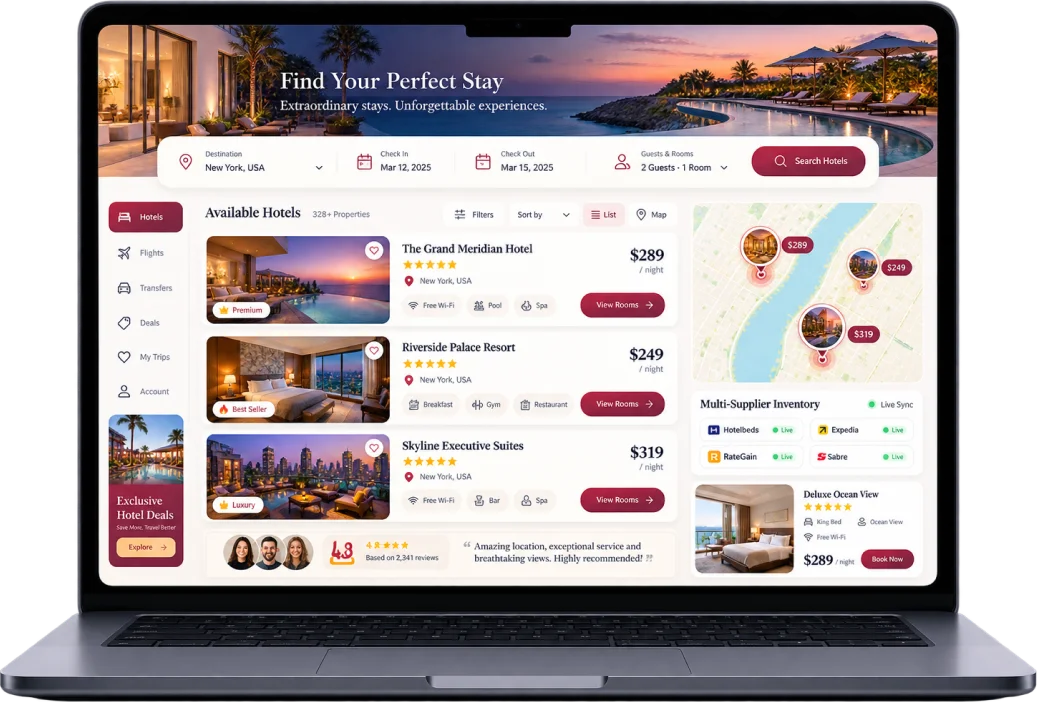






Our client is a mid-to-large-scale Online Travel Agency (OTA) offering hotel booking services across leisure and corporate travel segments. The platform aggregates hotel inventory from multiple third-party suppliers, including global distribution systems, wholesale hotel consolidators, and direct hotel-chain APIs, to offer travelers a wide selection of accommodations across domestic and international markets.
At the time of engagement, the client managed inventory from 12 hotel suppliers, covering over 80,000 hotel properties worldwide. Their business model depended on aggregating this inventory into a single, unified booking interface where customers could compare pricing, check availability, and complete reservations in real time.
For an OTA operating at this scale, inventory accuracy is not a technical detail; it is the foundation of customer trust. A single mismatch between what a customer sees on the platform and what a hotel can actually deliver translates directly into cancelled bookings, refund disputes, and reputational damage. As the client's supplier network grew, so did the complexity of keeping every source of hotel data consistent, current, and reliable.
The client approached Guru TechnoLabs with a clear business mandate: fix the inventory reliability problem before it limited growth. Their key objectives were:
In short, the client wanted to scale its supplier network and inventory catalog without scaling the manual effort, errors, and customer complaints that came with it.

As the client onboarded more hotel suppliers to broaden its inventory, several recurring business problems began affecting day-to-day operations and customer experience.

Each supplier maintained its own version of hotel availability and pricing. The same hotel room could show as available on one supplier feed and sold out on another, leaving the platform to guess which data to trust.
Every supplier structured and delivered hotel data differently; room types, amenities, cancellation policies, and pricing structures were labeled and organized inconsistently, making it difficult to present a clean, unified experience to customers.
Room inventory changed constantly as other channels sold the same rooms. Without near real-time updates, the platform often displayed rooms that were no longer available.
Rate changes from suppliers, including promotional pricing and dynamic rate adjustments, were not reflected quickly enough, leading to price mismatches between what customers saw and what suppliers ultimately confirmed.
Because multiple suppliers offered contracts with the same hotels, the same property frequently appeared multiple times under slightly different names or addresses, confusing customers and fragmenting reviews and ratings.
Customers would complete a booking only to receive a rejection or modification notice afterward, because the underlying room was no longer available by the time the supplier processed the request.
The operations team spent significant time manually cross-checking supplier data to catch discrepancies, a process that was slow, error-prone, and unsustainable as the supplier count grew.
All of the above surfaced as a steady stream of customer complaints about inaccurate pricing, unavailable rooms, and post-booking cancellations, directly affecting customer retention and brand credibility.
These challenges were not isolated technical glitches. Together, they represented a structural inventory management gap that limited the client's ability to grow its supplier network confidently.

Guru TechnoLabs designed and implemented a multi-hotel API integration platform built specifically to solve the inventory synchronization problem at its root, rather than patching individual symptoms.
We built standardized connectors for each of the client's 12 hotel suppliers, enabling new suppliers to be onboarded through a consistent integration framework rather than custom one-off development each time.
Regardless of how each supplier structured their data, our platform normalized hotel details, room categories, pricing, and policies into one consistent internal format, giving the client's team and customers a single, coherent view of every property.
Instead of relying on periodic batch updates, the platform continuously pulled and reconciled availability data from all suppliers, dramatically shortening the gap between what suppliers had and what customers saw.
Rate and availability changes from suppliers were automatically reflected on the platform, eliminating the delays that previously caused pricing mismatches at checkout.
We implemented a hotel content mapping process that identified when multiple suppliers referenced the same physical property and merged them into a single listing with the best available rates and terms.
Before finalizing any reservation, the system performed a final availability check against the live supplier feed, catching last-minute changes and preventing the customer from completing a booking on a room that was no longer available.
By automating reconciliation, mapping, and validation, the operations team's manual workload dropped significantly, allowing them to focus on supplier relationship management instead of data firefighting.
Every part of this solution was built to directly address a business pain point the client had identified, not to introduce technology for its own sake.
| Layer | Technology Approach |
|---|---|
| Backend | Node.js-based microservices architecture for supplier integration and business logic |
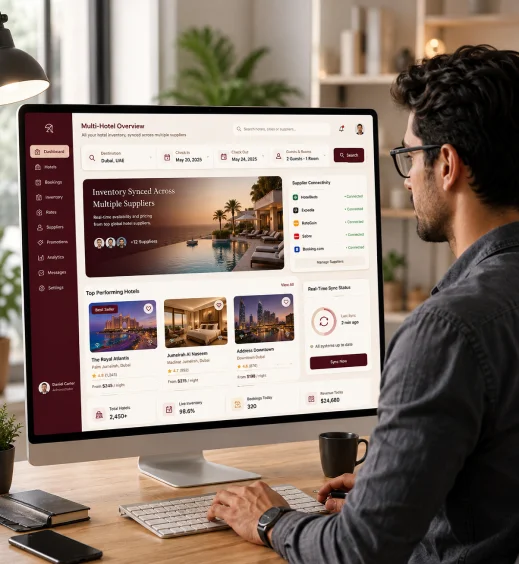
| Frontend | React-based admin dashboard for inventory oversight and reporting |
| Hotel APIs | REST/XML-based supplier API integrations across GDS, consolidator, and direct-chain sources |
| Database | PostgreSQL for structured hotel and booking data, Redis for high-speed availability caching |
| Cloud Infrastructure | AWS-based deployment with auto-scaling to handle search and booking traffic spikes |
| Monitoring & Logging | Centralized logging and alerting to track supplier API health and data sync status |
This stack was selected to support reliability and speed at scale, while remaining maintainable for the client's internal engineering team going forward.
A unified connector framework for all 12 suppliers, reducing the time and cost required to onboard future supplier partnerships.


Continuous availability checks ensured customers saw genuinely bookable rooms, directly cutting down post-booking rejections.
Automated rate updates kept displayed prices aligned with supplier-confirmed pricing, reducing checkout price discrepancies.


Merged duplicate listings of the same property across suppliers into one clean profile, improving the browsing experience and consolidating reviews.
The core system reconciling data from all suppliers into one accurate, unified inventory source of truth.


A final pre-confirmation check against live supplier data prevented customers from booking rooms that had just sold out elsewhere.
Automated identification of overlapping supplier listings, eliminating a longstanding source of catalog clutter and customer confusion.


Gave the operations team visibility into supplier performance, sync status, and inventory health without manual spreadsheet tracking.
Proactive notifications when a supplier feed failed or lagged, allowing the team to respond before customers were affected.


Ongoing visibility into booking failure rates, supplier reliability, and inventory accuracy trends to support data-driven supplier management decisions.
Each feature was designed to close a specific gap identified during the discovery phase, ensuring the solution mapped directly back to the client's original business challenges.
Following the implementation of the multi-hotel API integration platform, the client experienced measurable improvements across their booking operations:
These outcomes gave the client a stronger operational foundation to pursue additional supplier partnerships with confidence.


"Managing hotel inventory across multiple suppliers had become one of the biggest challenges for our business. Our team spent countless hours updating availability, resolving booking issues, and handling customer complaints caused by outdated inventory. Guru TechnoLabs helped us bring everything together into one reliable system. Today, our inventory stays synchronized, booking errors have dropped significantly, and our team can focus on growing the business instead of fixing operational issues. Their understanding of both travel technology and our business needs made them a trusted partner throughout the project."
— Director of Travel OperationsAccurate inventory is a trust-building asset, not just an operational nicety; customers judge a platform by whether what they see matches what they get.
Multi-hotel API integration reduces complexity, allowing OTAs and booking platforms to add suppliers without multiplying manual effort.
Automation minimizes human error in areas like reconciliation and duplicate detection that are too repetitive and high-volume for manual teams to manage reliably.
Reliable availability directly improves booking conversions, since customers are more likely to complete a purchase when they trust the information in front of them.
A centralized inventory system supports long-term growth, giving businesses the operational headroom to expand their supplier network strategically.
Booking validation before confirmation is a critical safeguard, preventing last-minute availability changes from becoming customer-facing failures.
If your business is struggling with inconsistent supplier data, delayed pricing, or booking failures, a multi-hotel API integration platform can resolve these issues at the source.
Cutting-edge technology for modern businesses.

Transparent communication and on-time delivery.
Skilled professionals dedicated to your success.
Solutions that drive growth and measurable results.
We have fulfilled the demands of clients working in different industries. For more details, check what our clients say about us.

Israel
We worked with Liron Feigenbaum on a UI/UX and mobile app development proje...

United States
Hi, my name is Tiami. I was looking for an overseas company and found Guru ...

United Kingdom
Hi, I am Doski. I work with Guru TechnoLabs' team and I am very happy...

Australia
We commissioned and adopt a website from Guru TechnoLabs. Website require...
Share your business needs or project requirements with us & we will get back to you quickly.



