
Home Services

United States
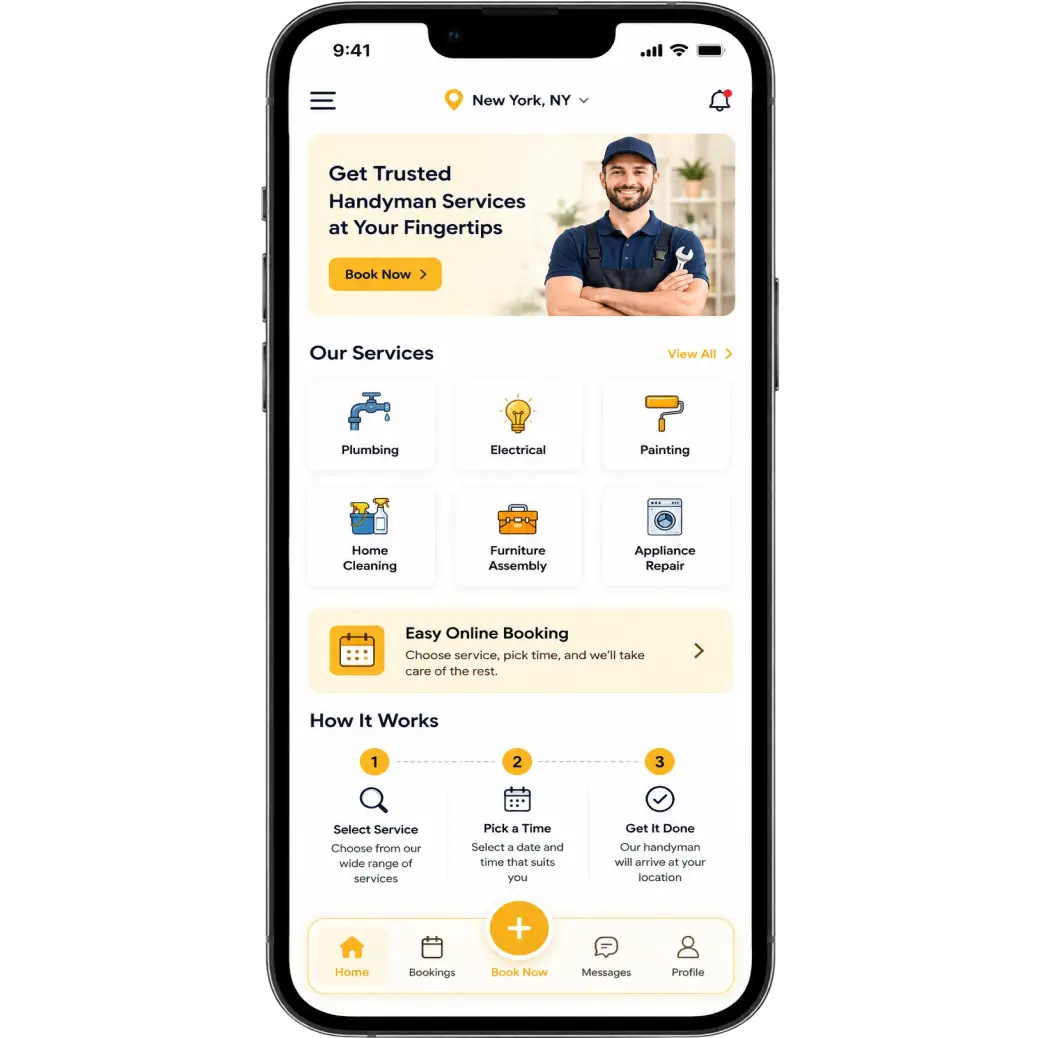







Our client is a growth-stage handyman and small-repair business operating across three metropolitan markets in the U.S. Midwest. Established in 2013, the company has built more than a decade of brand equity on a simple promise: reliable residential repairs, installations, and maintenance work, delivered on time.
By the time it engaged us, the business had grown to roughly 40 employees. This included 28 field technicians, supported by an in-house dispatch and administration team. It was serving an active base of around 9,000 households, along with a growing portfolio of property management and small commercial accounts.
The company runs a hybrid model, combining on-demand repair work with recurring maintenance agreements. That mix produced dependable revenue, but it also created real operational complexity. Job volume was high, the business covered multiple service zones, and a phone-based process was never designed to handle coordination at this scale.
The company did not set out to buy software. It set out to solve a problem that was holding back its growth. The way appointments were being taken and managed had quietly become a limit on how fast the business could expand.
The company had a few clear goals. It wanted to move bookings off the phone and onto a self-service system that customers could use at any hour. It wanted to recover the revenue it was losing to missed calls and abandoned enquiries. And it wanted to ease the workload on a dispatch team that had become a bottleneck. Beyond day-to-day efficiency, the business needed a booking system that could keep up with growth, such as more technicians, more markets, and higher volume, without a matching rise in back-office costs.
Put simply, the goal was to turn more of that demand into completed, paying appointments, while giving customers the easy booking experience they now expect from every service they use.

As the business expanded across multiple service areas, the scheduling process struggled to keep pace. What once worked for a smaller operation became increasingly difficult to manage at scale. Manual coordination, delayed responses, and limited booking availability began affecting both operational efficiency and customer experience.
To understand where the business was losing opportunities, we identified five interconnected challenges.

Customers could only schedule appointments by calling during business hours. However, many homeowners looked for repair services during evenings, weekends, or outside office hours when no one was available to answer their calls. Every missed enquiry represented a potential booking that often went to a competitor offering a faster, more convenient booking experience.
Managing appointments manually required the dispatch team to spend a significant portion of their day answering calls, checking technician availability, confirming bookings, and updating schedules. This left less time for coordinating field teams, resolving customer issues, and improving overall service operations.
As appointment volumes increased across multiple service regions, manual scheduling became increasingly prone to errors. Double bookings, incorrect job assignments, and missed appointments disrupted technician schedules, delayed service delivery, and negatively impacted customer satisfaction.
Customers rarely received immediate confirmation after requesting a service. Every booking required someone to manually verify availability before responding. These delays created uncertainty for customers, causing many to abandon their enquiries and book with businesses that could confirm appointments instantly.
Without a centralised scheduling system, assigning the right technician to the right job became increasingly complex. Limited visibility into technician availability and daily routes resulted in unnecessary travel time, inefficient resource allocation, and reduced productivity across the field service team.
As these operational challenges continued to grow, they began limiting the company's ability to scale. Missed booking opportunities, increasing administrative overhead, scheduling inefficiencies, and inconsistent customer experiences all contributed to lost revenue. It became clear that improving operational efficiency required more than process improvements it required replacing the entire scheduling experience with a digital-first booking system.

We designed and built a 24/7 online booking platform around the way our client actually works. The goal was never just to add a booking form to a website. It was to rethink the whole scheduling process, so that most of it runs on its own, reliably and without manual effort, and the team is free to focus on the decisions that really need them.
Customers can now book at any time, from any device, without picking up the phone. This removed the biggest limit on the business, which was its dependence on office hours. Evenings and weekends went from lost opportunity to a live source of new bookings.
The platform shows genuine, real-time availability, so every slot a customer sees is one that can actually be booked. This did away with the callback cycle, gave customers confirmation the moment they were ready to commit, and closed the gap where they used to drift off to competitors.
Each booking is matched to the right technician automatically, based on availability, location, and job type. A decision that once relied on what an individual staff member happened to know now happens instantly and consistently. Routing improved, allocation errors dropped, and the business no longer depended on any one person's memory.
Automated reminders keep both the customer and the technician on the same page ahead of every appointment. Fewer missed or forgotten visits meant fewer wasted trips and more completed, invoiced work, which protected revenue in a way the business could actually measure.
With customer and appointment data held in one place, the dispatch team works from a single accurate view instead of piecing together notes, spreadsheets, and phone messages. The result is faster scheduling for customers, lighter workload for staff, and far greater reliability across all three markets.
We chose every technology to serve a specific business goal, whether that was speed, reliability, or less manual work. Nothing was added for the sake of it. We also kept the stack deliberately lean, so the platform stays simple and affordable to maintain over the long run.
| Technology | Role in the Solution | Business Value |
|---|---|---|
| React | The booking screen customers use | A fast, mobile-friendly experience that keeps people from dropping off |
| Node.js | The scheduling engine and live availability | Quick, dependable responses, even during busy periods |
| PostgreSQL | The customer and appointment database | One trusted record of every booking across all regions |
| AWS | Cloud hosting and infrastructure | A stable platform today, with room to grow as demand rises |
| Twilio | Automated text confirmations and reminders | Fewer no-shows and far less manual follow-up |
| Google Maps API | Service-area checks and technician routing | Efficient dispatching and fewer jobs booked that can't be done |
| Stripe | Secure online payments and deposits | Healthier cash flow and less chasing payment after the job |
Once the online booking platform was in place, our focus shifted to optimising every stage of the scheduling journey. Rather than replicating the existing manual process in a digital format, we reimagined how customers booked services and how the business managed appointments behind the scenes. Every feature was designed to eliminate operational bottlenecks, improve customer convenience, and support long-term business growth.
We introduced a self-service booking experience that allows customers to schedule appointments whenever they need a service—without waiting for office hours. By making booking available around the clock, the business captured demand that was previously lost during evenings, weekends, and holidays while providing customers with the convenience they increasingly expect.


Customers can view available appointment slots in real time and receive immediate booking confirmation. Eliminating manual availability checks reduced scheduling delays, prevented double bookings, and gave customers the confidence to complete their booking in a single session.
To improve operational efficiency, we implemented an intelligent scheduling engine that automatically assigns jobs based on technician availability, location, and required skills. This streamlined daily scheduling, reduced unnecessary travel time, and helped technicians spend more time completing billable work.


Every confirmed appointment now triggers instant booking notifications, ensuring customers receive immediate confirmation without staff intervention. This improved customer confidence while significantly reducing the administrative effort previously required to manage appointment confirmations.
Automated reminders are sent before every appointment to both customers and technicians, reducing missed appointments and improving schedule adherence. As a result, the business experienced fewer no-shows, better resource utilisation, and a smoother service experience.


Customers can easily view, reschedule, or cancel appointments through a secure self-service portal without contacting the office. Giving customers greater control over their bookings reduced inbound call volumes while improving convenience and overall customer satisfaction.
The platform automatically verifies whether a booking request falls within an active service area before confirming the appointment. This prevents scheduling requests outside the company's coverage zones, helping dispatch teams optimise routes and maintain operational efficiency.


To simplify the payment process, we enabled customers to securely pay online or place a deposit during booking. This reduced payment delays, improved cash flow, and created a more seamless end-to-end customer experience.
We developed a unified scheduling dashboard that provides dispatch teams with complete visibility into appointments, technician availability, and daily workloads across all service regions. Managing operations from a single platform reduced manual coordination and enabled faster, more informed scheduling decisions.


The platform provides real-time insights into booking trends, technician utilisation, customer demand, and conversion performance. These analytics enable the business to make data-driven decisions around staffing, service capacity, and future expansion while continuously optimising day-to-day operations.
Within six months of launch, the business recorded measurable improvements across booking performance, operational efficiency, and customer experience.
Around 62% of all new bookings shifted to the online channel, with 35% made outside business hours capturing demand that was previously lost. Missed calls fell by 70%, while appointment confirmations became instant instead of taking hours.
Behind the scenes, the dispatch team recovered nearly 15 hours per week previously spent on manual scheduling. Scheduling conflicts and double bookings dropped by 85%, and technician utilisation increased from 68% to 81%, enabling the business to complete more jobs without expanding its workforce.
Most importantly, completed service appointments increased by 28%, contributing to 22% year-over-year revenue growth. By replacing manual scheduling with a 24/7 online booking system, the business unlocked sustainable growth through greater operational efficiency rather than additional overhead.


We knew our scheduling process was holding the business back, but we underestimated how much it was affecting both our customers and our team. Every missed call was a missed opportunity, and managing appointments manually had become increasingly difficult as we expanded. The Guru TechnoLabs team took the time to understand our operations before recommending a solution, which gave us confidence that it was built around our business rather than a generic booking platform. Since going live, customers can book services whenever it's convenient for them, our dispatch team spends far less time on administration, and we've been able to grow without increasing operational overhead at the same pace."
— Director of OperationsThe lessons from this engagement extend well beyond a single handyman business and apply to any field service operation facing scale.
Convenience drives more bookings. Giving customers the ability to book services anytime significantly increases completed appointments.
24/7 availability creates a competitive advantage. Businesses that accept bookings around the clock capture demand that would otherwise be lost.
Automation improves operational efficiency. Streamlining scheduling and confirmations reduces administrative effort and allows teams to focus on higher-value work.
Smarter scheduling increases productivity. Assigning the right technician to the right job improves resource utilisation while reducing travel time and scheduling conflicts.
Operational efficiency supports sustainable growth. Reducing manual processes enables businesses to scale without proportionally increasing operational costs.
A better booking experience builds customer loyalty. Fast, reliable, and hassle-free scheduling improves customer satisfaction and encourages repeat business.
The way customers book your services directly impacts your revenue and operational efficiency. Let us help you build a modern booking experience that captures more demand, reduces administrative workload, and keeps your technicians productive.
Cutting-edge technology for modern businesses.

Transparent communication and on-time delivery.
Skilled professionals dedicated to your success.
Solutions that drive growth and measurable results.
We have fulfilled the demands of clients working in different industries. For more details, check what our clients say about us.

Israel
We worked with Liron Feigenbaum on a UI/UX and mobile app development proje...

United States
Hi, my name is Tiami. I was looking for an overseas company and found Guru ...

United Kingdom
Hi, I am Doski. I work with Guru TechnoLabs' team and I am very happy...

Australia
We commissioned and adopt a website from Guru TechnoLabs. Website require...
Share your business needs or project requirements with us & we will get back to you quickly.



