ChatBot Development
Conversational AI engineered as an integration layer, connected to the systems your business actually runs on. We design and develop conversational AI applications, chatbots, voice agents, and AI assistants, that live inside your operational stack. Connected to CRM, helpdesk, knowledge base, commerce, and ERP systems. Grounded in your data through retrieval-augmented architecture. Built for measurable outcomes in support, sales, internal operations, and customer experience.
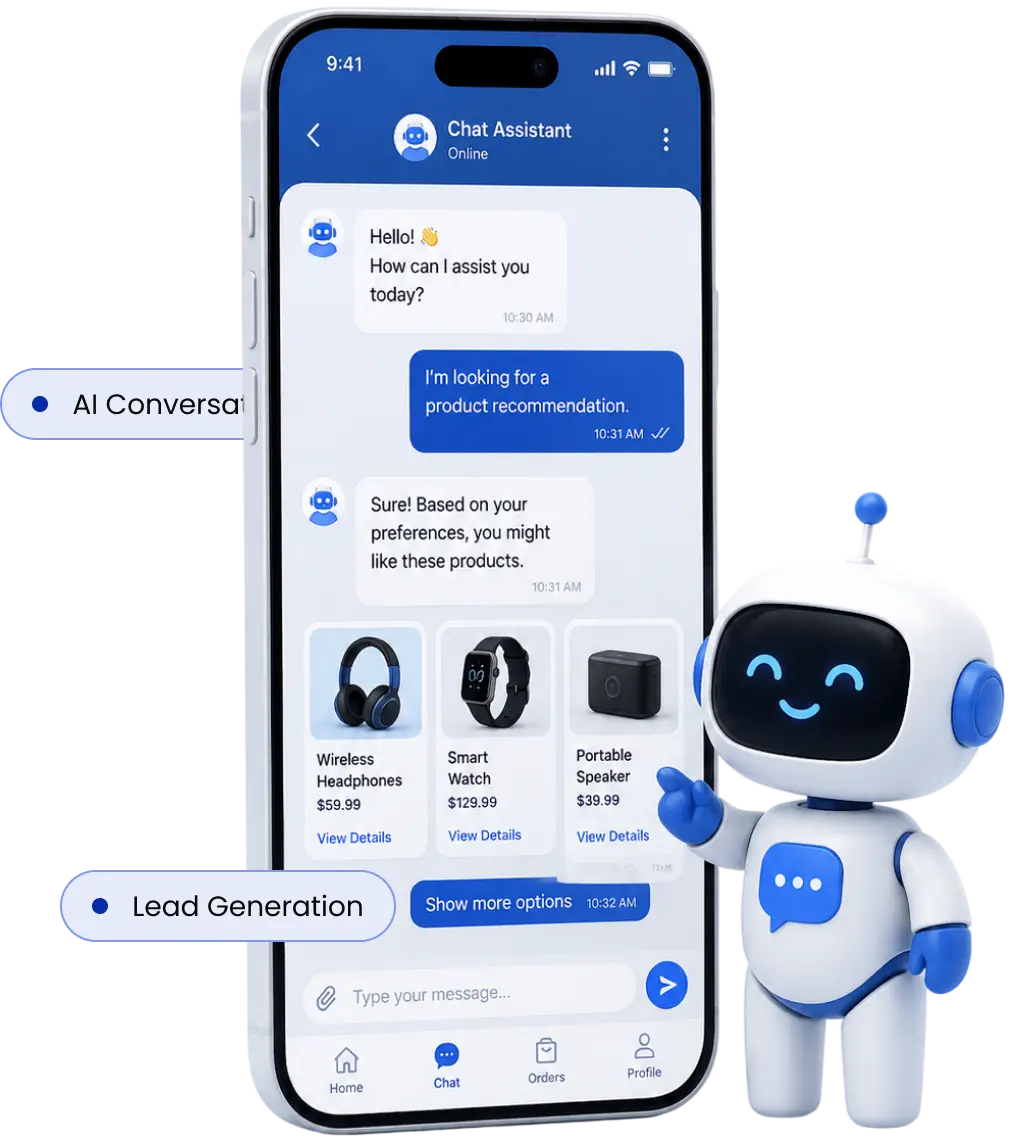








Most chatbot implementations fail at the same point: the chatbot operates separately from the systems where business operations actually happen. It answers basic questions from a knowledge source, but when the conversation requires order updates, ticket handling, customer verification, workflow execution, or transaction processing, the experience breaks. The user is transferred to a human agent or redirected to another channel. Instead of becoming an operational tool, the chatbot functions as a limited support layer.
The value changes when conversational AI is integrated directly into your business systems. Connected to your CRM, the chatbot can retrieve and update customer records in real time. Integrated with helpdesk and ticketing platforms, it can create, route, and resolve predictable support cases automatically. Connected to commerce platforms or ERP systems, it can process returns, check order status, update billing information, and complete transactions within the conversation. When integrated with internal knowledge systems through retrieval-augmented generation (RAG), responses are grounded in proprietary business data instead of generic AI outputs. The chatbot becomes an operational interface that reduces handling time, support costs, and channel switching across customer and internal workflows.
This level of integration requires engineering, not configuration. Effective chatbot systems depend on structured retrieval architecture, secure API orchestration, function calling, identity and access management, analytics pipelines, and evaluation frameworks that monitor hallucinations, response quality, and regression risks before deployment. Without this foundation, chatbot deployments often become disconnected interfaces that users bypass in favor of human support.
Guru TechnoLabs develops conversational AI systems as part of a broader platform engineering practice, integrating CRM, ERP, helpdesk, commerce, identity, and backend orchestration systems into a unified conversational layer. Our engagements typically evolve into long-term engineering partnerships focused on model evaluation, retrieval optimization, integration expansion, and continuous improvement driven by production conversation data.
NLU engineering across intent recognition, entity extraction, sentiment analysis, and multilingual understanding — built on modern transformer-based architectures and refined against your domain-specific conversation data.
Conversational AI engineering for Meta channels, Facebook Messenger, WhatsApp Business Platform, and Instagram Direct, integrated with your CRM, commerce, and customer data systems for unified cross-channel context.
Enterprise conversational AI on Microsoft’s stack, Copilot Studio, Bot Framework, Azure AI Services, and Teams integration, engineered with enterprise identity, data governance, and Microsoft 365 ecosystem connectivity.
Internal-operations chatbots for Slack, workflow automation, knowledge retrieval, ticket triage, status reporting, and approval flows, integrated with the operational tools your teams already work in.
Conversational AI for Telegram and other messaging platforms, community-facing bots, transactional bots, and customer engagement bots, engineered with channel-appropriate interaction patterns and shared backend logic.
End-to-end conversation design, flow architecture, fallback handling, personality and brand voice definition, error recovery patterns, and human-handoff protocols. Designed around the conversational realities of how users actually communicate, not idealized scripts.
Purpose-built conversational AI applications engineered around specific operational outcomes, not platform-template deployments. LLM selection (proprietary vs. open-weight), retrieval architecture, function-calling integration, and evaluation infrastructure designed for your specific use case.
Engineering for complex multi-turn conversations, dialog state management, context persistence, conversation memory, agent orchestration, and tool-use coordination. Built for use cases where a single-shot response is not enough.
Re-engineering existing rule-based or first-generation chatbots onto modern LLM and RAG architectures, preserving the conversation data and integrations, replacing the underlying intelligence layer, and rebuilding the evaluation harness for the new model.
Structured deployment across web, mobile, messaging, and voice channels, including staged rollout, conversation A/B testing, prompt version management, model evaluation pipelines, and progressive feature rollout for production conversational AI systems.
Post-launch engineering as an ongoing engagement: conversation analytics, hallucination monitoring, retrieval quality measurement, prompt optimization, model upgrades, integration evolution, and continuous improvement informed by real conversational data.
The commercial and operational outcomes conversational AI produces when engineered as a system grounded in your data and integrated with your operational stack.

Guru TechnoLabs provides a flexible business model to meet your diverse business needs in a stipulated time.

A defined-scope, milestone-based engagement model suited to bounded initiatives. This model works best for small projects as it is a low risk model for clients. You pay by milestones as we complete the checkpoints.

An embedded engineering pod for long-term initiatives. This model is best for complex and long term projects as it saves a lot of money. B2B clients, startups, and established businesses use it.
Guru Technolabs has been providing top software development services to startups and businesses worldwide for over 10+ years. Check out our work portfolio; We have successfully delivered over 350+ digital solutions to clients worldwide.

Niche Dating & Matching Application
Konnected wanted to create a professional dating platform for a specific user group where relevant matching and a smooth interaction experience were key priorities. The objective was to provide users with a focused environment for discovering and connecting with compatible profiles.
After understanding the target audience and product requirements, we structured the core user flows around profile discovery, matching, and interaction. Our Flutter development team delivered a cross-platform application with a consistent experience across mobile devices and a foundation for future feature expansion.

Relationship-Focused Dating Application
ForeverUs IN LOVE wanted to build a relationship-focused dating application designed to support meaningful connections and sustained user engagement. The objective was to create an intuitive platform that made discovering and interacting with potential matches simple and engaging.
We analyzed the required user journeys and designed the application around streamlined discovery, profile interactions, and engagement workflows. Our development team delivered a cross-platform mobile application focused on usability, maintainability, and a consistent experience across iOS and Android.

Flight, Hotel & Car Booking Application
LooneyTrips wanted to create a convenient travel booking platform that allowed users to search and book flights, hotels, and car rentals from a single application. The objective was to simplify the booking experience while bringing multiple travel services together in one platform.
We worked with the client to understand the business requirements, define the core booking workflows, and finalize the required features. Our team delivered a cross-platform travel application designed to provide a streamlined booking experience across mobile platforms.

Travel & Migration Information Application
DreamIL wanted to help people traveling or migrating to a new country find reliable answers to practical questions through a dedicated mobile application. The objective was to create an accessible platform where users could explore relevant questions and information from different categories.
We analyzed the content structure and user requirements and recommended a cross-platform application approach. Our developers built a user-friendly application that allows administrators to publish questions and articles while giving users an organized way to discover relevant information.

Local Business Discovery & Listing Application
WeDey wanted to enhance its existing local business listing platform with improved user experiences and scalable functionality. The objective was to create a more engaging and efficient platform where businesses could manage visibility while users could easily discover nearby services.
After analyzing the existing system, we identified opportunities for feature enhancement, workflow optimization, and scalability improvements. We delivered a cross-platform application that supports business registrations, category-based discovery, and location-driven search experiences for multiple service providers.

Buyer & Seller Marketplace Application
Pocketo wanted to create a marketplace platform that brought buyers and sellers together within a single digital ecosystem. The objective was to provide a structured environment where sellers could showcase products while buyers could discover listings and interact with sellers.
We analyzed the marketplace requirements and defined the core workflows around product listings, discovery, user interactions, and transactions. We delivered a cross-platform application designed to support the marketplace experience while providing a scalable foundation for future functionality.

Mobile Invoicing & Estimate Application
Quick Invoice Maker was developed to help individuals and SMEs create and share professional invoices and estimates from their mobile devices. The objective was to simplify everyday invoicing tasks and allow users to generate documents quickly without relying on desktop-based tools.
We analyzed the required invoicing workflows and focused on making document creation and sharing straightforward for users. We built a cross-platform mobile application with ready-to-use templates, automated invoice and estimate generation, and quick sharing capabilities.

Local Business Marketplace Application
ePlace wanted to create a digital marketplace connecting local businesses with users searching for products and services in their area. The objective was to give businesses a platform to register and promote their services while making local discovery easier for customers.
We translated the business requirements into a website and mobile application with structured discovery and engagement workflows. Our team delivered functionality for business registration, category-based search, location discovery, profiles, reviews, photos, favorites, and direct business contact.

Engineering teams with depth across the modern conversational AI stack, LLM integration (OpenAI, Anthropic, open-weight models), retrieval architectures, vector databases, evaluation pipelines, and the wider mobile, web, backend, and integration capabilities a production system requires.
Structured working with defined sprint reviews, written status reporting, and a single point of accountability on every engagement.
NDAs, secure development practices, source code custody, and clear data-handling standards are part of how we engage. Conversational AI engagements often involve proprietary knowledge, customer data, and operational workflows.
Structured sprint, layered QA across conversational, integration, performance, and safety dimensions, and predictable release engineering. Delivery dates are derived from engineering reality, not sales pressure.
Post-launch development, model evolution, retrieval optimization, and platform expansion as a continuous engagement rather than a closeout warranty. Most of our conversational AI clients move from initial build into multi-year roadmaps.
10+ years engineering software platforms for businesses worldwide. Conversational AI is one capability within a wider platform engineering practice.
Bring us your operational or commercial objective. We will respond with a conversational AI architecture designed to deliver it.
Cutting-edge technology for modern businesses.

Transparent communication and on-time delivery.
Skilled professionals dedicated to your success.
Solutions that drive growth and measurable results.
We have fulfilled the demands of clients working in different industries. For more details, check what our clients say about us.

Israel
We worked with Liron Feigenbaum on a UI/UX and mobile app development proje...

United States
Hi, my name is Tiami. I was looking for an overseas company and found Guru ...

United Kingdom
Hi, I am Doski. I work with Guru TechnoLabs' team and I am very happy...

Australia
We commissioned and adopt a website from Guru TechnoLabs. Website require...
Get updated with the latest industry trends, analysis, and tech news.
Get updated with the latest industry trends, analysis, and tech news.
Off-the-shelf conversational AI platforms work well when the use case is bounded, generic FAQ deflection, lightweight ticket triage, marketing-site engagement and the integration surface is shallow. Where they hit limits is operational complexity.
Custom-engineered conversational AI makes sense when the bot is becoming an operational interface to your business rather than a deflection layer in front of it.
Model selection is an architecture decision driven by four factors: capability requirements, data sovereignty, cost economics, and operational control. Proprietary models from OpenAI, Anthropic, and Google offer the strongest reasoning and tool-use capabilities with the lowest engineering overhead, at the cost of per-token pricing, data-residency dependencies on the provider, and rate limits at scale. Open-weight models, Llama, Mistral, Qwen, and similar, offer full data sovereignty, predictable infrastructure economics, and the option to fine-tune for specific domains, at the cost of higher operational complexity and inference-infrastructure ownership.
Conversational AI accuracy is measured through an evaluation infrastructure built alongside the system, not bolted on afterward. The evaluation harness combines a curated test set of representative conversations with expected outcomes, automated regression testing on every prompt and retrieval change, response quality scoring across factual accuracy, tone, and policy compliance, and continuous monitoring of real production conversations flagged for review.
We design data flow around three principles: minimize what enters the model, isolate what does, and audit every boundary. Proprietary knowledge used for retrieval is stored in infrastructure you control or in a vector database within your environment, not in third-party platforms. PII detection and redaction are built into the conversation pipeline so personally identifiable data does not enter the model context unless explicitly required by the use case. Where regulated data is involved, health information under HIPAA, financial records, personal data under GDPR, the system is designed to meet the relevant compliance regime from architecture stage, including LLM provider selection (some providers offer enterprise data agreements with stronger guarantees), regional data residency, and audit logging at every system boundary. Compliance is treated as an engineering requirement, not a policy document.
Timelines depend on integration complexity and evaluation rigor, not conversation count. A focused proof-of-concept on a single use case with limited integration typically runs 6–8 weeks and produces a working prototype with measurable baseline accuracy.
Share your business needs or project requirements with us & we will get back to you quickly.



