
Travel

Website
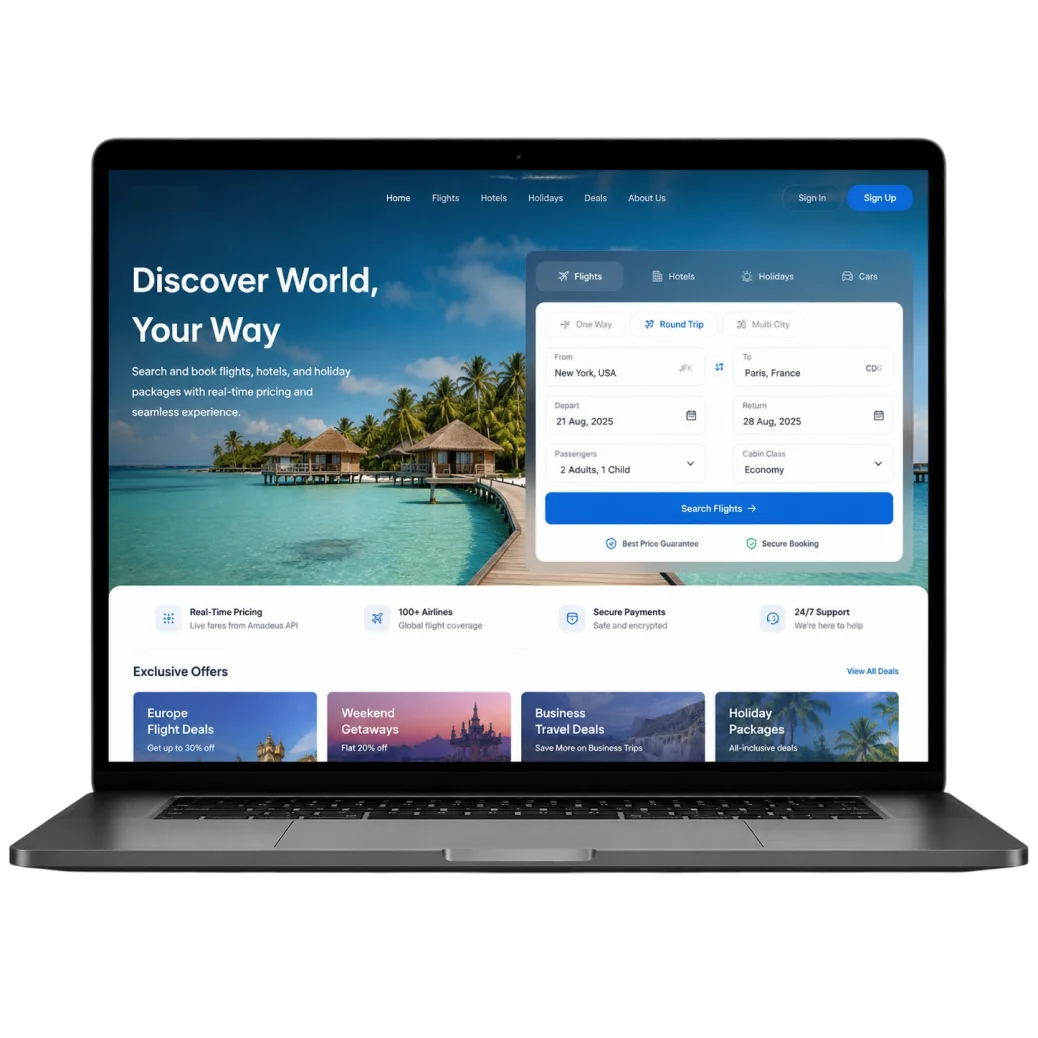







The client is a growth-stage online travel agency with a flight-first business model. Headquartered in Dubai, it serves customers across the GCC and South Asia. Over about 7 years, it had grown from a small booking desk into a recognized regional brand, handling somewhere near 55,000 online flight bookings a year, plus a smaller volume of hotel and ancillary sales. Its customers were a mix: budget-conscious leisure travelers, residents living abroad booking multi-leg routes home, and a growing base of repeat business travelers.
By the time we started working together, digital wasn't just a channel for this business. It was the business. More than 80% of transactions came through the website, which meant the site was the revenue engine, the customer service desk, and the operational backbone all rolled into one. When it was slow or broke, that showed up directly in the numbers.
That reliance was also the risk. The platform running everything had been built during an earlier, faster growth phase, when getting to market quickly mattered more than getting the architecture right. It was a monolith with years of patches layered on top, pulling flight content from a mix of cached data and manual updates. In other words, the technology that got the company this far was now the thing holding it back. And the data was starting to prove it.
Every lost booking was money the business could see slipping away, and the trend line was pointing the wrong way. This wasn't about a prettier website. It was about stopping the leak and building a platform that could carry the company's next stage of growth. So we framed the work around business outcomes, not a feature list.
The client wanted to recover the bookings it was losing to poor performance and unreliable flight data. It wanted to rebuild customer trust in a checkout that kept failing at the last step. And it needed a platform that could grow with demand instead of straining under it. Underneath all of that sat one requirement: accurate, real-time flight availability and pricing. No amount of design polish fixes a booking flow built on stale inventory.
In practice, that meant two things at once. Modernize the customer experience, and replace the fragile flight-data layer. Do only one, and you've solved half the problem.

The revenue leak didn't come from one broken thing. It came from three that reinforced each other: an aging platform, a flight-data layer nobody could trust, and an architecture that made both slow to fix. Together they were draining conversion, trust, and revenue at the same time.

On mobile, the old platform took six to eight seconds to load, and mobile was now close to 70% of all traffic. Years of bolted-on features had left the navigation cluttered and the booking flow longer than it needed to be. For a customer comparing fares across three or four tabs at once, those extra seconds and clicks were often the difference between a sale and a bounce. Mobile conversion had fallen to about a third of the desktop rate, which meant the business was losing exactly the audience that was growing fastest.
The drop-off wasn't isolated to one point; it happened all the way down. Visitors searching for a specific route frequently abandoned before checkout. Repeat customers, the segment worth the most over time, were leaving without booking because they'd learned to expect a slow, unreliable experience. Overall online conversion had slipped below 2%, low for a flight-focused OTA at this stage of growth. At the client's booking volume, every fraction of a percentage point translated into real, recurring revenue walking out the door.
This was the most expensive problem, and customers never saw it coming until the worst possible moment. Because the platform ran on cached availability and partly manual fare updates, the prices shown in search results often didn't match what was actually bookable. A customer would choose a fare, reach the payment page, and be told the price had jumped or the seat was gone. Roughly one in eight booking attempts failed at or near confirmation. The lost sale hurt, but the real damage was to trust: a traveler burned at checkout rarely gives you a second chance.
Fixing any of this was harder than it should have been because of how the system was built. The monolithic codebase made even small changes slow to ship and risky to deploy. Routine maintenance consumed engineering time that should have gone into improvements. And preparing for peak periods, like holiday travel or a fare sale, meant scaling up the entire application instead of just the parts under load, which drove up cost without solving the bottleneck. The architecture had quietly become a cost center of its own.
Individually, each issue was a nuisance. Together, they added up to an experience that undercut everything the company was trying to be. Slow search, an awkward checkout, prices that couldn't be relied on. In a market where trust decides who gets the booking, the platform was teaching customers to take their business elsewhere.

We approached this as a revenue-recovery solution, not a redesign. The work ran on two connected tracks: modernizing the customer experience, and rebuilding the flight-data foundation on the Amadeus API. Neither was cosmetic, and neither would have worked on its own. Each was aimed at a specific point in the funnel where the business was losing money.
We rebuilt the customer-facing platform mobile-first, because that's where both the revenue and the growth actually lived. The redesign took the journey most customers make- search a route, compare fares, book- and made it as short and clear as we could. We cut steps out of the flow, trimmed the navigation down to what people actually used, and re-engineered the front end for speed. Typical mobile load times dropped from six to eight seconds to under two and a half.
The reasoning was simple. Removing friction stops high-intent visitors from bailing before they book, and a mobile-first build wins back the audience the old site was quietly losing by design. Same traffic, more of it converting.
The heart of the recovery was replacing the unreliable flight-data layer with a live Amadeus API integration. Instead of serving cached availability and hand-maintained fares, the platform now pulls real-time schedules, live pricing, seat availability, and fare rules from a global source the instant a customer searches.
That single change fixed the client's most expensive problem. The prices customers saw became the prices they could actually book. Availability finally matched reality. The gap between what was displayed and what was bookable, the same gap that had been failing one in eight bookings, effectively disappeared. Checkout stopped collapsing at the final step, and booking reliability turned from a liability into something the business could sell on.
It solved a back-office problem too. The operations team had been spending real hours keeping fares current by hand, and that work simply went away. Accurate inventory became a byproduct of the system rather than a daily chore, freeing the team for work that actually moved the business.
Underneath both tracks, we built a performance and operations layer for a business that lives or dies on uptime. Search and checkout were tuned for speed and stability so the platform held up even under peak load, when the cost of a slow page is highest. On the operational side, automated inventory removed manual effort, a modular architecture made the platform safer and cheaper to maintain and extend, and infrastructure could finally scale with demand instead of against it. Every one of those improvements ties back to a business result: lower running costs, faster iteration, and a platform that grows without breaking.
We built the solution on a modern, cloud-native stack chosen for reliability and scale, not novelty:
Node.js microservices to isolate search, booking, and payments
PostgreSQL for transactional data, with Redis for high-speed session and fare caching
AWS with auto-scaling and load balancing for peak-demand elasticity
Amadeus API for real-time flight search, pricing, availability, and fare rules
Optimized query layer with intelligent short-lived caching to balance speed and price accuracy
Real-time application monitoring plus funnel and conversion analytics
PCI-DSS-aligned payment handling, encryption in transit and at rest, and secure authentication
Every feature below was chosen to close a specific gap in the booking funnel. For each one, the same three questions apply: what it does, which problem it solved, and how it changed the customer experience.
Connects the platform to live global flight content. It fixed the client's core problem of inaccurate inventory, giving customers pricing and availability they can trust and a checkout that no longer fails on stale data.


Returns accurate schedules and open seats the moment someone searches. This closed the mismatch between search results and bookable fares, which cut the failures that were costing the business.
Shows current fares and their conditions up front. Customers understand what they're buying before they commit, which reduces late drop-off and support tickets.


A fast, clean experience on the devices most customers actually use. It won back the mobile audience the old site was losing and lifted mobile conversion sharply.
Lets travelers narrow by stops, times, price, and airline. A quicker path to the right flight shortens the journey and lifts completion.


A streamlined, protected payment flow with clear booking states. Reliability and security at the final step rebuilt the trust the old checkout had worn down.
Saves traveler details for faster repeat booking and prices fares in the customer's own currency. Both cut friction and lift conversion, especially with the repeat and expatriate segments that mattered most.


Immediate, dependable confirmation. Certainty at the moment of purchase is a trust signal that helps customers book with confidence and come back.
Gives the business real-time visibility into bookings, revenue, and funnel performance. Leadership can now see where customers drop off and act on it, which turns the platform into a decision-making tool instead of a black box.

The program produced measurable recovery in exactly the metrics the client had been losing ground on. Within two quarters of launch:
Each of these traces back to an original problem. The conversion lift answers the lost bookings. The failure-rate drop answers the unreliable flight data. The performance gains answer the outdated site that was quietly costing the business its mobile audience.


"We came to Guru TechnoLabs with a revenue problem, not a technology wish-list, and that's exactly how they treated it. Modernizing the website made us faster and easier to use, but the Amadeus integration is what rebuilt customer trust. Our prices are accurate now, our bookings actually complete, and the platform holds up when demand spikes. We got back the bookings we were losing and came away with a foundation we can grow on. It was a real partnership, from strategy through delivery."
— Head of travel agencyA modern website is a trust asset, not a cosmetic one. In travel, speed and clarity have a direct say in whether a high-intent visitor turns into a customer.
Real-time inventory isn't optional for flight commerce. The gap between the price you display and the price you can actually book is one of the most expensive, and least visible, sources of lost revenue.
Faster, simpler booking journeys convert. Every step you remove and every second you save wins back customers who would otherwise leave, especially on mobile.
API integration is an operational win, not just a technical one. Automating flight content freed the client's team from manual work and made accuracy a property of the system instead of a daily task.
Customer experience and revenue are the same conversation. Reliable checkout rebuilds trust, and trust is what turns first-time bookers into repeat customers.
Modernization sets up the future. A scalable, modular platform lets the business add markets, channels, and products without rebuilding from scratch.
If your travel platform is leaking revenue to slow performance and unreliable flight data, the losses add up quietly, and they don't fix themselves. Guru TechnoLabs helps growth-stage travel companies rebuild for accuracy, speed, and scale.
Cutting-edge technology for modern businesses.

Transparent communication and on-time delivery.
Skilled professionals dedicated to your success.
Solutions that drive growth and measurable results.
We have fulfilled the demands of clients working in different industries. For more details, check what our clients say about us.

Israel
We worked with Liron Feigenbaum on a UI/UX and mobile app development proje...

United States
Hi, my name is Tiami. I was looking for an overseas company and found Guru ...

United Kingdom
Hi, I am Doski. I work with Guru TechnoLabs' team and I am very happy...

Australia
We commissioned and adopt a website from Guru TechnoLabs. Website require...
Share your business needs or project requirements with us & we will get back to you quickly.



