
Travel

Website
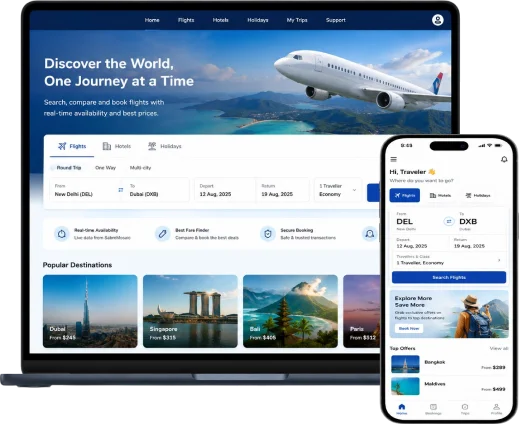






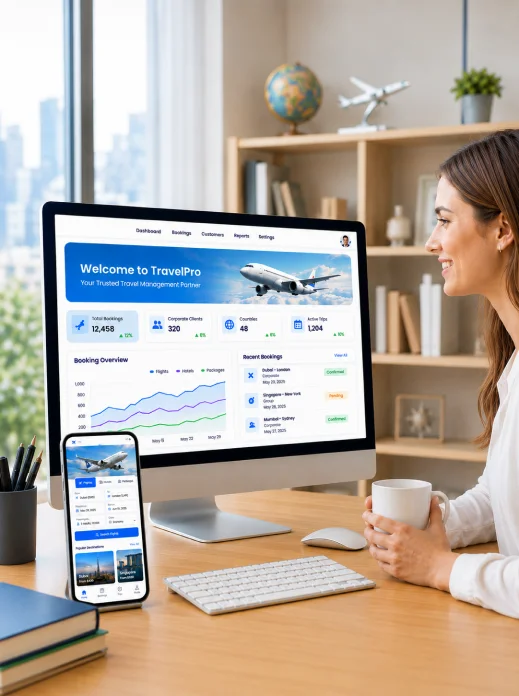
Our client is a Travel Management Company (TMC) that handles corporate and consolidated air travel for large business accounts across the Gulf, South Asia, and East Africa. What started fifteen years ago as a single ticketing desk had grown into a multi-branch operation booking several thousand flights a day: corporate trips, group departures, and a good amount of agency-to-agency volume, all running through the Sabre booking system.
For a business like this, the booking system isn't a supporting tool. It's the whole company. Every travel policy, every negotiated fare, every last-minute change and refund passes through the same central operation. When that runs smoothly, the company can take on bigger clients without hiring more people. When it jams, the cost shows up right away, in agent overtime, in confirmations that arrive late, and in the trust of corporate clients who were promised a reliable, professional service.
By the time our team was brought in, the client had run out of room. Their platform was really a set of parts stitched together over a decade: an aging back-office application, a handful of separate Sabre workflows, spreadsheet reconciliation done by hand, and a customer website that had been added years later with no shared data behind it. Each piece did its own job. The trouble was that none of them talked to each other.
And the pressure wasn't seasonal. It was built into how the business ran. Volume was climbing 20 to 25 percent a year, but so did the work. More bookings meant more manual effort, almost in exact proportion. That arrangement is fine for a small agency and a dead end for one trying to move upmarket. Modernizing had stopped being a nice-to-have. It was the thing standing between the company and its next stage of growth.
Leadership described what they wanted in plain business terms. They wanted to keep winning larger clients without watching costs climb every time volume did. Everything else followed from that one idea.
In practice, the goals were to:
Worth noting: the client never asked for a full rebuild. They asked for a platform that would let the same team handle a growing amount of business. That framing shaped every choice we made afterward.

None of the client's problems came from a single broken part. They came from the gaps between the parts, the manual handoffs where one system stopped and another started. Those gaps were exactly where time, money, and accuracy leaked away.

To finish one trip, an agent had to work across several tools that knew nothing about each other. A fare quoted in one Sabre workflow got re-typed into the back-office application, then checked by hand against the customer website. Every re-entry was a chance to make a mistake and a drag on speed. A booking that should have taken a few minutes ended up passing through several tools and several people, and the complicated multi-flight corporate trips were slower still.
The business felt it directly. Slow confirmations annoyed corporate clients who expected fast answers, and every duplicated keystroke was work the company paid for twice.
The heaviest cost sat in the back office. Sabre queues were worked by hand, one ticket at a time. Exchanges and reissues, which are among the trickiest jobs in air servicing, leaned almost entirely on the memory and experience of a few senior agents. Unusual cases had no set process, so they just landed on whoever had a free moment.
That made the whole operation fragile. Getting the work done depended on a handful of experienced people, support volume rose in step with bookings, and every busy period forced a choice between paying overtime or accepting delays. Neither one held up as the business grew.
The client had real Sabre know-how, but the connections to Sabre had grown up by accident rather than by plan. Different tasks reached Sabre in different, inconsistent ways. There was no single controlled process, so the same job could be done three different ways by three different agents, and reviewed by no one. Keeping Sabre's records and the company's own records matching up was a manual job, which meant it was sometimes simply wrong.
The result was constant, low-level confusion. There was no single reliable version of a booking's status, and a steady trickle of effort went into keeping the systems in agreement.
The platform was fine at normal load and shaky under pressure. During busy spells, at quarter-end, around big events, on large group departures, everything slowed down and agents sat waiting on screens that should have been instant. Because the work got more tangled faster than it got bigger, each new level of business made the system harder to run, not just busier.
Leadership couldn't see the operation as it happened. Reports were pieced together afterward from exported spreadsheets. There was no live view of how many tickets were waiting, which bookings were stuck, or how many errors were happening. So when something went wrong, spotting it, understanding it, and fixing it all took far too long, and more often than not the client had already noticed.
Put it all together and it's clear why "just hire more people" had stopped working. The problem was in the way the systems were built, and it needed a fix at that level.

We treated this as a change to how the business operates, with technology as the way to get there, not as a technology project with operational side effects. The guiding idea was simple: replace the manual handoffs with connected, automated steps, and give the whole Sabre setup one clean point of control.
The client's old booking-record way of working was the source of a lot of the manual effort. SabreMosaic gave us a more modern foundation to move onto. In plain terms, it treats what a traveler is buying and what has actually been confirmed as clear, well-organized records, instead of loose booking segments an agent has to read and piece together by hand.
Moving to SabreMosaic let us make every booking follow the same steps, priced and serviced the same way each time. Instead of a dozen slightly different routes to the same result, there was now one consistent booking process behind every transaction. That consistency is what made the automation possible in the first place, because you can't reliably automate something that behaves differently every time.
Instead of letting every tool reach into Sabre on its own, we built a single central booking service that handles every connection to Sabre. The rest of the system talks to that service, and that service is the only thing that talks to Sabre directly. That gave us one place to enforce the right steps, keep records in sync, and see everything that happened.
Through that single service, we connected the Sabre APIs the operation genuinely relied on. (An API is simply the connection that lets one system pull data or trigger actions in another.)
We only connected the parts that served the story. The goal was a smaller set of clean, reliable connections, not the widest possible reach.
Under that central service, we built clear, separate services for each job: search, booking management, ticketing, servicing, and reporting each became its own defined piece instead of behavior buried inside a screen. A shared database became the single source of truth for every booking, which fixed the matching-by-hand problem at the root. Sabre's records and the company's records now stayed in sync on their own.
Two things that had been missing entirely got built in from day one. First, proper handling of failures: when a booking hit a snag, the system now retried it automatically where that was safe, and passed it cleanly to a person where real judgment was needed, instead of failing quietly and being found hours later. Second, full tracking and monitoring, so every booking could be followed step by step and problems showed up on their own rather than arriving as client complaints.
This is where the cost actually came out of the business. Work that used to be manual became automatic. Queues that agents had worked one ticket at a time now ran on their own, sending only the genuine exceptions to a person. Tickets were issued automatically once a booking was ready. Exchanges and reissues followed a set, guided process instead of depending on someone's memory. Traveler and policy details filled in each trip automatically instead of being re-typed.
Automation didn't replace the agents. It took the drudgery off the agents, which freed the experienced staff to spend their time on the complicated, high-value cases where their judgment was the whole point.
To keep things fast and steady under pressure, we stored the data agents look up most often, like flight availability and traveler details, close at hand so it loaded instantly. We also moved the heavy jobs, such as issuing tickets and sending notifications, into the background so they didn't freeze the agent's screen. And we set the platform up so we could quickly add computing power during busy periods and pull it back afterward.
That last choice leads to the point that matters most for the business: the platform now handles more volume by adding capacity, not by adding complexity. Taking on a bigger client no longer means rebuilding the way the business runs.
We chose each technology for reliability and long-term ease of maintenance, not to look impressive. Every choice matched a real need.
SabreMosaic and Sabre APIs, abreMosaic and Sabre APIs, the modern booking foundation and the connection to the airline booking world the business runs on
Java and Spring Boot, a well-proven combination for business systems that need to handle many bookings at once without errors
React, for the single, responsive workspace agents use, replacing several separate terminals
PostgreSQL, the main database where every booking is stored, chosen because accuracy here couldn't be compromised
Redis, to keep frequently used data close by so it loads instantly
Apache Kafka, to let background jobs like ticketing and notifications run without slowing the main booking flow
Docker and Kubernetes, to package the system so we could add or remove computing power quickly during busy periods
AWS cloud, for reliable, managed computing power that scales up and down with demand
Elasticsearch, to make bookings, records, and logs instantly searchable for agents and reporting
Central logging, monitoring, and a safe update process, so the platform stayed easy to watch and improvements could be released often and safely
None of this was chosen for show. Every piece earned its place by solving a real problem.
Bookings are now created and serviced in the modern SabreMosaic way, with clear, organized records instead of loose booking segments. This made every booking consistent, which is what made automation possible, and it gave the business a clean base to build on in future.


One workspace replaced five separate screens. Agents can now complete a trip from start to finish without re-typing data between tools. This turned out to be the single biggest daily time-saver, and it wiped out a whole category of copy-paste mistakes along the way.
The steps from search to confirmation to ticketing now run as one connected flow. Confirmations that used to wait on manual steps finish in a fraction of the time, so corporate clients get the fast turnaround they expect.


Live flight and fare data through the Sabre APIs means agents and clients see accurate options and prices in the moment. That put an end to the errors that came from stale data and manual re-entry.
Tickets are now issued automatically once a booking is ready, and the system works the Sabre queues, passing only the real exceptions to staff. This removed the single biggest source of repetitive back-office work and gave senior agents their time back for complex jobs.


Reissues and refunds now follow a set, guided process instead of depending on individual know-how. The operation's most error-prone task became one of its most consistent, and it's no longer held up by the two or three people who happened to know how it was done.
Corporate traveler details and travel-policy rules now fill in each trip automatically. Bookings move faster and follow company policy more closely, without anyone having to check it by hand.


Leadership can finally watch the operation as it happens. Waiting tickets, stuck bookings, and errors all sit on one screen, with alerts that flag trouble early. Problems get caught and cleared before clients notice them, instead of after.
Every action is limited by permission and recorded. That gave the business the security and clear record-keeping its large clients increasingly ask for in their contracts.

The improvements were both measurable and felt on the floor. The figures below come from the client's own before-and-after comparison across the twelve months on either side of the launch, and we've kept them deliberately conservative.
The numbers matter, but so does the change you couldn't put on a chart. Senior agents stopped spending their days on repetitive queue work and got back to the complex servicing that actually used their expertise. Leadership went from reacting to problems clients reported to seeing and fixing them first. The operation just stopped feeling fragile.


"We didn't want another tool bolted onto the pile. We'd tried that, and it never helped. What Guru TechnoLabs delivered was a real change to how we operate. Their team knew Sabre and SabreMosaic at a depth we rarely see from a partner, but what set them apart was that every decision came back to how our desk actually works. Our agents stopped fighting their screens, our back office stopped drowning in manual tickets, and for the first time I can see the whole operation in real time. We're taking on clients today that we'd have turned away two years ago, with the same team. That's the difference this made."
— Director of Operations, Travel Management CompanyManual work, not booking volume, is what breaks growing travel businesses. The client's problem was never how many bookings came in. It was that each one demanded manual effort. Automating the way the business runs, rather than just speeding it up, is what created room to grow.
Consistency has to come before automation. SabreMosaic mattered because it made every booking follow the same clear steps. You can't reliably automate something that behaves differently every time.
One controlled connection beats many scattered ones. Giving Sabre a single point of control ended the mismatched records, made the operation easy to review, and turned a tangle of inconsistent paths into one dependable process.
Seeing the operation in real time is a real advantage, not just a nice report. Watching waiting tickets, bookings, and errors live let the business fix issues before clients noticed, which is a genuine service edge in enterprise travel.
Building for scale means growing without the mess growing too. The platform now handles more volume by adding capacity rather than more people or more overhead, and that's what lets a steady team move upmarket profitably.
Modernizing the core lowers the cost of every booking. By breaking the link between volume and manual cost, the client brought down its long-run cost to serve each client, which is about the most lasting advantage a travel business can build.
If manual work and disconnected Sabre workflows are capping how much business your team can handle, the ceiling is in how your systems are built, and it can be removed. Guru TechnoLabs builds scalable, automated booking platforms on SabreMosaic and the Sabre APIs, designed around how your operation actually runs.
Cutting-edge technology for modern businesses.

Transparent communication and on-time delivery.
Skilled professionals dedicated to your success.
Solutions that drive growth and measurable results.
We have fulfilled the demands of clients working in different industries. For more details, check what our clients say about us.

Israel
We worked with Liron Feigenbaum on a UI/UX and mobile app development proje...

United States
Hi, my name is Tiami. I was looking for an overseas company and found Guru ...

United Kingdom
Hi, I am Doski. I work with Guru TechnoLabs' team and I am very happy...

Australia
We commissioned and adopt a website from Guru TechnoLabs. Website require...
Share your business needs or project requirements with us & we will get back to you quickly.



