
Dating

Web App
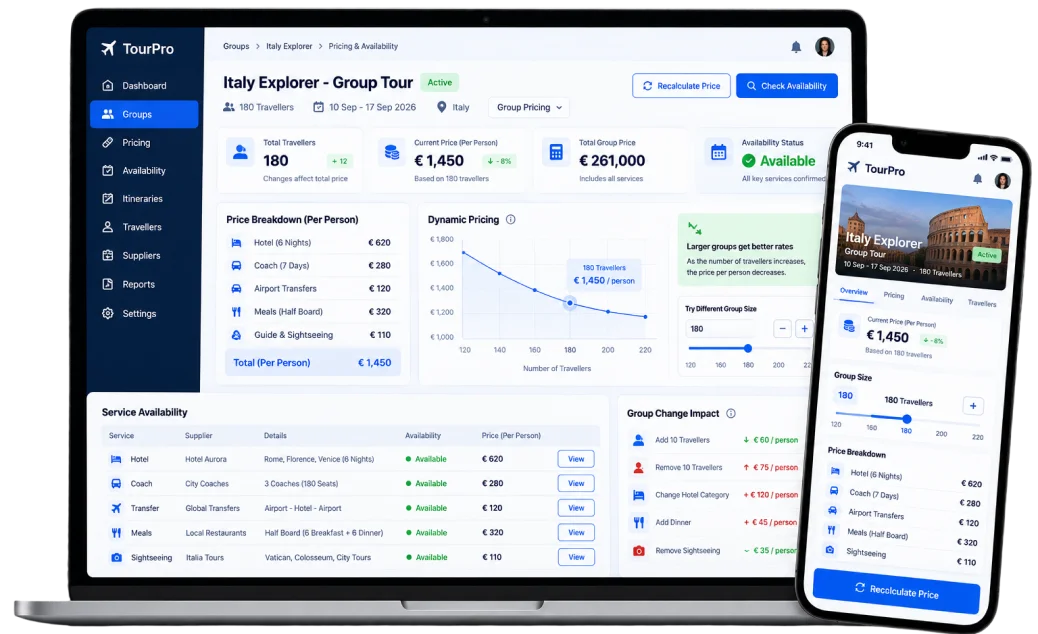








A family-owned operator priced each custom club tour once, in a workbook, and then watched the group change for months. We tied the costing to the live group, so every registration now reruns price and capacity, and people are alerted only when a threshold is crossed.
Family-owned US operator running custom tours to Greece for clubs and associations
A regional garden society, later joined by a second club, with an island stay
A price set at proposal stage that went stale with every registration
A costing model that reads live headcount, room mix and supplier capacity
Recalculation automated; commercial decisions kept with people

The operator sells scheduled departures to individual travellers through its website, and its booking system handles those well. Its second line, custom tours for garden societies, alumni chapters and museum members' groups, is smaller but higher-margin.
The product manager costs a 10-day itinerary and quotes a price per person in bands by group size. The contract fixes the bands, free places and confirmation dates. Then the organiser spends months recruiting members, who register through a group booking page.
The price was set at the proposal. The group only became real at final payment.
Everything in between was movement: people joined, dropped out, switched to single rooms, or arrived as a second club. Each change could move the band, the free places, the coach and guide cost per paying traveller, and whether a small island hotel still had enough rooms. It's the problem behind how group tour pricing breaks down when numbers keep changing, and here it showed up four ways:

| Option | Where it fits | Why it did or didn't fit here |
|---|---|---|
| A better costing workbook | Operators with a few simple groups a year | Still one assumed size per copy, and still blind to registrations |
| A generic pricing product | Operators whose rules match the common case | This operator's bands, free-place terms and supplements varied by club contract |
| The operator's own costing logic, connected to the live group | Operators with negotiated, group-specific terms | Chosen: it keeps the product manager's proven logic and makes it recalculate itself |
The design rule: describe each cost by how it behaves when the group changes, not just by what it costs.
| Component | What it does | Gap it closes |
|---|---|---|
| Cost behaviours | Each cost is per group (guides), per vehicle (coaches), per room by occupancy (hotels) or per person (ferry, meals, entrances) | Fixed costs divided by an assumed headcount |
| Contract rules | Bands, free-place ratio, organiser's place, single supplement and target margin stored with each group | Rules hidden in copied formulas |
| Live inputs | Reads paying travellers, free places and requested room types from the booking system's registrations | A costing blind to real numbers |
| Service capacity | Allotment by room type and release date for each hotel, coach seats, the ferry allocation, restaurant maximums | Capacity checked by email |
| Costing versions | Every recalculation saved with its trigger and any decision taken | Workbook copies that diverged |
The model keeps no traveller list of its own; it reads registrations from the booking system. Capacity is shown as headroom per service, the same calculation described in tracking group availability across supplier capacity, so price and availability are always read together.
The model prices each band and shows how sensitive each one is to the share of solo travellers.
Bands, free-place terms, supplier capacities and the confirmation dates are stored on the group.
Each registration, cancellation or room change reruns the band, cost per paying traveller, margin and headroom.
A band crossing, a gained or lost free place, a service short of capacity, or margin below target alerts the product manager; small moves stay quiet.
The choice (reprice, absorb, ask for space, or cap the group) is saved with the costing version.
A garden society contracted three bands (20–29, 30–39, 40+ paying travellers), one free place per 20 payers, plus the organiser's place. Registrations settled at 31, in the middle band, with no alerts.
Then a neighbouring club asked to bring 11 members. Before saying yes, the product manager ran it as a what-if: 42 payers moved the group into the top band and earned a second free place, but the newcomers' single rooms overran the island allotment and the dinner exceeded the taverna's maximum. The operator secured extra island rooms and a second sitting before accepting.
Close to departure, five travellers withdrew, two leaving sharers alone in twins. The group fell to 37, lost its second free place and slipped below target margin, and the island hotel now had unused rooms past their release date. The operator chose to absorb the band change for a long-standing client, charge the single supplement only to the two affected travellers after speaking with them, and give the organiser a short window to refill. Each choice sits on the costing version.

Automating the calculation is not automating the judgement. The system doesn't decide whether to reprice, since a long-standing club may matter more than one group's margin. It doesn't decide whether to accept more travellers. It knows the allotment a hotel contracted, not the hotel's own inventory. And because it was built around this operator's contracts, it isn't a generic product.
| Area | Before | After |
|---|---|---|
| When the price was checked | When someone remembered, usually near final payment | After every registration, cancellation or room change |
| Band crossings and free places | Noticed late, sometimes after travellers paid | Alerted as they happen |
| Supplier capacity | Asked by email, answered days later | Headroom per service, before saying yes |
| Margin on a group | Known after it travelled | Visible throughout recruitment |
| Decisions | Made in conversation, rarely written down | Recorded with the costing they relied on |
The largest gain was timing. Experienced people still make the pricing calls; they now make them while there is time to recruit, renegotiate or ask a supplier for space. Seeing each band's sensitivity to solo travellers has also made proposals more realistic from the start.
Describe how each cost behaves. A costing that knows a coach from a hotel room can recalculate itself.
Price the room mix you have, not the one you assumed. Solo travellers change both cost and capacity.
Alert on thresholds, not on every change. Band crossings, free places, capacity and margin are what need a person.
Build pricing after the group data exists. Recalculation needs reliable headcount and room requests; start with linked traveller bookings or one group operations record.
If your platform runs your business but buckles when a large group arrives, see how we build custom group travel management solutions for tour operators.
We have fulfilled the demands of clients working in different industries. For more details, check what our clients say about us.

Israel
We worked with Liron Feigenbaum on a UI/UX and mobile app development proje...

United States
Hi, my name is Tiami. I was looking for an overseas company and found Guru ...

United Kingdom
Hi, I am Doski. I work with Guru TechnoLabs' team and I am very happy...

Australia
We commissioned and adopt a website from Guru TechnoLabs. Website require...
Share your business needs or project requirements with us & we will get back to you quickly.



