
Travel

Confirm: Web Application
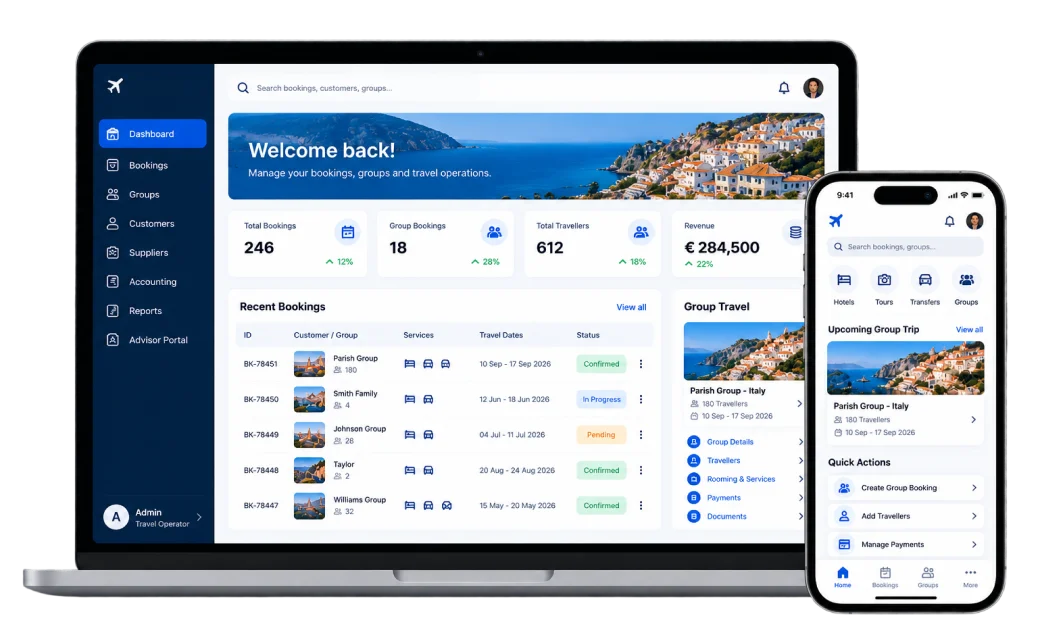








A family-owned US tour operator won a 180-person church pilgrimage that its booking platform couldn't hold. We added a group travel management module beside the core system: no migration, no rebuilt integrations, no cutover.
Established, family-owned US tour operator selling packaged tours to Europe
180-person church pilgrimage to Italy, drawn from several parishes
A booking platform built around one lead customer and one payer per booking
A group module beside the core platform, connected through a few narrow actions
Three phases around a live departure; the core platform never went offline

The operator is decades old and family-owned, with a headcount in the tens and one or two technology staff. It sells hotels, tours, transfers, rail and packaged itineraries into Europe through its website, by phone, and through an advisor portal.
Its custom booking platform holds the package catalogue, years of customer history, card payments, supplier API connections, the accounting export and the advisor portal. Small groups of 25 or 30 ran as one booking under the leader's name, with a spreadsheet on the side.
Then it won a pilgrimage to Italy for 180 travellers: about 90 rooms a night across several hotels, consolidator PNRs, free places for clergy, and a parish paying part of the cost. The owner's first question: can our system even hold this?
The old workaround of one booking, three spreadsheets and a shared deadline calendar held at 25 travellers. At 180, it exposed the limits of a booking system built for individual bookings:

| Option | Where it fits | Why it did or didn't fit here |
|---|---|---|
| Replace the core with an all-in-one system | Operators whose platform is failing broadly | The platform wasn't failing; replacement meant migrating live bookings to fix a group-only gap |
| Add a standalone group SaaS | Operators whose business is mainly groups, or new to them | A second set of customers and payments, re-keyed into the core |
| Extend the core with a custom group module | Established operators whose platform works but has no group model | Chosen: keeps everything that works, adds only the missing layer |
The problem was a missing capability, not a broken platform. Replacement is right when the foundation itself is at end of life, as in our case study on modernising a legacy group system without missing a departure.
Against an existing package and departure, with capacity, minimum numbers, free places and the parish contribution on the record.
Each sign-up matches returning pilgrims to their profile and creates a linked core booking with the deposit due.
Cards and cheques post to each traveller's booking; the parish payment is recorded once and allocated.
Allotments and name deadlines sit on the group, so supplier deadlines are checked against current headcount.
The booking, rooming list and headcount update together.
Weeks before departure, a returning couple who shared a double room withdrew. Two other travellers had asked to share a twin.
Before, this meant two spreadsheet edits, a hand-calculated refund against the leader's booking, and a re-emailed rooming document with no confirmation record.
Now a staff member marks both travellers withdrawn. The module cancels their core bookings; the core applies its terms and refunds the cards that paid. The two single registrants are paired into the freed twin in the same session. A new rooming list version goes to the hotels, marked "awaiting confirmation" until each replies. Headcount drops to 178 and the next release date is flagged for review. The accounting export shows two named refunds. Nobody re-keyed anything.
The module shipped in the order the group needed it: registration and payments first, then rooming and deadlines, then a read-only leader view, later extended into self-service for group leaders and travellers. Automated pax-band pricing was deferred until the data was flowing; see automating group tour pricing and availability. The core never went offline, so no phase needed a cutover.
| Area | Before | After |
|---|---|---|
| Payment matching | Every receipt on the leader's booking, matched by hand | Each payment on the traveller who made it |
| Rooming changes | Re-emailed document, no confirmation record | Dated versions with confirmation status |
| Deadlines | A calendar unconnected to headcount | On the group record, checked against numbers |
| Accounting | One large sale plus explanations | Per-traveller sales and refunds |
| Platform risk | Replacement meant migrating live bookings | No migration, no cutover |
A change made once now reaches the booking, the payments, the rooming list and the headcount. The operator can now take on more parish groups without more spreadsheet work.
If your platform fails only for groups, you're missing a group model, not a platform.
Linked per-traveller bookings keep refunds, history and accounting working.
A few well-defined actions beat rewriting the booking engine.
If groups are your whole business, a dedicated group platform may be the answer.
If your platform runs your business but buckles when a large group arrives, see how we build group travel management solutions for tour operators.
We have fulfilled the demands of clients working in different industries. For more details, check what our clients say about us.

Israel
We worked with Liron Feigenbaum on a UI/UX and mobile app development proje...

United States
Hi, my name is Tiami. I was looking for an overseas company and found Guru ...

United Kingdom
Hi, I am Doski. I work with Guru TechnoLabs' team and I am very happy...

Australia
We commissioned and adopt a website from Guru TechnoLabs. Website require...
Share your business needs or project requirements with us & we will get back to you quickly.



