
Dating

Web App
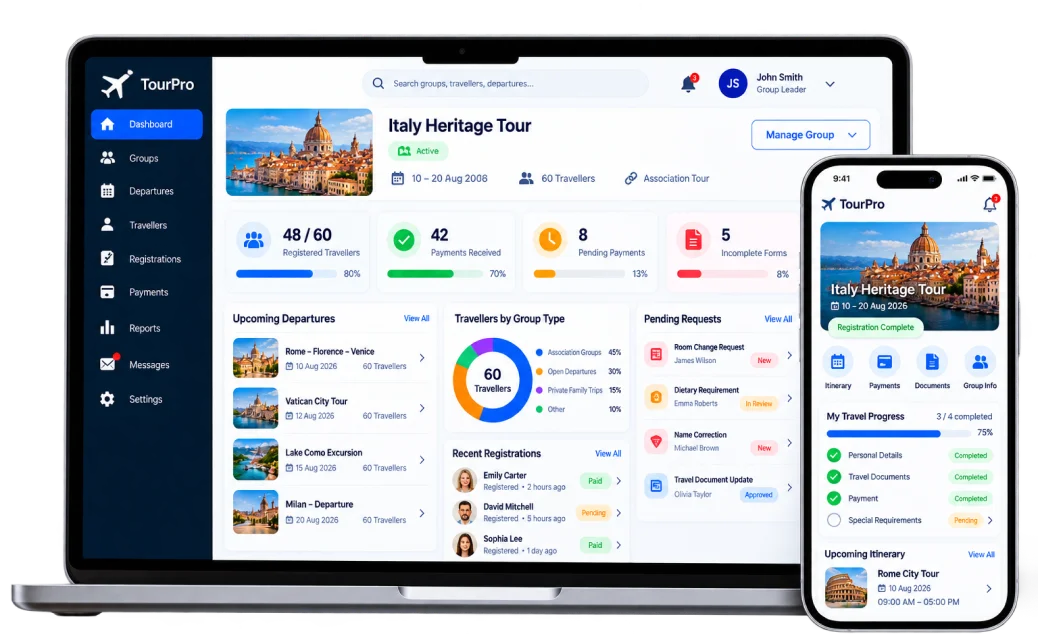








A concert-tour operator's back office held every answer, but a volunteer choir director had become the channel for all of them. We built role-based self-service on the existing group record, so routine questions now end where the answer is.
US operator of concert tours for community choirs, orchestras and bands
About 100 singers and non-singing companions on a two-week Ireland and Scotland tour
Every payment, rooming, form and venue question routed through one unpaid leader
Self-service for travellers, a status view for the leader, and a request queue for staff
Leader view first, then traveller self-service, then the request queue

For decades the operator has built tours for amateur ensembles. It arranges the travel and what makes a trip a tour: concert venues, rehearsal space, pianos, host choirs and publicity.
Its back office already held each group as a group, with traveller bookings and payments linked to it, much like a group module on an existing booking platform. Staff could answer almost any question in seconds. Nobody outside the office could see any of it.
The tour was a community chorus with concerts in several cities and a joint performance with a local choir. It travelled as two kinds of traveller: singers, and companions who skip rehearsals for alternative sightseeing.
Its leader was the music director, helped by a volunteer coordinator. Neither was paid to do administration, yet both became the contact point for everyone:
She forwarded questions, waited, and relayed answers from a weekly status PDF that was stale a day after it arrived, sometimes chasing someone who had paid yesterday. Staff often answered the same question twice, once from the singer and once from the leader. And passports and medical notes passed through a volunteer's personal inbox, the kind of traveller data the operator can't secure or delete.
The real risk was commercial. Directors who bring a choir back are the ones who enjoyed leading it, a pattern explained in why tour operators take admin off the group leader.

| Option | Where it fits | Why it did or didn't fit here |
|---|---|---|
| More frequent status reports | Small groups with a few questions a week | Still stale by the time they're read, and still built by hand |
| A portal for the leader only | Groups where the leader really does handle all admin | The obvious brief, but travellers would keep asking the leader, and nothing would settle who may change what |
| Role-based self-service on the existing group record | Groups whose answers already sit with the operator | Chosen: each person sees their own part of one record, and changes stay with staff |
The harder work was deciding what the leader should not see, using what leaders actually asked about, before any screens were built.
The design rule: the leader sees progress, not private data, and anything that changes a supplier commitment is a request, not an edit.
| Component | What it does | Gap it closes |
|---|---|---|
| Traveller self-service | Each person registers as singer or companion, enters their own details, uploads passport data, pays, and sees their balance | Questions about balances and forms routed through the leader |
| Leader dashboard | Registrations against places; who is paid, due or overdue (not amounts); whose form is incomplete; reminders to the group or a nudge to one person | The weekly PDF |
| Leader's own tasks | Maintains the performer list by voice part and uploads the concert programme | Counts emailed from the leader's spreadsheet |
| Request queue | Room swaps, new travellers, dinner add-ons and cancellations arrive with the traveller's request and the leader's endorsement for staff to approve | Changes relayed third-hand |
| Role-based documents | Itineraries and schedules published once, in a singer and a companion version | Companions working out their days from the full itinerary |
The leader can invite new travellers while places remain and post announcements, but never sees passports, medical details or payment amounts.
The leader activates the group after contract signature and shares an invitation link with the choir.
Travellers register and upload documents themselves; nothing passes through the leader's inbox.
Travellers pay online and check their own balance, with reminders from the operator, not the leader.
The leader watches progress and nudges people without knowing the amounts.
The leader handles the music; staff send the performer list and programme to venues.
Changes become requests that staff approve, and the supplier lists update from there.
The week before a tour leaves used to be the help desk's busiest. On the Ireland and Scotland tour, five things happened that week.
Before, each would have gone to the leader, then staff, then back, a day or more per question.
Now a tenor checks his own booking and sees his final payment, with the receipt. A companion opens her version of the itinerary to see which days she skips rehearsals. The leader confirms the performer list and staff send it to the host choir. Two altos ask to share; the leader, who knows them, endorses it, and staff approve it, so the hotel's rooming list updates from the record rather than from a forwarded email. And a bass whose passport name doesn't match his booking hears directly from staff; the leader only sees that his form is now complete, without ever handling the document.

Many chorus members are retired and some prefer the phone, so adoption shaped the design. Travellers sign in from an emailed link instead of a password, on screens built for phones first. Staff can act for anyone who calls, in the same system, so the leader's view stays accurate. The leader dashboard went live first, replacing the weekly PDF; traveller self-service followed, then the request queue. A short guide explains to directors what they can and can't see, and why.
| Area | Before | After |
|---|---|---|
| Group leader | Relay for payments, rooming, forms and venue details | Sees progress, endorses changes, owns the music |
| Travellers | Waited for answers via the leader | Check their own balance, documents and itinerary |
| Operations staff | Answered questions twice; built weekly PDFs | Work a queue of real changes; status is live |
| Venues and host choir | Counts from the leader's spreadsheet | Performer lists and programmes from the operator |
| Personal data | Passed through volunteers' inboxes | Entered by travellers, held by the operator |
The measure that mattered wasn't a count of emails. Routine questions now end where the answer is, and only changes that need a decision reach a person. Leading a tour is closer to what directors signed up for.
Map the questions before designing the portal. Most answers already sit with the operator; the job is to let people reach them.
Decide what the leader must not see. Status without private data is enough to lead.
Separate looking from changing. Self-service for information, staff approval for anything that touches a supplier.
Give the leader the tasks only they can do. For a choir, the performer list; for a pilgrimage, perhaps the daily services. And self-service needs one group record behind it.
If your group leaders spend more time on admin than on their group, see how we build self-service group travel management for tour operators.
We have fulfilled the demands of clients working in different industries. For more details, check what our clients say about us.

Israel
We worked with Liron Feigenbaum on a UI/UX and mobile app development proje...

United States
Hi, my name is Tiami. I was looking for an overseas company and found Guru ...

United Kingdom
Hi, I am Doski. I work with Guru TechnoLabs' team and I am very happy...

Australia
We commissioned and adopt a website from Guru TechnoLabs. Website require...
Share your business needs or project requirements with us & we will get back to you quickly.



