
Dating

Web App
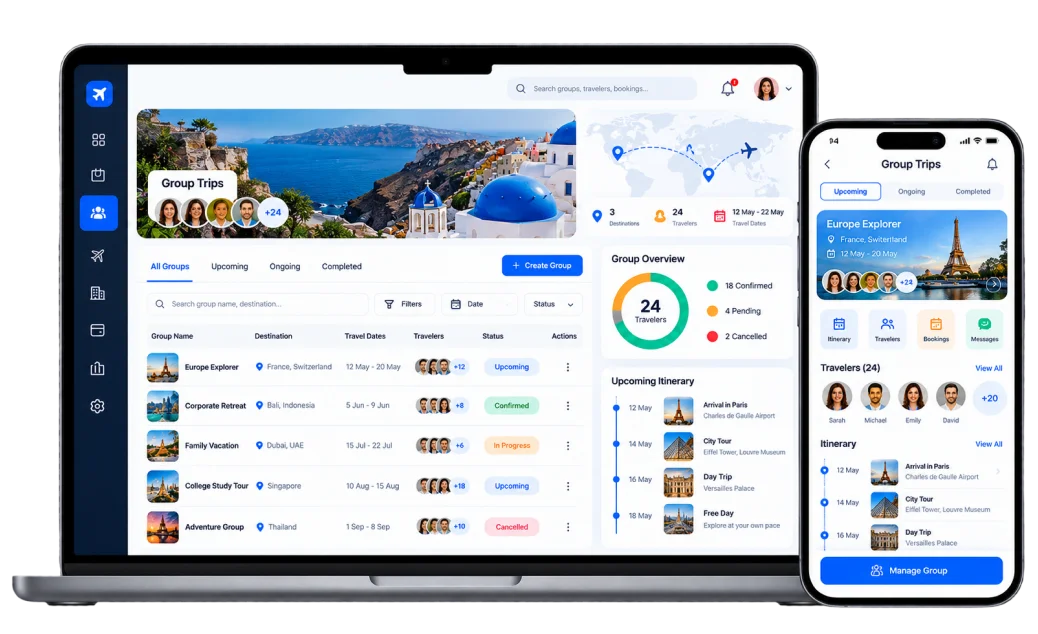








A trade-only wholesaler ran a 150-person, three-city alumni tour from one master workbook that only one coordinator could safely edit. We replaced it with a linked operations record, so one change now reaches every supplier it affects.
US wholesaler of European travel, selling only through advisors
About 150 alumni on a 12-day Prague, Vienna and Budapest tour
A master workbook that copied every traveller into a tab per supplier
One operations record linking travellers to services, with manifests generated per supplier
One departure run in parallel, then new groups first

The operator doesn't sell to the public. Advisors build itineraries on its trade portal or call its reservations team, and it contracts the hotels, transfers, guides and sightseeing behind them. Most of its business is tailored independent travel.
Its booking system handles that well: each advisor booking is a separate file with its own client, commission and terms. But an association's members book through their own advisors, so one group arrives as many separate bookings that the system doesn't know belong together.
The alumni tour needed four hotels (two in Vienna, as no single property could take the block), three coaches, transfers from several US gateways, local guides, group dinners, and two optional extras bought by part of the group. Over a dozen suppliers each needed a different slice of the same traveller list.
It all lived in "the master", a clever workbook with a tab per supplier, kept by one senior coordinator. It failed one change at a time:

| Option | Where it fits | Why it did or didn't fit here |
|---|---|---|
| A better, shared online spreadsheet | One small group a season, in one city | Removes emailed copies, not copied tabs; formulas can't show which suppliers a change affects |
| A standalone group product | Operators who book and collect for the whole group | The travellers were advisor bookings whose commissions and terms had to stay in the booking system |
| A linked operations record beside the booking system | Operators whose bookings work but group operations don't | Chosen: it reads tagged advisor bookings and leaves booking, commission and payments alone |
The connection to the booking system was kept deliberately light. For a deeper integration that adds group bookings and payments inside a platform, see how an operator added a group module without replacing its booking system.
The design rule: a traveller is entered once, and every supplier list is a view of that record.
The key is the assignment. A traveller's room in Vienna, their coach, their transfer slot and their dinner choice are links to services, not rows retyped in four tabs.
| Component | What it does | Gap it closes |
|---|---|---|
| Group and services | Each supplier commitment (a hotel block, a coach, a dinner) as one service | No record of the group as a whole |
| Traveller record | Passport name, advisor agency, booking reference, dietary and mobility needs | The same person pasted into a dozen tabs |
| Assignments | Which traveller is on which service, with their room share or meal choice | Changes copied tab by tab |
| Arrivals | Each PNR or own-flight arrival, linked to its transfer and first night | No link between a flight and what depends on it |
| Manifest versions | What went to each supplier, when, in its format, and its acknowledgement | "Sent" logged, never "confirmed" |
Colleagues can now cover the coordinator safely, tour managers see their own coach on the day, and advisors see no change.
For each hotel block, coach, transfer slot, dinner and extra.
Tagged bookings appear with agency and reference; nobody retypes a name.
With defaults where everyone shares one, such as the farewell dinner.
For each supplier in the format it already uses.
Each send is a dated version, "awaiting acknowledgement" until the reply is logged; this is confirmation as a discipline, built in.
The record lists every service and manifest a change makes out of date.
Ten days before departure, the consolidator moved one gateway's flight into Prague. Eight travellers would land five hours later, in the evening.
Before, the coordinator worked out every consequence herself, and the welcome dinner was the step most often forgotten.
Now she updates the arrival once, and the record lists every service that depends on it: the transfer, the first night in Prague, the welcome dinner and the tour manager's list. She moves the eight to the evening transfer and agrees a late meal with the restaurant; the system records that decision, it doesn't make it. Two land-only travellers sharing rooms with people on that flight stay on their own arrival, so nobody is moved by mistake. New manifest versions go to the transfer company, the hotel and the restaurant. When the restaurant hasn't acknowledged two days later, its manifest appears on the open items and a colleague follows up.

Other groups were live on their own workbooks, so there was no clean start. We walked every tab with the coordinator, turning rules she applied by eye (such as which Vienna hotel took overflow rooms) into fields. Travellers were matched to advisor bookings by reference, not name. One departure ran in both systems until the manifests matched; then new groups started in the record while groups close to travel finished on their workbooks. For a full system migration, see moving a legacy group system to the cloud between seasons.
| Area | Master workbook | Operations record |
|---|---|---|
| Traveller data | Entered once, copied into many tabs | Entered once, linked to every service |
| Impact of a change | Worked out from memory | Listed by the system, service by service |
| Supplier manifests | Filtered and pasted per supplier | Generated in each supplier's format |
| Confirmation | "Sent" noted in a status tab | Each version tracked to acknowledgement |
| Cover during absence | One person knew the tabs | Any colleague can work the record |
The team no longer spends the last weeks before departure reconciling tabs. And a second multi-city group no longer means a second workbook only one person can edit, the real limit of running large group tours on tools built for individual bookings.
The warning sign is the same traveller pasted into many places.
Most group errors are right data that never reached one supplier.
The change belongs inside the operator, not in the formats suppliers receive.
If your platform runs your business but buckles when a large group arrives, see how we build custom group travel management solutions for tour operators.
We have fulfilled the demands of clients working in different industries. For more details, check what our clients say about us.

Israel
We worked with Liron Feigenbaum on a UI/UX and mobile app development proje...

United States
Hi, my name is Tiami. I was looking for an overseas company and found Guru ...

United Kingdom
Hi, I am Doski. I work with Guru TechnoLabs' team and I am very happy...

Australia
We commissioned and adopt a website from Guru TechnoLabs. Website require...
Share your business needs or project requirements with us & we will get back to you quickly.



