
Travel & Tourism

United States
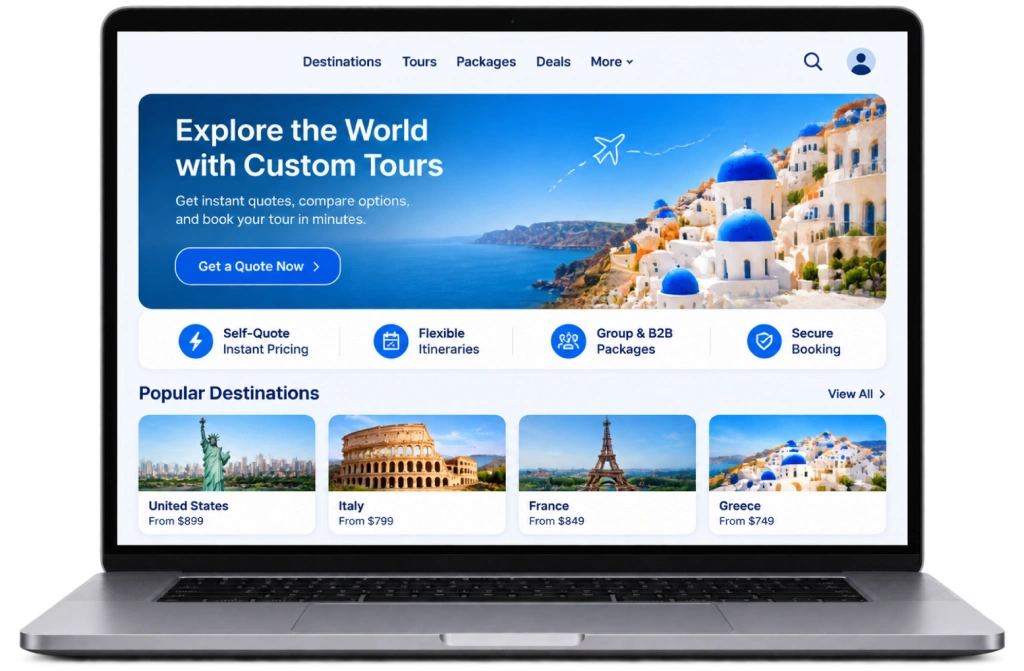









For a tour wholesaler, generating quotations is an important part of converting travel inquiries into confirmed bookings. When customers or travel agents face delays in obtaining quotations, interested buyers may lose momentum before completing a booking.
A U.S.-based tour wholesaler wanted to improve how users generated quotations and moved forward with bookings through its existing travel platform. The objective was to reduce dependence on manual assistance and make it easier for users to receive quotations for supported travel products.
Guru TechnoLabs enhanced the existing booking platform with self-quoting capabilities, allowing eligible users to generate quotations and move through the booking process with fewer manual steps.
Following the implementation, the client's quotation-to-booking conversion rate increased from 2% to 19%, an improvement of 17 percentage points.
The project demonstrates how integrating quotation management into an existing booking platform can help travel wholesalers improve the buying experience and convert more quotations into confirmed bookings.
The U.S.-based tour wholesaler already had a travel booking platform, but its quotation process needed improvement. Users could explore travel products, yet obtaining a complete quotation and moving toward a booking was not as straightforward as the business wanted.
The client reported a quotation-to-booking conversion rate of just 2%, meaning only 2 out of every 100 generated quotations resulted in confirmed bookings.
The business needed to improve how quotations were created, presented, and connected to the booking process.

The existing quotation process relied on manual assistance for requests that the business wanted users to handle independently.
This created additional steps between selecting travel products and receiving a quotation. For travel agents and customers evaluating different options, having to request assistance could make the buying process less convenient.
The wholesaler wanted to reduce this dependency by allowing eligible users to generate quotations directly through its booking platform.
Generating a quotation is only one part of the sales process. Users also need to review the offer, understand the pricing, and decide whether to proceed with a booking.
The client's existing platform needed a more direct connection between these activities.
When quotation creation and booking are not closely connected, users may face additional steps before completing a purchase. The wholesaler wanted to make this process easier without requiring users to move through unnecessary manual interactions.
The client's reported quotation-to-booking conversion rate was 2%.
This meant that a relatively small proportion of generated quotations became confirmed bookings.
Although the conversion rate alone did not establish why users failed to complete bookings, it highlighted an important commercial opportunity.
Improving the quotation experience could help the business make better use of existing sales opportunities rather than depending entirely on attracting more inquiries.
The wholesaler wanted to enhance its existing booking platform with self-service quotation capabilities.
The objective was to allow eligible users to select supported travel products, obtain quotations, review pricing, and move toward booking through a more direct process.
At the same time, the business needed to retain the pricing rules and operational controls required for travel distribution.
Rather than replacing the existing platform, the priority was to improve its quotation capabilities and create a better path from quotation generation to confirmed booking.
Guru TechnoLabs worked on enhancing the wholesaler's existing travel booking platform with self-service quotation capabilities. The objective was to make quotation generation more accessible to eligible users and reduce the manual steps between selecting travel products and proceeding with a booking.
Instead of introducing a separate quotation system, the project focused on improving the existing platform so users could manage more of the quotation process in one place.

The self-quote functionality was designed to allow eligible users to select supported travel products and generate quotations directly through the booking platform.
This addressed the client's need to reduce dependence on sales-team assistance for routine quotation requests.
By making quotation generation part of the platform experience, the wholesaler aimed to give travel agents and customers a more direct way to evaluate available travel options and obtain pricing information.
A quotation must reflect the pricing conditions associated with the selected travel products.
For a tour wholesaler, these conditions can include supplier rates, selling prices, markups, commissions, taxes, and product-specific restrictions.
The quotation workflow therefore needed to account for the client's applicable pricing rules while presenting users with a clear offer.
This was particularly important because self-service quotation generation needed to support the wholesaler's commercial requirements without creating inconsistencies between quoted prices and the booking process.
The project focused on improving the connection between quotation creation and the next step in the booking journey.
Users needed a practical way to review their quotations and proceed toward booking without unnecessary manual interactions.
Bringing these activities closer together within the existing platform was intended to reduce friction between receiving a quotation and deciding to book.
For the wholesaler, this approach supported the broader objective of converting more quotation opportunities into confirmed bookings.
The client already had a travel booking platform, so the priority was to improve its quotation capabilities rather than introduce an entirely new system.
Guru TechnoLabs focused on the self-quoting experience within the existing booking environment.
This approach allowed the project to address a specific business requirement while keeping the existing platform at the center of the quotation-to-booking process.
The objective was to help the wholesaler make better use of its existing technology investment and provide users with a more convenient way to obtain quotations and move toward booking.
The project focused on improving the wholesaler's quotation process without replacing its existing travel booking platform. This required understanding how travel products, pricing information, quotations, and bookings worked together. Our implementation approach centered on making quotation generation easier for users while maintaining consistency with the platform's existing business processes.
We started by examining how users selected travel products, obtained quotations, and proceeded toward booking.
The objective was to identify which activities required manual assistance and where self-service functionality could improve the user experience.
This assessment helped define how the new quotation capabilities should fit into the existing platform rather than operate as a separate system.
The next step was to establish the information and business rules required to generate quotations.
For a tour wholesaler, quotations need to account for the selected travel products, applicable pricing conditions, and any restrictions that affect the offer.
We focused on defining the quotation requirements so that the self-service workflow could support the client's existing commercial processes.
The self-quote functionality was designed around a straightforward user journey: selecting supported travel products, providing the required trip details, and generating a quotation.
The development approach focused on making these activities accessible through the existing booking platform.
This reduced the need to treat routine quotation requests as separate manual interactions and created a more direct experience for eligible users.
An important consideration was how quotation information would be used when a user decided to proceed with a booking.
The implementation approach focused on connecting the quotation workflow with the existing booking environment so users could move forward without unnecessary duplication of information.
This helped address the gap between obtaining a quotation and taking the next step toward a confirmed booking.
Testing needed to cover the quotation process from travel product selection through quotation generation and the subsequent booking steps.
Key considerations included the accuracy of quoted information, supported travel product combinations, applicable pricing conditions, and the handling of different user scenarios.
The objective was to ensure that the self-quote functionality supported the intended business process and provided users with reliable quotation information.
The project's business objective was to improve the proportion of generated quotations that resulted in confirmed bookings.
Following implementation, the client reported an increase in quotation-to-booking conversion from 2% to 19%.
This result indicates a substantial improvement in the reported conversion rate. However, the available information does not establish how much of that improvement can be attributed specifically to the self-quote functionality.
The self-quote engine needed to work within the wholesaler's existing travel booking environment rather than operate as a separate application.
The architecture therefore focused on connecting travel product selection, quotation generation, pricing information, and booking workflows.
The quotation process needed access to the travel products and pricing information available through the existing platform.
When users selected supported travel products, the self-quote functionality needed to use the relevant information to prepare a quotation.
This connection was important for keeping quotation generation consistent with the products and pricing conditions managed by the wholesaler.
The quotation workflow needed to account for the commercial rules applicable to the selected travel products.
Depending on the client's confirmed requirements, these could include supplier rates, selling prices, markups, commissions, taxes, and product-specific restrictions.
The architecture needed to support the application of relevant pricing conditions so that users could receive quotations based on the wholesaler's established business rules.
The final consideration was how quotation information would move into the existing booking process.
Rather than treating quotation generation and booking as unrelated activities, the system needed to support a logical transition between them.
This approach was intended to reduce unnecessary steps when users decided to proceed with a quotation and move toward a confirmed booking.
By keeping the quotation process connected to the existing booking environment, the project aimed to improve the buying experience without requiring the wholesaler to replace its platform.
Guru TechnoLabs enhanced the existing travel booking platform with self-quoting capabilities to help eligible users generate quotations and move toward booking.
The following table summarizes the core capabilities described in the project scope. Additional functionality should be included once confirmed against the implementation records.
| Capability | Business Value |
|---|---|
| Self-service quotation generation | Allows eligible users to generate quotations through the booking platform rather than relying on manual assistance for every routine request. |
| Quotation generation within the existing platform | Keeps the quotation experience connected to the client's existing booking environment instead of requiring a separate quotation application. |
| Quotation-to-booking workflow | Supports the transition from reviewing a quotation to proceeding with a booking. |
These capabilities address an important business requirement: making it easier for users to obtain quotations and take the next step toward booking.
The objective was not to automate every interaction. It was to make routine quotation activities more accessible while preserving the role of the wholesaler's team in handling requests that require additional attention.
Following the implementation of the self-quote engine, the tour wholesaler reported a significant improvement in its quotation-to-booking conversion rate.
Previously, approximately 2 out of every 100 generated quotations resulted in confirmed bookings. After implementation, that figure increased to 19 out of every 100 quotations.
| Performance Metric | Before | After |
|---|---|---|
| Quotation-to-booking conversion rate | 2% | 19% |
| Bookings per 100 quotations | 2 | 19 |
| Percentage-point improvement | — | +17 |
| Relative conversion rate increase | — | 850% |
The increase from 2% to 19% indicates that a greater proportion of generated quotations resulted in confirmed bookings.
By introducing self-service quotation capabilities within the existing booking platform, the project addressed a key part of the buying process: helping users obtain quotations and proceed toward booking without unnecessary manual steps.
For the wholesaler, the improvement meant converting a larger share of quotation opportunities into bookings without relying solely on generating additional inquiries.
The reported results demonstrate the commercial value of improving the quotation-to-booking journey, although the conversion figures alone do not establish how much of the improvement was attributable specifically to the new functionality.

“We wanted to make it easier for customers to move from getting a quote to actually booking their trip. Guru TechnoLabs helped us add that capability to our existing booking platform, rather than starting from scratch. It was important for us to make the booking process easier for customers while continuing to use the system we already had in place.”
— Tour WholesalerWe have fulfilled the demands of clients working in different industries. For more details, check what our clients say about us.

Israel
We worked with Liron Feigenbaum on a UI/UX and mobile app development proje...

United States
Hi, my name is Tiami. I was looking for an overseas company and found Guru ...

United Kingdom
Hi, I am Doski. I work with Guru TechnoLabs' team and I am very happy...

Australia
We commissioned and adopt a website from Guru TechnoLabs. Website require...
Share your business needs or project requirements with us & we will get back to you quickly.



