
Travel

Confirm: Web Application
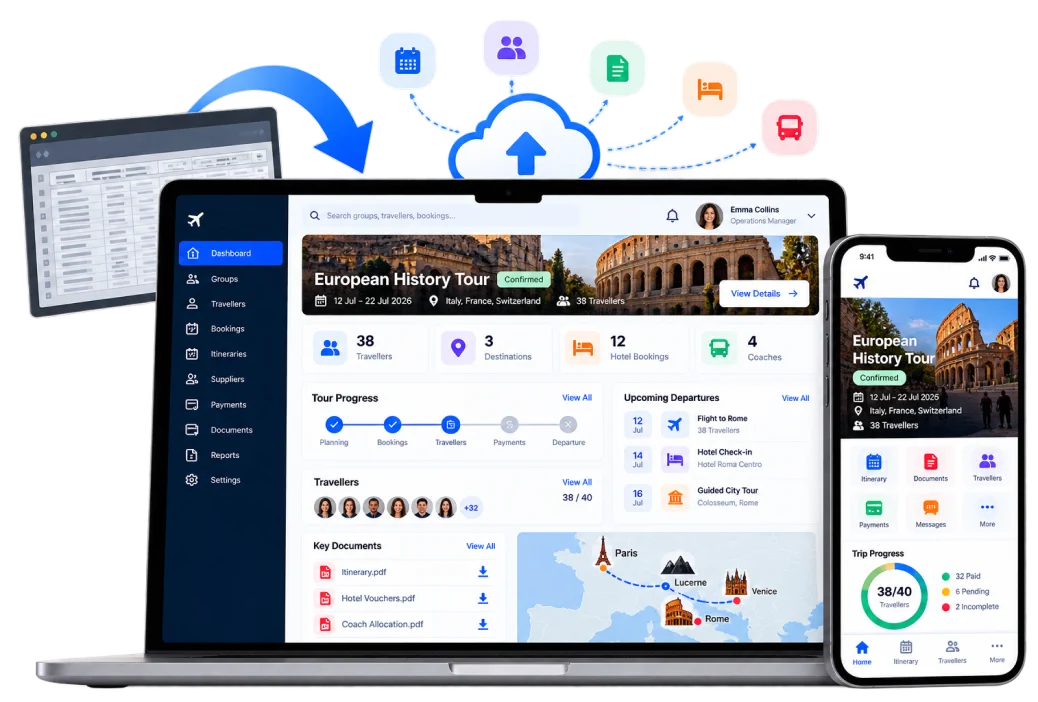








A family-owned history tour operator had run every group for twenty years on a desktop application only its retiring author understood. We moved it to a cloud-based group management system between seasons, keeping decades of traveller history and never putting a live departure at risk.
Family-owned US operator of escorted history and battlefield tours in Western Europe
Commemorative departures, returning veterans' and reunion associations, multi-generation repeat travellers
An office-bound legacy application, near end of support, understood by one retiring contractor
A cloud-based group management system with the old system's rules written down and tested
Parallel run, then a between-season cutover with every live group reconciled

No single failure forced the decision. Several pressures arrived together:
Every commemorative season also ran on one machine; an outage in those weeks would have stopped the business. The question wasn't whether to modernise, but how, without losing the memory or a live departure. Groups were always somewhere between recruiting and travelling, peak season ruled out any move, and some behaviour lived in queries and forms that nobody had documented.
| Option | Where it fits | Why it did or didn't fit here |
|---|---|---|
| Extend the existing system with a group module | Operators whose core still works and only lacks group capability | The foundation itself was at end of life; see when extending an existing platform is the better path |
| Copy the old application into a browser | Systems whose workflows still fit the business | Would have moved the old limits, and the notes-field workarounds, to the cloud |
| Write down the old rules, redesign the workflows, then migrate | End-of-life systems that still encode how the business runs | Chosen: keeps the knowledge, drops the constraints |
The design rule: treat the old system as the specification. Every form, report and saved query was walked through with the staff who used them, and with the contractor while he was still available. Each behaviour was written down as a plain business rule; anything nobody could explain was marked for testing, not guessed.
| Component | What it does | Gap it closes |
|---|---|---|
| Linked groups, departures and travellers | Association groups, open departures and private family trips share one model, like a wholesaler's linked operations record | Workarounds for anything outside the original design |
| Structured traveller needs | Accessibility, dietary needs, room shares and the memorial a family is visiting, as fields | Critical facts buried in free-text notes |
| Online registration and payments | Website registrations and gateway payments post straight to the traveller; accounting exports from the same records | Emailed registrations and hand-keyed payments |
| Tour manager access | Phone or tablet sign-in to the group's manifest, needs and memorial visits, with changes recorded on the road | Calls to the office across time zones |
| Managed cloud hosting | Backups, separate test and live environments, role-based access and an audit trail | One office server in peak season |
Data was cleaned on the way across. Duplicate travellers were merged with staff reviewing uncertain matches, never on name alone, and wherever a note's meaning was unclear, the original was kept beside the new fields. Nothing was thrown away.
Plan the season's departures with hotels, coaches and guides, drawing on what earlier seasons recorded.
Open association groups from their history: preferred hotels, usual leader, past travellers to invite.
Register travellers. Repeat travellers are recognised, with their needs and memorial visits on file to confirm.
Produce manifests in the formats hotels and coach companies already know.
Run the tour on the ground, with tour managers recording changes the office sees immediately.
Feed the next season, so the next invitation starts from accurate history.
During the parallel run, one departure was managed in both systems and every manifest compared. Rooming and meal lists matched. Coach seating didn't.
Before, travellers with mobility needs had always appeared in the front rows, and the tour manager's seat was always held. Nobody had listed it as a rule. An old seating report was quietly sorting travellers by a code staff typed into the notes field when someone needed help with steps.
Now it is an explicit rule, run from the structured accessibility field: travellers with a recorded mobility need are offered front seats first, the tour manager's seat is held, and the manifest shows the driver why. For elderly veterans and their families, that decides whether someone can get off the coach at a cemetery with dignity. The rule inventory had flagged the behaviour as unexplained; the parallel run proved it.

The cutover was timed to the gap between seasons, not a project deadline. The old system went read-only for a short window, every open group was migrated, and each was reconciled against supplier confirmations, headcount, balances and rooming from the old system's own reports before going live. One veterans' group travelled weeks later; when a traveller had to leave mid-tour, the tour manager logged it in France that evening and the US office started the follow-up next morning without a phone call. Staff reviewed the rules for their own work, their daily reports were rebuilt first, and training used the operator's own groups.
| Area | Legacy application | Cloud system |
|---|---|---|
| Where it works | The office, or a fragile remote connection | Anywhere, including tour managers abroad |
| Continuity | One server, one contractor | Managed hosting, backups, a documented rule set |
| Business rules | Hidden in queries and forms | Written down, tested, visible on manifests |
| Traveller needs | Free text in notes | Structured fields, original notes kept |
| Repeat-traveller history | Locked in the office | Merged and available wherever the group runs |
The most important result is the easiest to overlook: the operator's memory survived the move. Twenty years of families, associations and their needs no longer depend on one machine or one person.
Extend if you can, replace if you must. Replacement makes sense when the foundation is unsupported, office-bound and dependent on one person.
Expect rules nobody wrote down. A parallel run that compares real manifests is where they surface.
Never switch a live group without reconciling it against the old system's own reports.
Keep the memory. Merge duplicates carefully and keep original notes.
If your group operation still depends on an ageing system and the one person who understands it, see how we build custom group management systems for tour operators
We have fulfilled the demands of clients working in different industries. For more details, check what our clients say about us.

Israel
We worked with Liron Feigenbaum on a UI/UX and mobile app development proje...

United States
Hi, my name is Tiami. I was looking for an overseas company and found Guru ...

United Kingdom
Hi, I am Doski. I work with Guru TechnoLabs' team and I am very happy...

Australia
We commissioned and adopt a website from Guru TechnoLabs. Website require...
Share your business needs or project requirements with us & we will get back to you quickly.



