25 Best Mobile App Ideas for 2026: Profitable Opportunities for Startups & Entrepreneurs

Table of Contents
- The Mobile App Market in 2026: A Window You Can’t Ignore
- What Separates a Profitable Mobile App Idea from a Failed One
- 25 Best Mobile App Ideas for Startups in 2026
- Technologies Making These App Ideas More Powerful in 2026
- How to Validate Your Mobile App Idea Before You Build
- Final Thoughts
- Frequently Asked Questions
The mobile app market is growing fast, and it’s becoming super important for the world economy. By 2026 its expected to make over $330 billion in revenue. Could even reach $58 trillion by 2030. People are downloading lots of apps. Using them for trillions of hours every year.
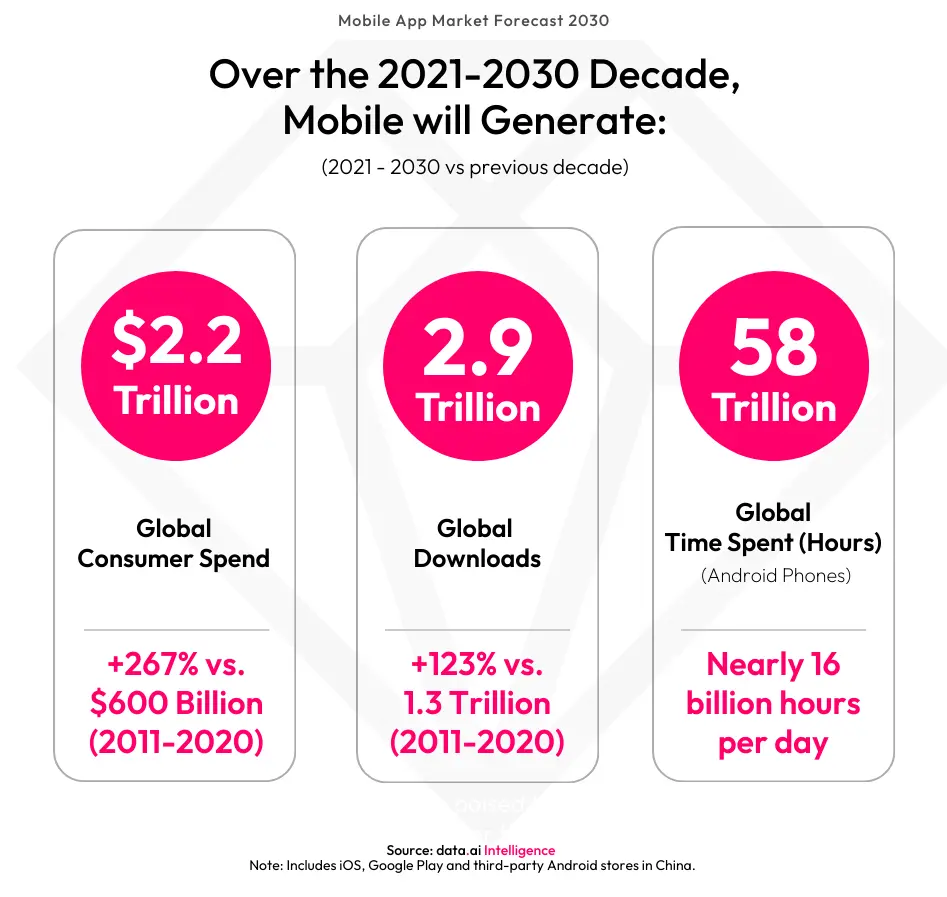
Source: Sensor Tower
The truth is, the market isn’t too crowded. It’s just getting rid of bad ideas. Apps that aren’t helpful or don’t solve problems are being ignored. The ones that are helpful and work well are growing quickly.
If you want to build an app, your idea is the important thing. Picking something useful, relevant, and timely can make the difference between failing and succeeding.
This guide looks at 25 app ideas that people really want. So you can think like a builder, not someone following trends.
The Mobile App Market in 2026: A Window You Can’t Ignore
A few big changes are making 2026 a time to launch a mobile app.
First, AI is now a must-have. Most apps use it in some way. Users expect things like personalized recommendations, smart suggestions, and automation. If an app doesn’t have these, it feels old.
- Second, the thing about 5G is that it is changing what apps can do. The speeds are fast now, so things like tracking your health in real time, shopping with augmented reality, or working together with other people without any problems are becoming what people expect, not what’s special.
- Third, making apps is a lot easier now. You can use tools that do not need a lot of coding, so you can go from having an idea to trying out a prototype in a few weeks. That means that the important thing is not just being good with technology, but having a good idea and doing it well.
- For businesses, apps are not just about how many people download them. They help keep customers happy, make it easier for them to interact with the business, create ways for the business to make money directly, and give the business information to make decisions.
What Separates a Profitable Mobile App Idea from a Failed One
Almost half of all apps get deleted after one month. The main reason for this is that they do not work well or they do not offer value to the people using them.
Before you spend time or money on an idea, you should think about it carefully with three questions:
1. Real problem
Can you explain the problem in one sentence? Who has this problem? Why are the solutions that are available now not good enough?
2. Proven demand
Are people actually looking for something like this? You can check things like what people are searching for, what people are looking for in app stores, or if other apps like this are being downloaded.
3. A clear way to make money
How will your app make money? The common ways that apps make money now are by subscription, by selling things inside the app, or by selling to other businesses.
If your idea passes all three of these questions, then it is worth thinking about seriously.
25 Best Mobile App Ideas for Startups in 2026
You may want to build an application in 2026, but you do not know how to get started. This list contains twenty-five of the best applications you can develop and will help inspire your upcoming project. Each application was developed based on the need for its real-world functionality, its potential for long-term use/return, and innovation beyond the latest trends.
All twenty-five applications have been listed category-wise to enable you to search for a functional match at your convenience.
AI-powered Apps
1. AI Personal Finance Manager: A mobile app that allows you to aggregate all of your bank accounts and provides automated tracking of your expenditures. The app will categorize your expenditures and make budgeting recommendations according to your previous spending habits.
Monetization: Fees can be generated both from a free version with paid features as well as through paid insights.
2. AI Content Creation & Marketing: A mobile app that creates title captions for photos, scripts for videos, ad campaigns, or blog posts, all based upon answers to simple questions. It is a great resource for individuals and or small business owners so they can save time developing their online digital presence.
Monetization: Subscription Fee based on the frequency of usage or the size of the team using the app.
3. AI Mental Health & Wellness Companion: An app that checks in on your mood, suggests simple exercises, and helps deal with stress with guided techniques. It adapts to you over time, making it more personal.
Why it works: People are looking for easy, daily mental health support.
4. AI Career Coach & CV Builder: Helps users build strong resumes, prepare for interviews, and find relevant job opportunities. Especially useful as hiring becomes more AI-driven.
Why it works: Job seekers are already relying on AI tools.
Health & Wellness Apps
5. Telehealth & Remote Monitoring App: Let users consult doctors, manage prescriptions, and track health conditions without visiting a clinic.
Why it works: Saves time and improves access to healthcare.
6. AI Fitness Coaching App: Creates personalized workout plans, tracks progress, and even checks exercise form using the phone camera.
How it makes money: Premium fitness plans and features.
7. Nutrition & Meal Planning App: Tracks food, suggests meals, and builds weekly plans based on user goals. Can also connect with grocery delivery services.
Extra advantage: Daily use keeps users engaged.
On-Demand Service Apps
8. Home Services App: Connects users with trusted professionals like plumbers, electricians, or cleaners, with booking and payment built in.
Why it works: People want quick, reliable services.
9. Hyper-Local Food & Grocery Delivery App: Focuses on a specific area or niche (like healthy food or local stores) instead of competing with big platforms.
Why it works: Smaller, focused markets can still be very profitable.
10. EV Charging Finder & Booking App: Helps electric vehicle users find nearby charging stations, check availability, and reserve a slot.
Why it works: EV users face this problem daily.
11. Pet Care & Vet Booking App: An all-in-one app for pet owners – book vet visits, find pet sitters, track vaccinations, and set reminders.
Why it works: Pet owners are highly engaged and spend consistently.
E-Commerce & Retail Apps
12. Augmented Reality Virtual Try-On Shopping App: This is an eCommerce retail app that provides users with the ability to try on eyewear, shoes, furniture, or clothing via augmented reality before purchasing them.
13. AI Personal Shopper Application: An AI personal shopping app that learns about the user’s style, brands he/she likes, and budget to create custom recommendations from various platforms and retailers.
14. Subscription Box Discovery & Management Application: With the increasing popularity of subscription boxes in various categories such as beauty, food, lifestyle, and tech, users often don’t keep track of what they are subscribing to. This application provides the ability to feature businesses through ads and manage subscriptions.
Education & Productivity Apps
15. Micro Learning & Skill Certification App: This is an educational app that allows users to learn short, simple lessons in programming, designing, marketing, data science, business strategy, and more. It is for those who cannot afford to take up a course but want to learn continuously.
16. AI Meeting Summarizer & Action Tracker: Meetings consume a significant portion of the workday. It can take a considerable amount of time to read through the notes made during and after the meeting. This app solves these problems by automatically recording your conversation (which can be in person or virtual), automatically summarizing the key points of the meeting, and automatically identifying the actions from the meeting for you.
17. Language Learning App with AI Conversation Coach: The language learning app is different from other apps in that it allows for more conversation compared to other apps.
Fintech & Business Apps
18. BNPL & Digital Wallet App for Niche Verticals: “Buy now, pay later” is a very common term in the retail business, but there is a lot of potential for its use in other industries such as healthcare, education, and home repairs, where you have to spend a lot of money on something you were not expecting to spend money on.
19. B2B Expense & Invoice Management App: Small business owners, independent contractors, and freelancers need a quick and easy way to manage their finances on a mobile device. This app has developed a single platform for recording all your expenses, putting together invoices, and preparing your taxes.
20. AI-Powered Business Analytics Dashboard App: This app will allow users to view all of your data from different platforms, such as CRM, sales, marketing, etc., in a single dashboard. The analytics Dashboard and business users want to spend money on something.
Real Estate & Travel Apps
21. AR Real Estate Virtual Property Tour App: Instead of physically visiting different properties, an individual could use an app that lets them explore different homes virtually. This app utilizes augmented reality and lets an individual walk around a house and even see how a piece of furniture could fit inside a house.
22. AI-Powered Travel Itinerary Planner: Planning a trip is not an easy task. With so many things to consider and so many variables to take into account, an individual could use an app that lets them plan a travel itinerary based on different inputs and requirements.
Social & Community Apps
23. Niche Community & Micro-Social Network App: With traditional social media platforms becoming crowded and less personal, a new opportunity is created for smaller communities and social network apps that are based on different niches and interests.
24. Sustainable Living & Carbon Footprint Tracker: With many individuals becoming aware of the need for sustainable living and reducing their carbon footprint, an app could be created that lets them track their daily activities and even provides them with options for a better and more sustainable lifestyle. The app could even offer a gaming experience for such an activity.
25. Virtual Event & Professional Networking App: With remote and hybrid work becoming standard, virtual events are no longer temporary – they’re a core part of how people connect professionally.
Technologies Making These App Ideas More Powerful in 2026
The ideas we just covered become even stronger because of a few key technologies that are already accessible and widely used today.
Generative AI
AI now makes it possible to personalize experiences at scale – whether it’s creating content, giving recommendations, or acting as a coach. At this point, AI isn’t a “nice-to-have” anymore; it’s expected. What really matters is how well you use it.
Augmented Reality (AR)
AR helps users see and experience things before making decisions. Whether it’s trying on clothes, visualizing a home, or even training in a simulated environment, it removes uncertainty. This makes it incredibly valuable in areas like shopping, real estate, education, and healthcare.
IoT & Wearable Integration
Apps can now connect directly to real-world data through devices like smartwatches, fitness trackers, home systems, or even vehicles. This allows apps to respond in real time – for example, tracking health metrics or adjusting based on user behavior – making the experience more proactive and personalized.
Blockchain
Blockchain adds a layer of trust by making data verifiable and secure. This is especially useful in areas like financial transactions, certifications, and health records, where accuracy and transparency matter. It’s not needed in every app, but in the right use cases, it becomes a strong advantage.
5G and Real-Time Experiences
With faster and more stable connectivity, apps can now support real-time features like live coaching, instant data streaming, or smooth multiplayer collaboration. What used to feel slow or unreliable is now seamless, opening the door to entirely new kinds of user experiences.
How to Validate Your Mobile App Idea Before You Build
A great idea means nothing if you can’t pull it off – and the first real test of that is validation. Most apps don’t fail because the idea was bad. They fail because the people building them were too eager to jump straight to building.
Start by defining the problem clearly: Try to describe it in one sentence: who is facing the problem, what exactly it is, and why current solutions aren’t good enough. If this isn’t clear, the app won’t be either.
Check if there’s real demand: Look at search trends to see if interest is growing. Go through reviews of similar apps – especially the low-rated ones. That’s where users openly talk about what’s missing or frustrating.
Talk to real users: Before designing anything, have conversations with at least 10 people who might use your app. Focus on understanding what they currently do and where they struggle, rather than asking if they “like” your idea.
Build a simple MVP (Minimum Viable Product): Don’t aim for perfection in the beginning. Create the simplest version of your app that solves the core problem and test it. The goal is to learn quickly, not to launch something perfect.
Decide how you’ll make money early: Be clear about your revenue model from day one – whether it’s subscriptions, in-app purchases, commissions, or B2B pricing. This will shape your product decisions, pricing strategy, and even how you pitch to investors later on.
Final Thoughts
There are still plenty of untapped niches in the market where a well-built mobile app can thrive. If you have an idea, the best thing you can do is start bringing it to life.
Not sure where to begin? Contact us. Our team covers the full development journey – from the initial concept all the way to launch. And if you’re unsure whether your idea has real market demand, we can help you build a Proof of Concept to research the landscape, validate your vision, and map out the smartest path forward.
We also specialize in MVP development – a lean, focused version of your product built to test with real users as quickly as possible. It keeps costs low, gets you to market faster, and gives you actual feedback to shape the final product into something people truly want.
Frequently Asked Questions
The most profitable mobile app ideas for startups in 2026 include AI-powered productivity tools, mental health and wellness apps, hyper-local service platforms, fintech apps for underserved markets, and on-demand home services.
To validate your mobile app idea, start with market research to identify your target audience and competitors. Build a Proof of Concept (PoC) or MVP to test core functionality with real users.
In 2026, AI-integrated apps, health and fitness trackers, financial management tools, and apps leveraging AR/VR are among the most in-demand. Apps that solve everyday friction - like scheduling, budgeting, or remote collaboration - continue to see steady growth across both iOS and Android platforms.
The cost to build a mobile app for a startup typically ranges from $15,000 to $150,000+, depending on complexity, features, and whether you hire in-house developers or outsource.
An MVP (Minimum Viable Product) is the most cost-effective starting point, often built for $15,000–$50,000, allowing you to test your idea before committing to full development.
An MVP (Minimum Viable Product) is a version of your app with only the core features needed to solve your users' primary problem. Startups use MVPs to launch faster, spend less, and gather real user feedback before building the full product.
For most startups in 2026, building a cross-platform app using frameworks like Flutter or React Native is the smartest approach - it lets you target both iOS and Android users with a single codebase, cutting development time and cost.
A basic MVP typically takes 3 to 6 months to develop, depending on complexity and team size. A full-featured app can take 9 to 18 months. The timeline includes discovery and planning, UI/UX design, development, testing, and App Store submission.