
Dating

Web App
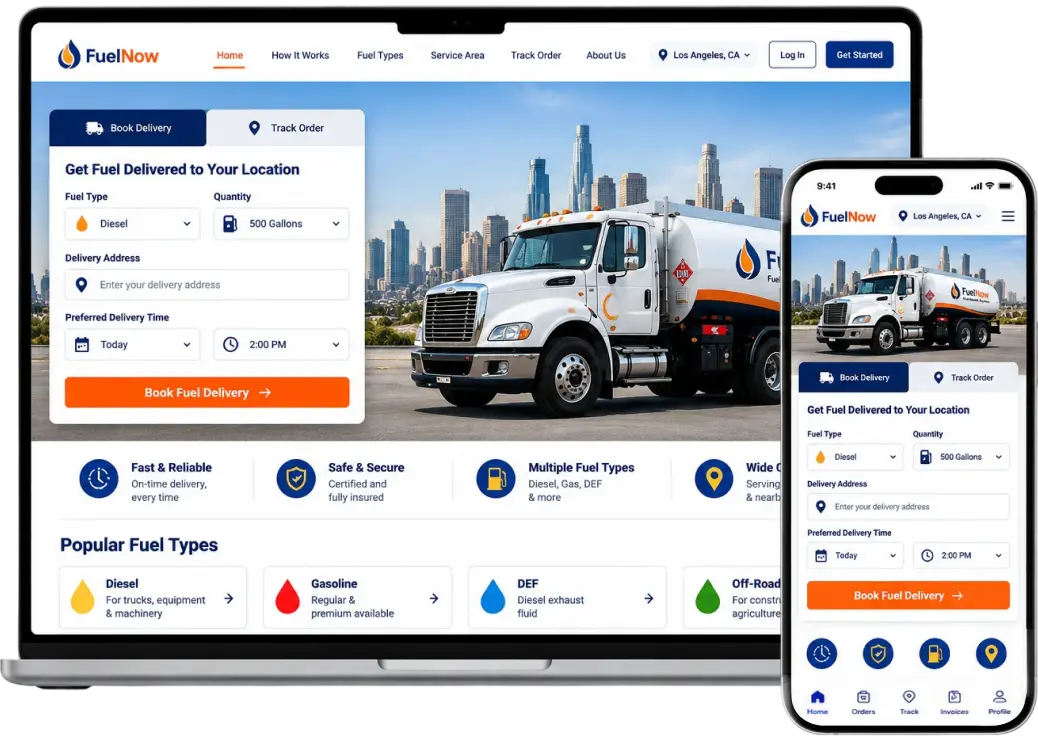






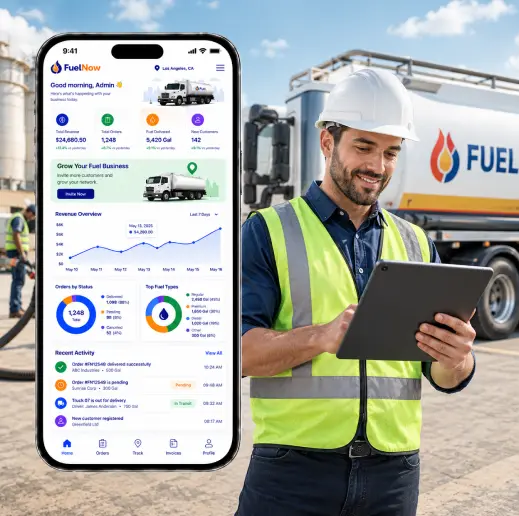
Our client had been selling fuel in bulk to local businesses and factories for years. It was steady work, but the business wasn't going anywhere. Orders picked up in some seasons and dried up in others, profits were thin, and the owner kept coming back to the same question: how do you grow without risking money you can't afford to lose?
The answer they chose was smaller than most people would expect. Instead of buying several trucks and building a full delivery operation right away, the client bought one truck and started offering fuel delivery on the side. They focused on customers who needed regular fuel drops but didn't want the hassle of driving to a station or signing a long-term supply deal: construction crews, small trucking outfits, farms, and local shops.
There was no plan to compete with the big delivery companies. The goal was much simpler: use one truck and real customers to find out if people actually wanted this service, before spending any more money on it.
The client had a practical goal: start small, prove the business model, and expand only when there was clear evidence of demand. Rather than making a significant upfront investment, they wanted to launch an on-demand fuel delivery service that could operate efficiently from day one while creating a foundation for future growth.
Their objectives were clear:
The objective wasn't to build a large operation overnight. It was to establish a sustainable business model, learn from real customer demand, and scale the business with confidence.

Starting with a single fuel truck gave the client a low-risk way to enter the market, but it also highlighted several operational challenges that needed to be addressed before the business could scale.

Most fuel delivery software on the market is built for fleets, not for a single truck. Anything the client adopted had to earn its keep at a much smaller scale, or it wasn't worth the cost.
Orders came in by phone and text. During busy stretches, that meant missed requests and no reliable record of what had actually been promised to which customer.
Everything lived in spreadsheets and paper logs. It held up when volume was low, but even a modest uptick in orders started producing errors and double-bookings.
The owner had no way to see where the truck was mid-route, how many stops were left, or whether the driver was running on time. Every check-in meant a phone call.
New customers weren't sure what to expect. Would the truck actually show up on time? Was paying online safe? Those doubts were enough to stall a first order.
With only one truck on the road, there was no margin for a bad route or a missed window. A single inefficient day showed up directly in that day's revenue.
None of these were dramatic on their own, but together they set a hard limit on how far the business could grow with the tools it had. Adding more trucks wouldn't have fixed any of it; it would have just made the same problems bigger.

We built a fuel delivery platform sized for exactly where the client was starting, not where a large competitor might be. The priority wasn't a feature-heavy system; it was giving a one-truck operation what it needed to run smoothly, with the ability to add capacity later without switching platforms entirely.
With the platform in place, the client could:
Over the following months, the platform became the thing the business actually ran on. As the owner's confidence in the model grew, the platform simply absorbed more volume; no new system required, no rebuild.
Within the first two complete booking cycles following the launch, the business began seeing measurable improvements across key conversion and customer engagement metrics.
| Component | Technology Used | Business Purpose |
|---|---|---|
| Mobile Apps | Native iOS and Android Apps | Let customers and drivers order and deliver without friction |
| Backend | Cloud-Hosted Infrastructure | Keep the system reliable and ready to scale |
| Real-Time Tracking | GPS-Based Location Services | Show live delivery status to the business and the customer |
| Route Optimization | Mapping and Routing APIs | Plan efficient delivery sequences automatically |
| Payments | Secure, PCI-Compliant Payment Gateway | Process transactions safely and speed up cash flow |
| Admin Dashboard | Web-Based Management Console | Give the owner one place to run orders, drivers, and deliveries |
| Analytics | Reporting Tools Built into the Dashboard | Surface the data behind expansion decisions |
Every feature below solved a specific problem the client was facing day to day; none were added just because they were possible to build.
Ordering fuel took minutes instead of a phone call, and customers could see their order status without asking. That alone changed how the service felt, less like a favor from a small operator, more like a real business.


Routes, order details, and delivery instructions landed directly on the driver's phone. Less back-and-forth, faster stops.
The owner could see every order, every driver, and every delivery in progress from a single screen no more piecing it together from calls and spreadsheets.


Taking orders digitally cut out the missed calls and mixed-up requests that had been quietly capping how much business the truck could actually handle.
Customers could book ahead instead of calling same-day, which let the business plan routes instead of scrambling to react to them.


This one mattered more than any other feature. With a single truck, every extra mile costs real money. Automated routing meant more stops per day, less fuel burned, and customers who didn't have to guess when the truck would show.
Being able to see the delivery on its way cut down on "where's my order" calls and gave first-time customers a reason to trust the service enough to order again.


No more chasing cash or waiting on invoices. Payment happened at the point of order, which meant the business actually had the cash on hand it had earned.
Every order had a timestamp and a record, which made billing, customer questions, and planning far less of a guessing game.


The data showed the owner which zones and time slots were busiest the same data that eventually made the case for buying a second truck.
Every one of these features exists because it solved a real problem the client had, not because it was possible to build.
By the end of the first year, the change was clear:
The growth wasn't a result of adding trucks and hoping for the best. It came from proving the model first, then expanding once the numbers said it was time.


"We didn't want to invest in a large fleet before proving there was enough demand. Starting with one truck was a calculated decision, and we needed a technology partner who understood both our business and our long-term vision. The Guru TechnoLabs team took the time to understand how we operated, identified opportunities to simplify our workflows, and built a platform that fit our business instead of forcing us to change the way we worked. We went from managing orders over the phone to running the entire operation from a single dashboard with complete visibility. As demand grew, the platform scaled with us, allowing us to expand at the right pace. Today, fuel delivery has become one of the most reliable and profitable parts of our business, and we have the confidence to keep growing."
- Founder of Fuel Delivery BusinessStart small and scale strategically. One truck was enough to test the model without putting real capital at risk.
Validate demand before expanding. The decision to grow the fleet came from order and route data, not a hunch.
Digital operations remove hidden inefficiencies. Getting off phone orders and spreadsheets closed gaps that had been quietly limiting growth.
Route optimization has an outsized impact on small fleets. With few vehicles, efficient routing is often the line between breaking even and turning a profit.
Customer trust is built through visibility. Real-time tracking and secure payments did more for retention than any marketing push.
The right platform grows with the business. Because the system was built to scale from day one, expansion meant adding capacity, not starting over.
Whether you're starting with one truck or planning a bigger rollout, the right platform is what separates a risky bet from a validated, scalable business.
Cutting-edge technology for modern businesses.

Transparent communication and on-time delivery.
Skilled professionals dedicated to your success.
Solutions that drive growth and measurable results.
We have fulfilled the demands of clients working in different industries. For more details, check what our clients say about us.

Israel
We worked with Liron Feigenbaum on a UI/UX and mobile app development proje...

United States
Hi, my name is Tiami. I was looking for an overseas company and found Guru ...

United Kingdom
Hi, I am Doski. I work with Guru TechnoLabs' team and I am very happy...

Australia
We commissioned and adopt a website from Guru TechnoLabs. Website require...
Share your business needs or project requirements with us & we will get back to you quickly.



