
Fuel Distribution & Energy

United States
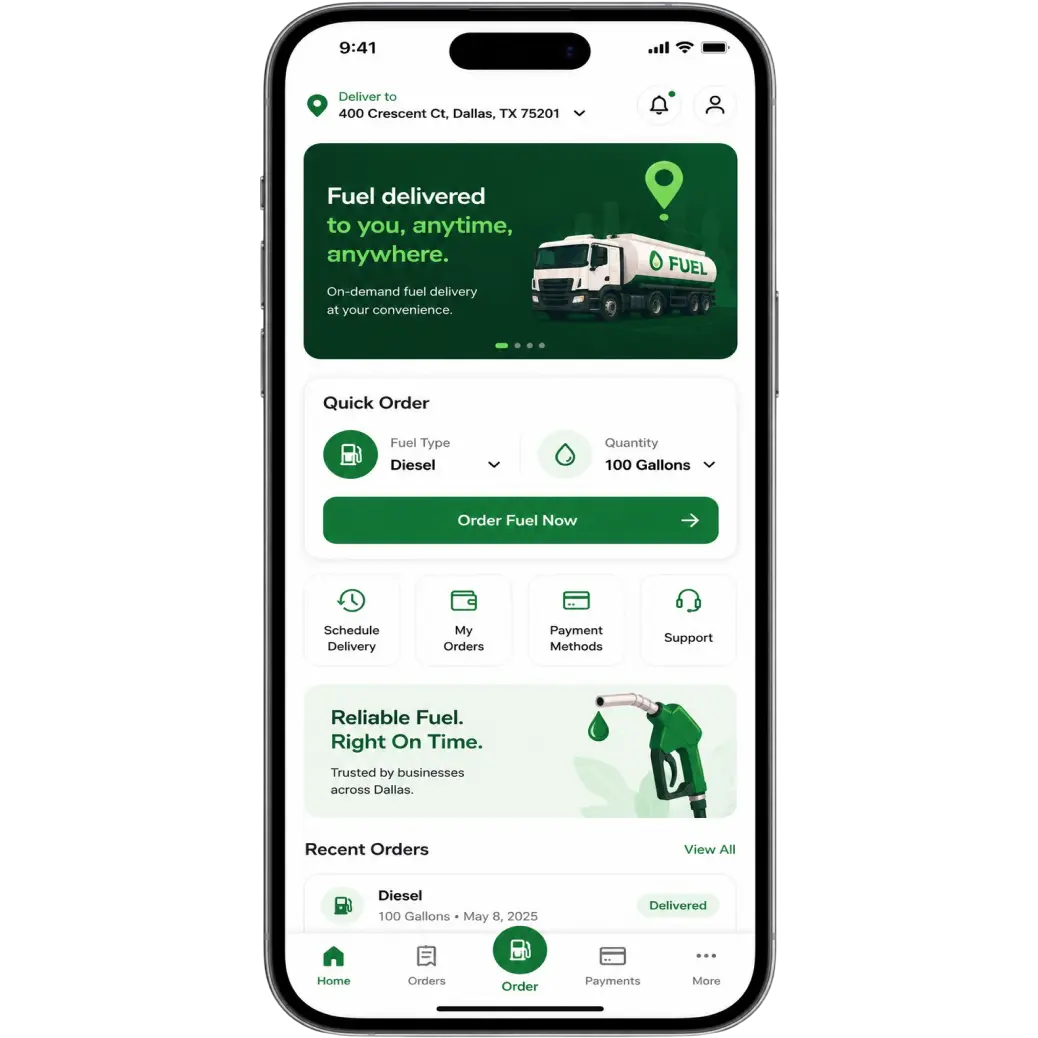






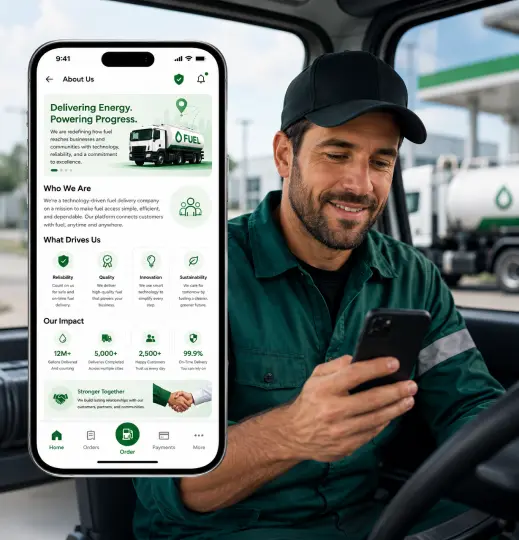
Our client is an established regional fuel retail and distribution business that has operated for over a decade in a growing metropolitan market in the United States. The company runs a network of company-owned fuel stations and a bulk distribution arm that supplies diesel and petroleum products to commercial accounts across the region.
Their customer base is broad. On the retail side, they serve everyday motorists through their forecourt operations. On the commercial side, they supply fleet operators, construction firms, agricultural operations, backup power generators, and small industrial units that depend on reliable access to fuel to keep their operations running.
At the point we began working together, the business was solidly profitable but firmly rooted in a traditional operating model. Fuel moved through two channels: customers came to the station, or the distribution team fulfilled scheduled bulk contracts. It was a stable, revenue-generating business but one that had started to feel the ceiling of a physical, station-dependent model.
The leadership team came to us with a clear commercial ambition rather than a technology wish list. They wanted to grow fuel volume without simply building more stations, an approach that carries high capital cost and long payback periods.
Their objectives were straightforward:
In short, the client wanted to turn fuel delivery from an occasional, manually coordinated service into a scalable, self-serve business line that could grow independently of their real estate.

To identify the root cause of booking abandonment, we looked beyond analytics dashboards and examined the booking journey from the traveler's perspective. This approach uncovered five interconnected challenges that were creating friction, increasing uncertainty, and ultimately preventing users from completing their bookings.

The pressure behind this ambition was real. Demand for delivered fuel, particularly among fleet operators and businesses running generators or off-grid equipment, was clearly rising in the region. Yet the client's fuel sales had plateaued. The demand existed; the business simply had no efficient way to capture it.
Several operational and commercial constraints were holding growth back.
Revenue was concentrated in the forecourt. The overwhelming majority of sales depended on customers physically arriving at a station. When walk-in traffic flattened, so did revenue, and the business had no second engine to compensate.
Customers had no convenient way to order fuel remotely. Commercial buyers who wanted fuel delivered had to call, negotiate timing, and wait for a callback. Many simply took their volume elsewhere, to competitors who had begun offering digital ordering.
Dispatch and order management were manual. Orders were captured on phone and paper, then coordinated informally between the office and drivers. This introduced errors, slowed fulfillment, and made it nearly impossible to scale volume without adding administrative headcount.
Delivery operations lacked visibility. Once a truck left the depot, the office had little insight into where it was, whether a delivery had completed, or how efficiently the day was running. Customers, in turn, could not be told reliably when their fuel would arrive.
Fleet utilization was inefficient. Memory and habit rather than data planned routes. Trucks ran partial loads, backtracked across the service area, and sat idle during coordination gaps Individually, each issue was manageable. Together, they capped the business at the volume a manual process could physically coordinate and left a visible, growing pocket of demand unserved.

We approached the engagement as a business problem first and an engineering problem second. The goal was not to build an app; it was to build a new, scalable revenue channel with the operational discipline to run it profitably.
Working closely with the client's operations leadership, we designed and developed an on-demand fuel delivery platform that connected three groups the business had never before linked in a single system: the customer placing the order, the driver fulfilling it, and the operations team coordinating everything in between.
For customers, the platform turned fuel ordering into a simple digital transaction. They could request delivery to a site or address, choose quantity and fuel type, schedule the timing that suited them, pay securely, and track their order to arrival without a single phone call.
For the client, the platform did something more strategic. It replaced informal, memory-driven coordination with a centralized operating system for the entire delivery business. Orders flowed automatically into a dispatch queue. Deliveries were assigned to drivers and routed intelligently. Every truck's position and status was visible in real time. And the whole operation was measurable, which meant it was now something the business could actively manage and grow.
Critically, we architected the platform to scale. The client did not want a tool that worked for fifty orders a week and broke at five hundred. We built the system so that adding drivers, service zones, or order volume was a matter of configuration rather than re-engineering, allowing the new channel to expand as demand grew without a proportional increase in administrative effort.
The two sides reinforced each other in practice: simpler ordering brought in more customers, while automated operations gave the business the capacity to fulfill that demand without straining its back office.
We selected technologies that balanced fast delivery, long-term maintainability, and the ability to scale as order volume increased.
Flutter
React
Node.js
REST APIs
PostgreSQL
Google Maps API
Stripe
Firebase
AWS
Docker
The stack was chosen to support the operational reality of a delivery business: real-time coordination, location awareness, secure transactions, and headroom to grow.
Every feature was designed to solve a specific business problem, not simply to add functionality.
Gave commercial and residential customers a self-service ordering channel, removing the phone-and-callback friction that had been sending demand to competitors. It became the primary entry point for the new delivery business.


Equipped drivers with their assigned orders, optimized routes, and delivery confirmation in one place, replacing verbal instructions and paperwork, reducing errors, and speeding up each stop.
Gave the operations team a single command center to manage orders, drivers, fleet, and deliveries. What previously required constant phone coordination now happened through one screen.


Automated the capture, validation, and routing of every order into the dispatch queue, eliminating manual re-entry and allowing the business to process far higher volume without adding admin staff.
Gave both the operations team and the customer visibility into where a delivery was and when it would arrive, improving customer confidence and reducing the "where is my order?" calls that consumed staff time.


Planned efficient delivery routes based on location and load rather than habit, cutting mileage and time per delivery and letting each truck complete more orders per shift.
Provided a live view of vehicle availability, assignments, and utilization, helping the business get more productive hours out of the same fleet.

Allowed customers to book delivery windows and let operations plan capacity in advance, smoothing demand and improving fulfillment reliability.
Enabled customers to pay digitally at the point of order, accelerating cash flow and removing collection friction from the delivery process.


Kept customers informed at each stage: order confirmed, driver dispatched, delivery completed, reinforcing the reliability that commercial buyers weigh when choosing a fuel supplier.
Made repeat ordering effortless for regular commercial buyers, encouraging the recurring business that underpins a stable delivery channel.

Turned the delivery operation into measurable data volumes, delivery times, route efficiency, and revenue, giving leadership the visibility to manage and grow the channel deliberately.
Within the first twelve months of operating the platform, the on-demand delivery channel moved from a standing start to a meaningful contributor to the business.
Total fuel volume grew by approximately 24%, driven almost entirely by the new delivery channel rather than by additional forecourt traffic.
The delivery channel accounted for roughly 18% of total fuel volume within a year, a genuinely new revenue stream where none had existed before.
Average order fulfillment time fell by about 35%, as automated dispatch and routing replaced manual coordination.
Fleet utilization improved by around 30%, with route optimization allowing each truck to complete more deliveries per shift.
Repeat ordering among commercial customers climbed to roughly 60% of monthly delivery volume, supported by saved order history and reliable, trackable delivery that made re-ordering effortless.
Administrative effort per order fell substantially as the operations team processed several times the previous order volume without adding back-office headcount, as automated capture and dispatch removed manual re-entry.
Order-status inquiries to the office dropped by more than half, as real-time tracking and notifications answered the "where is my delivery?" question before customers had to ask.
Just as importantly, the business gained something it had never had before: a scalable growth engine that did not require building another station.


"For years, our growth depended almost entirely on people coming to our fuel stations. We knew there was growing demand for fuel delivery, but we didn't have the right platform to turn that demand into a scalable business. Working with the team changed that. They took the time to understand how our operations worked, the challenges our drivers and dispatch teams faced, and what our customers actually needed. The result wasn't just a new application it was a new revenue stream for our business. Today, we can serve customers wherever they are, manage deliveries far more efficiently, and have complete visibility into our operations. Most importantly, we now have a platform that's built to grow with our business, not hold it back."
- Director of OperationsConvenience creates new revenue. Rising demand for delivered fuel existed long before the platform did; the business simply had no efficient way to capture it. Removing ordering friction unlocked sales that were already available.
Growth doesn't have to mean more real estate. A digital delivery channel let the client expand fuel volume without the capital cost and long payback of building additional stations.
Automation is what makes new channels scalable. Digital ordering alone would have overwhelmed a manual back office. Automating dispatch, routing, and payments is what allowed volume to grow without proportional cost.
Real-time visibility improves both operations and trust. Seeing where every delivery is on the operations side and the customer side reduced coordination overhead and built the reliability that recurring commercial business depends on.
Data turns a service into a business line. Once the delivery operation became measurable, leadership could manage it deliberately, optimize it, and grow it with confidence.
Architecture-first thinking protects the investment. Building for scale from the start meant the client could grow the channel through configuration rather than costly rebuilds.
If your fuel sales are constrained by a station-dependent model while demand for delivery keeps rising, a well-architected digital platform can turn that unmet demand into a scalable revenue stream. We help fuel and energy businesses design integration-heavy, automation-driven systems built to grow with them.
Cutting-edge technology for modern businesses.

Transparent communication and on-time delivery.
Skilled professionals dedicated to your success.
Solutions that drive growth and measurable results.
We have fulfilled the demands of clients working in different industries. For more details, check what our clients say about us.

Israel
We worked with Liron Feigenbaum on a UI/UX and mobile app development proje...

United States
Hi, my name is Tiami. I was looking for an overseas company and found Guru ...

United Kingdom
Hi, I am Doski. I work with Guru TechnoLabs' team and I am very happy...

Australia
We commissioned and adopt a website from Guru TechnoLabs. Website require...
Share your business needs or project requirements with us & we will get back to you quickly.



