
Travel

Website
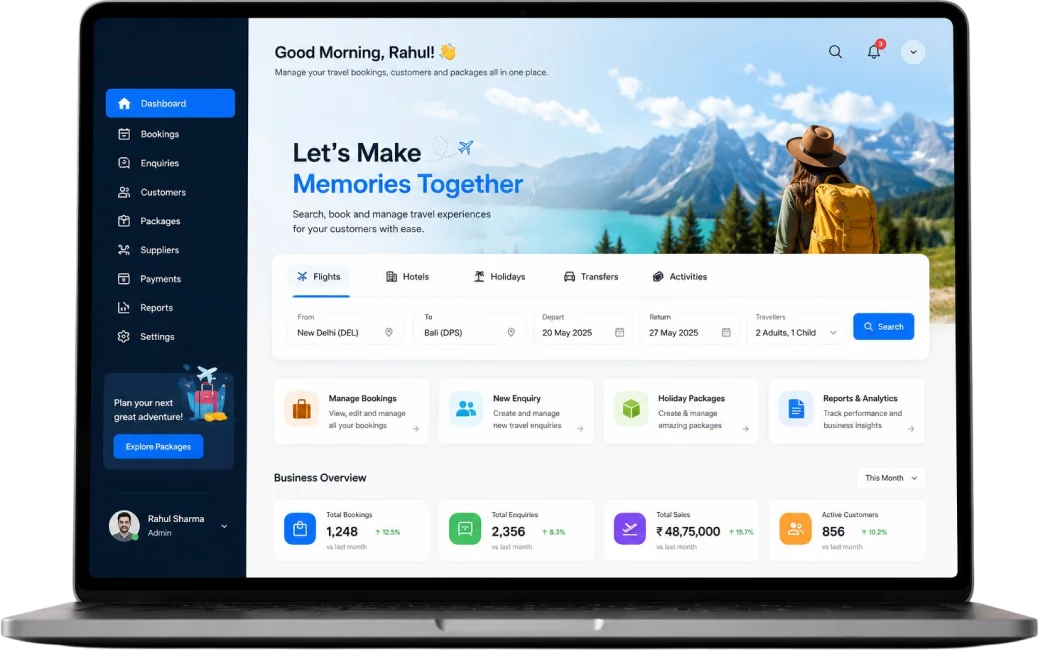






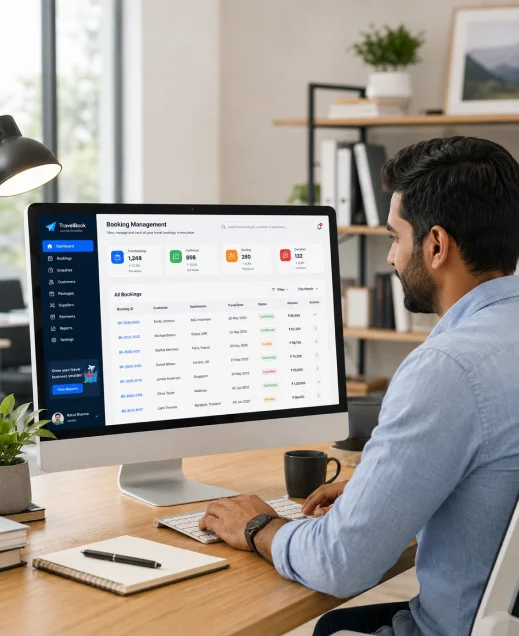
The client is an established mid-market travel agency and corporate travel provider based in the Gulf region, serving a mix of corporate accounts, group travel, and outbound leisure customers. What began as a small agency handling walk-in and phone bookings had, over a decade, matured into a multi-branch business managing a steady flow of complex, multi-component itineraries spanning airfare, accommodation, visa coordination, ground transport, and corporate travel programs.
Their reservations and travel operations department numbered close to 35 staff across booking, corporate desk, ticketing, and after-sales support. Because much of their corporate business ran on tight service-level expectations, the speed and accuracy of each booking wasn't just an internal metric; it directly shaped client retention and contract renewals.
The underlying issue was a familiar one for a business at this stage: growth had outpaced the systems supporting it. Corporate contracts were expanding and booking complexity was rising, but the team was still running day-to-day operations on tools and habits designed for a far smaller volume. Handling more business increasingly meant adding more people and more manual effort, and leadership recognized that this model would not hold as the company continued to grow. Operational efficiency had moved from a nice-to-have to a strategic priority.
Leadership wanted more than a surface-level fix. The goal was to change how bookings actually moved through the organization. Specifically, the client set out to:
In short, they wanted the business to be able to grow booking volume without growing headcount at the same rate. That single objective shaped every decision that followed.

Before any solution could be designed, Guru TechnoLabs spent time inside the client's day-to-day operations. What emerged was a set of workflow problems that compounded one another.

Bookings were assembled by hand, often across spreadsheets, email threads, and supplier portals. A single itinerary might touch four or five separate tools before it was complete, with no system tying them together.
Reservations lived in one place, customer details in another, supplier confirmations in inboxes, and financials in yet another. Because these systems did not talk to each other, the team became the integration layer, manually carrying information from one place to the next.
The same booking details were re-entered several times as a reservation moved from inquiry to confirmation to invoicing. This was slow, and every re-entry was an opportunity for a mistake.
Wrong dates, mismatched supplier confirmations, and outdated pricing surfaced regularly. Each error consumed time to detect and correct, and some reached the customer before they were caught.
Because so much of the work was manual and sequential, turnaround times were longer than the business wanted, especially during peak season when volume spiked.
Managers had no reliable, real-time view of what was in progress, what was stuck, or where bottlenecks were forming. Status updates depended on asking individuals directly.
Handoffs between reservations, supplier coordination, and customer service were informal. Ownership of a booking was often unclear, leading to duplicated effort or dropped tasks.
When a booking changed, someone had to update every affected system by hand and notify everyone involved, which rarely happened consistently.
Leadership struggled to answer basic operational questions: how many bookings were processed last week, where delays occurred, and how workload was distributed. Reporting was assembled manually and was often outdated by the time it was ready.
None of these problems were catastrophic on their own. Together, they created constant operational drag that quietly capped how much the business could handle.

Guru TechnoLabs designed and built a centralized booking system to replace the patchwork of disconnected tools with one platform that the entire operations team worked from. The guiding principle was architecture-first: rather than digitizing the old broken process, we redesigned how a booking moves through the business and built the system around that flow.
The platform unified booking operations end to end. From the moment an inquiry entered the system to final confirmation and invoicing, every step lived in one place, with a single, consistent record for each booking. This alone removed the need for the team to act as a manual bridge between tools.
We automated the repetitive tasks that had been consuming the team's time, including data propagation across steps, status updates, and routine notifications. Work that had required manual attention now happened in the background, freeing staff to focus on higher-value coordination and customer care.
Booking management was simplified into a structured, guided workflow, so every booking followed the same reliable path regardless of who was handling it. Customer and booking information was centralized into a single record, eliminating duplicate data entry and the errors that came with it.
Internal collaboration improved because ownership, status, and next steps were now explicit and visible to everyone involved. And by giving managers a real-time operational view, the platform turned visibility from a manual question-and-answer exercise into something available at a glance.
Every improvement was tied to a concrete business outcome: less manual work, fewer errors, faster processing, and the capacity to handle more volume with the same team.
The technology was chosen to be dependable and scalable rather than novel for its own sake, with an emphasis on a stable, integration-ready architecture that could grow with the business.
| Layer | Technology Used | Why It Was Chosen |
|---|---|---|
| Frontend | React | A fast, responsive interface that worked cleanly across desktop and tablet for the operations team. |
| Backend | Node.js | A structured API layer exposing well-defined services for bookings, customers, suppliers, and reporting. |
| APIs & Integrations | REST APIs & Webhooks | Automated exchange of booking data with third-party suppliers and downstream tools, removing manual entry. |
| Database | PostgreSQL | Reliable, relational storage suited to the transaction-heavy nature of booking data. |
| Cloud Infrastructure | AWS | Managed hosting, automated backups, and the ability to scale during peak booking periods. |
| Reporting & Analytics | Analytics & Dashboard Layer | Live operational metrics surfaced to managers without manual report-building. |
Each feature was designed to solve a specific operational problem the client had described.
A single screen showing all active bookings and their status. The team no longer had to check several tools to understand what was in progress, which cut wasted time and reduced things falling through the cracks.


A structured, guided booking workflow that standardized how every reservation was created, updated, and confirmed. This made processing faster and far more consistent across the team.
A centralized customer record holding contact details, history, and preferences. Staff could pull up everything about a customer instantly, improving both speed and service quality.


Routine steps such as status changes, data updates, and internal handoffs were automated. This removed a large share of the repetitive manual work and reduced the errors that came with it.
Every booking carried a live status visible to the whole team. Coordination improved because no one had to chase colleagues for updates.


Clear ownership of each booking, with the ability to assign and reassign work. This eliminated confusion over who was responsible and balanced workload across the team.
Automated alerts for changes, approaching deadlines, and required actions. Fewer bookings stalled because the system prompted the right person at the right time.


Live operational metrics on volume, turnaround times, and workload distribution. Leadership could finally make decisions based on current data instead of manually compiled, outdated reports.
Fast search across bookings and customers with flexible filtering. Finding a specific booking became instant instead of a manual hunt across systems.


Permissions aligned to each team's responsibilities. This kept data secure, reduced accidental changes, and gave each team a focused, relevant view of their work.
Within a few months of adopting the centralized booking system, the operational improvements were clear and measurable.
The headline outcome was an approximately 30% increase in operational efficiency, measured by the volume of bookings the team could process within the same working hours. Booking processing became noticeably faster, as automation and a single source of truth removed the delays caused by manual data movement and system-switching.
Booking errors dropped significantly, driven largely by the elimination of duplicate data entry and the standardization of the booking workflow. Less rework followed directly from fewer errors, returning time to the team that had previously been spent on corrections.
The volume of repetitive manual work fell sharply, allowing staff to spend more of their day on coordination and customer-facing activity rather than data handling. Staff productivity improved as a result, and the team reported that the work itself felt less fragmented and less stressful.
Managers gained real operational visibility for the first time, which made it easier to spot bottlenecks early and distribute work more evenly. And because bookings were processed faster and more accurately, customers experienced fewer mistakes and quicker responses, which lifted overall customer satisfaction.
Critically, the business achieved all of this without a proportional increase in headcount, meaning it could now grow booking volume without growing operational overhead at the same pace.


"Before this project, our team was working incredibly hard just to keep up, and every busy season stretched us to the limit. The centralized booking system changed that. Managing bookings is far simpler now, our team gets through more work with less effort, and the errors that used to eat up our days have largely disappeared. Just as importantly, I can finally see what's happening across our operations in real time. Guru TechnoLabs took the time to understand how we actually work before building anything, and it shows in the result. We now have room to grow without feeling like we're constantly one step behind."
— Owner of Travel AgencyThe engagement offers several practical lessons for any travel business facing similar operational pressure.
Automation reduces manual work and human error together. Automating repetitive steps does more than save time; it removes the re-entry and hand-off points where most errors originate.
Better visibility leads to better decisions. Real-time operational data lets managers spot problems early and allocate work intelligently, rather than reacting after the fact.
Simplified, standardized workflows help teams scale. When every booking follows the same reliable path, adding volume or people becomes far less disruptive.
Efficiency compounds into customer experience. Faster, more accurate internal operations translate directly into fewer mistakes and quicker responses for customers.
Growth should not require proportional overhead. The right architecture lets a business handle more volume without hiring at the same rate, protecting margins as it scales.
If outdated workflows are holding your travel business back, a centralized booking system can transform how your team operates. Guru TechnoLabs designs architecture-first, automation-driven platforms built for scale.
Cutting-edge technology for modern businesses.

Transparent communication and on-time delivery.
Skilled professionals dedicated to your success.
Solutions that drive growth and measurable results.
We have fulfilled the demands of clients working in different industries. For more details, check what our clients say about us.

Israel
We worked with Liron Feigenbaum on a UI/UX and mobile app development proje...

United States
Hi, my name is Tiami. I was looking for an overseas company and found Guru ...

United Kingdom
Hi, I am Doski. I work with Guru TechnoLabs' team and I am very happy...

Australia
We commissioned and adopt a website from Guru TechnoLabs. Website require...
Share your business needs or project requirements with us & we will get back to you quickly.



