How to Develop a Web Application (Step-by-Step Guide)

Web applications are no longer optional, they are essential for modern businesses. Web app development helps companies streamline workflows, improve user engagement, and build scalable digital solutions for internal teams and customer-facing platforms.
Whether you want to develop a web app for internal operations or launch a SaaS product, a well-planned approach is critical. This guide explains how to develop a web application step by step, covering planning, design, development, security, and scalability.
What is a Web Application?
A web application is software that runs in a browser and allows users to perform tasks, manage data, and interact with systems online. What is web app development? It refers to the process of designing, building, testing, and maintaining these interactive browser-based applications.
If you want to explore real-world use cases, these web app examples show how businesses apply web applications across industries.
Examples include task management tools, CRM platforms, and online booking systems. Different products fall under different types of web applications, depending on their functionality and complexity.
Web App vs Website
Web applications and websites serve different purposes, even though both run in a browser.
A website mainly delivers information, while a web application allows users to perform actions, submit data, and interact with systems in real time. This detailed comparison of website vs web application explains the technical and functional differences in depth.
From a business perspective, web applications reduce distribution costs, simplify updates, and enable faster iteration, making them ideal for scaling teams and global users.
Web App vs Desktop App
Desktop applications require installation on a specific device, while web apps are accessible through any modern browser. This makes web apps easier to maintain and update across teams and locations.
If you’re deciding between these options, this guide on web app vs desktop app breaks down accessibility, updates, maintenance, and cost considerations.
Do you want to develop a web app?
Unlock the full potential of your custom-built web app. Take the first step towards developing and start growing your business today!
Why Businesses Choose Web Applications
Businesses invest in developing a web application because it delivers measurable operational benefits.
Web apps:
- Improve accessibility across devices
- Scale as business needs grow
- Automate repetitive workflows
- Centralize updates and maintenance
For growing teams and customer-facing platforms, web applications offer flexibility that traditional software often cannot.
For example, internal web apps can reduce manual operational effort by centralizing data and automating workflows, while customer-facing web apps enable faster onboarding and self-service.
12 Steps to Develop a Web Application
A structured development process helps businesses reduce risk, manage costs, and build a web app that can grow over time. Rather than jumping straight into development, following clear steps ensures each decision—from idea validation to technical planning supports real user needs and business goals. This makes the application more stable, easier to build, and simpler to improve as requirements change.
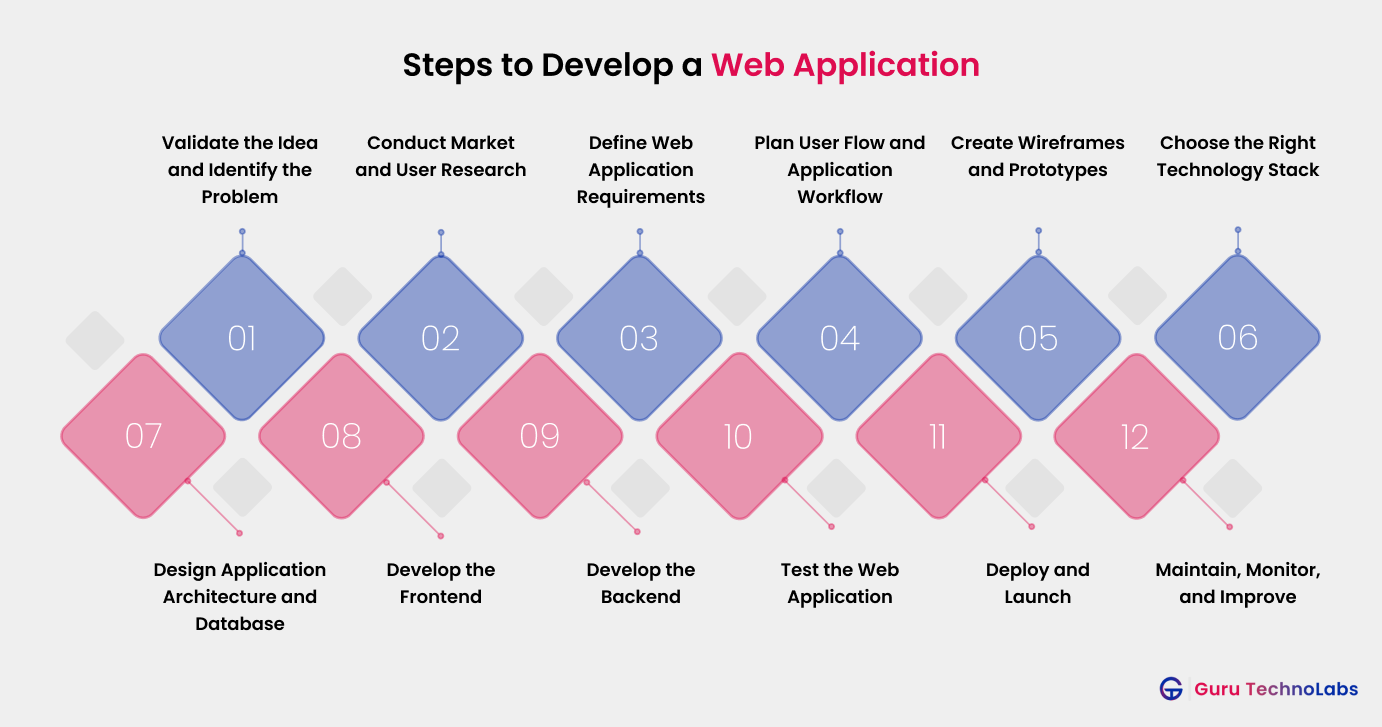
1. Validate the Idea and Identify the Problem
Validating demand early reduces the risk of building features that never get adopted, one of the most common reasons web applications fail.
2. Conduct Market and User Research
Market and user research helps you understand target users, competitors, and industry trends. Analyzing similar products reveals what works, what doesn’t, and where gaps exist. These insights guide smarter feature and positioning decisions.
3. Define Web Application Requirements
Well-defined requirements prevent scope creep, control development costs, and ensure every feature aligns with business and user goals.
Do you need help to decide features of your web app?
Let us help! Contact us now to schedule a free consultation. Our team
can assist with your web app features and development needs.
4. Plan User Flow and Application Workflow
Planning user journeys and workflows creates a logical structure that improves usability and reduces friction across the application.
5. Create Wireframes and Prototypes
Wireframes and prototypes allow early usability testing, helping teams fix design issues before development begins.
6. Choose the Right Technology Stack
Selecting the right technology stack for web development ensures better performance, scalability, and easier maintenance as your web application grows.
7. Design Application Architecture and Database
A well-planned architecture separates frontend, backend, and data layers for better scalability. Database design ensures efficient data storage and faster queries. This foundation supports future integrations and performance optimization.
Need an easy to use and elegant web app design?
Discuss your project idea with us. With our web application design service we
help your build create a custom-designed web application.
8. Develop the Frontend
Frontend development focuses on building responsive layouts and intuitive interfaces. It ensures consistency across devices and browsers while maintaining accessibility standards. A strong frontend improves engagement and user retention.
Want to Hire Front-end Developers?
Our front-end developers are up-to-date with the latest trends and best practices,
ensuring that your web app stands out from the competition.
9. Develop the Backend
Backend development manages authentication, APIs, and data processing. Choosing the best web application framework reduces stability issues and supports secure, scalable growth over time.
10. Test the Web Application
Testing verifies functionality, performance, and security across multiple environments. Identifying issues early prevents failures after launch. Regular testing improves overall application quality and user trust.
11. Deploy and Launch
Deployment moves the application from development to a live environment. Using cloud platforms and CI/CD pipelines ensures smoother releases and easier rollbacks. A structured launch minimizes downtime and technical risks.
12. Maintain, Monitor, and Improve
Post-launch maintenance keeps the application secure and up to date. Monitoring performance and user behavior helps identify improvement areas. Continuous updates ensure the web app evolves with business and user needs.
Common Mistakes to Avoid in Web App Development
Mistakes during web app development often happen when teams rush planning or focus only on features instead of real user needs. These issues can lead to higher costs, delayed launches, and poor user adoption. When businesses develop a web app without validating ideas, selecting the right technologies, or addressing security early, long-term scalability becomes a challenge. Avoiding these mistakes upfront helps ensure smoother development and stronger performance.
Common mistakes to watch out for:
- Skipping MVP validation: Launching a full product without testing a minimum viable version increases the risk of building features users don’t actually need.
- Choosing the wrong tech stack: An unsuitable tech stack can limit performance, scalability, and future integrations as the application grows.
- Ignoring security early: Failing to follow proven web application security best practices from the start can expose your app to vulnerabilities and costly fixes later.
- Overcomplicating UX: Too many features or a complex interface can confuse users and reduce engagement.
Avoiding these common pitfalls leads to better usability, improved security, and a more scalable web application over time.
Transform your idea into reality with our web development services. Let us help you create an impactful and user-friendly web application.
Cost Optimization Tips for Web App Development
Web app development costs vary based on features, technology stack, design complexity, and long-term scalability needs. Understanding where costs typically increase helps businesses plan smarter and avoid unnecessary spending. A detailed breakdown of web application development cost can further help set realistic expectations before development begins.
Rather than cutting corners, the goal should be to optimize costs while maintaining quality and performance. Strategic planning early in the development process often leads to significant savings later.
Practical Ways to Optimize Web App Development Costs
- Focus on MVP features first: Start with core functionality that solves the main problem. Building a minimum viable product (MVP) helps validate the idea quickly and prevents spending on features users may not need.
- Use open-source frameworks and tools: Leveraging mature open-source technologies reduces licensing costs and speeds up development without compromising stability or security.
- Choose a scalable infrastructure: Avoid overbuilding at launch. Cloud platforms allow you to scale resources gradually as user demand grows, keeping initial costs under control.
- Plan the technology stack carefully: Selecting the right frontend, backend, and database early helps avoid costly rewrites and performance issues later.
- Work with experienced developers:Skilled teams deliver cleaner code, fewer errors, and faster development cycles saving money over the long term.
Optimizing costs is not about building less—it’s about building smart so your web application remains scalable, secure, and cost-effective as your business grows.
Future Trends in Web Application
Web application development continues to evolve as businesses demand faster performance, better user experiences, and scalable architectures. The following trends are shaping how modern web apps are built, maintained, and scaled, and they play a key role in long-term product success.
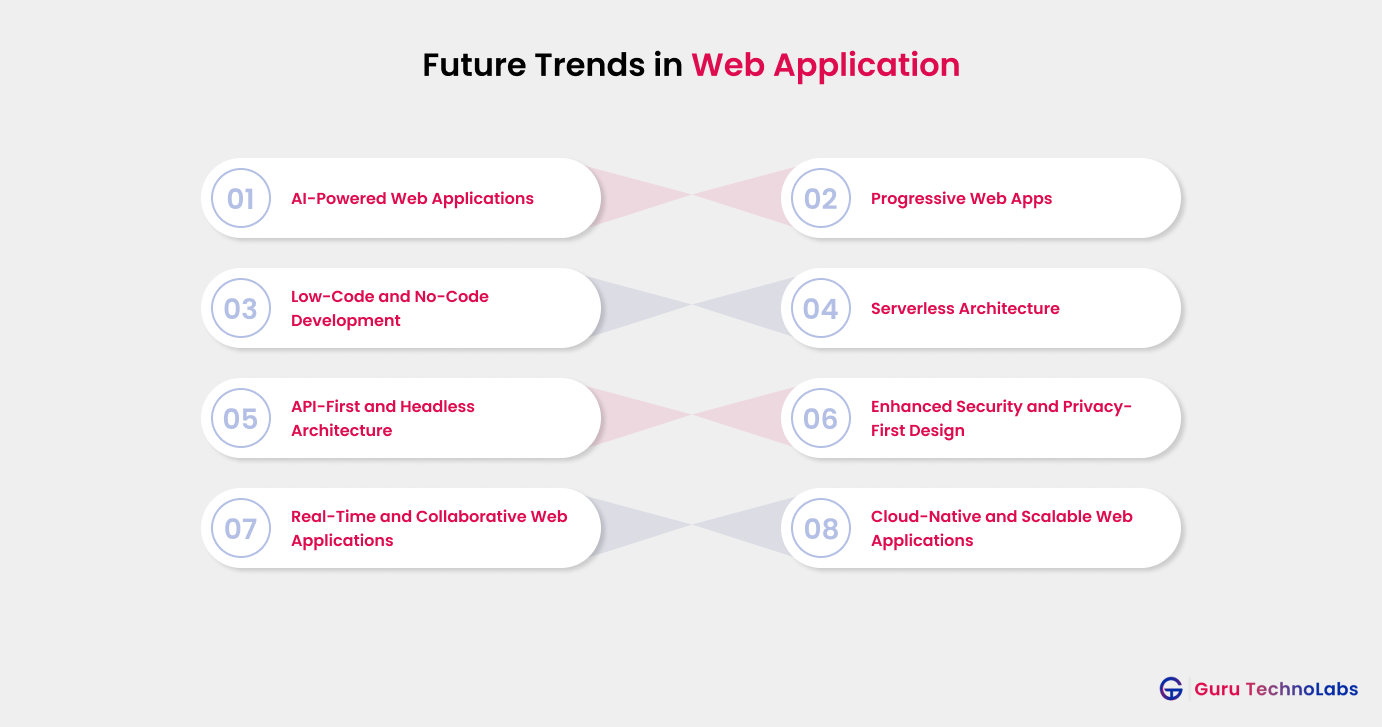
AI-Powered Web Applications
AI-powered web applications use machine learning and automation to deliver smarter, more personalized user experiences. These applications can analyze user behavior, automate customer support through chatbots, generate recommendations, and provide predictive insights. As AI becomes more accessible, web apps are moving from rule-based logic to adaptive systems that respond in real time to user actions.
Progressive Web Apps (PWAs)
Progressive Web Apps combine the reach of web applications with the functionality of native mobile apps. PWAs run in a browser but support offline access, fast load times, and push notifications. This approach allows businesses to deliver app-like experiences without building separate mobile applications, making PWAs a cost-effective and scalable solution.
Low-Code and No-Code Development
Low-code and no-code platforms allow businesses to develop web apps faster by reducing the amount of manual coding required. These tools are commonly used for MVPs, internal dashboards, and workflow automation. While they accelerate development, traditional web app development remains essential for complex, highly customized, or performance-intensive applications.
Serverless Architecture
Serverless architecture enables web applications to run without direct server management, allowing development teams to focus on application logic rather than infrastructure. This model supports automatic scaling, reduces operational costs, and improves reliability. Serverless is particularly useful for event-driven applications and products with fluctuating traffic patterns.
API-First and Headless Architecture
API-first and headless architecture separates the frontend from the backend, allowing each layer to evolve independently. This approach improves flexibility, supports multi-platform delivery, and simplifies integration with third-party services. Web applications built using this model are easier to scale and adapt as new devices and user interfaces emerge.
Enhanced Security and Privacy-First Design
Modern web applications are increasingly designed with security and privacy as foundational elements. This includes strong authentication, encrypted data storage, secure APIs, and compliance with data protection regulations. Security-first development helps prevent breaches, protects user data, and builds long-term trust with customers.
Real-Time and Collaborative Web Applications
Real-time functionality has become a standard expectation in many web applications, especially in productivity and enterprise tools. Features such as live updates, real-time notifications, and collaborative editing improve engagement and efficiency. These capabilities allow users to interact with data and with each other instantly.
Cloud-Native and Scalable Web Applications
Cloud-native web applications are built to scale efficiently using modern cloud infrastructure. By leveraging microservices, containers, and auto-scaling resources, businesses can ensure consistent performance as usage grows. This approach simplifies maintenance and supports long-term application growth.
Build In-House or Hire a Development Company?
Building an in-house team gives you more control, but it also demands strong technical leadership, higher hiring costs, and ongoing management. To reduce risk and speed up development, many businesses prefer working with a reliable web app development company that already has experienced designers, developers, and QA specialists in place.
Guru TechnoLabs is a trusted web app development company that helps businesses build scalable, secure, and high-performance web applications while avoiding the complexities of in-house hiring. Their proven development process ensures faster delivery and predictable outcomes.
If monetization is part of your long-term plan, it’s also important to plan early. Using well-defined web app monetization models helps align your technical decisions with business goals from day one.
Wrapping Up
Building a web application is a structured process that combines planning, design, development, and continuous improvement. By following the right steps to build a web application, avoiding common mistakes, and focusing on security and scalability, businesses can create reliable and high-performing digital products.
Whether you build internally or partner with experienced developers, a well-executed web app supports growth, efficiency, and long-term success.
Frequently Asked Questions
The cost of developing a web application depends mainly on its complexity and features. A simple web app typically costs between $5,000 and $15,000, a medium-complexity app ranges from $15,000 to $50,000, while enterprise-level or highly scalable web applications usually start at $50,000 or more.
Development timelines vary by project scope. A basic web application can take 4 to 8 weeks, a medium-sized app usually requires 3 to 6 months, and complex or enterprise web applications may take 6 to 12 months or longer, including testing and optimization.
A web application is better when users need to interact, perform tasks, or manage data. Websites are primarily informational, while web applications are designed for functionality such as dashboards, bookings, payments, and user accounts.
Hiring a professional web app development company is recommended for customer-facing, scalable, or complex projects, as it ensures quality, security, and faster delivery. Building in-house can work for small internal tools if you already have the technical expertise and resources.
Common types of web applications include static web apps, dynamic web apps, single-page applications (SPAs), progressive web apps (PWAs), and enterprise web applications, each serving different business and user needs.
Web app development typically involves frontend frameworks, backend programming languages, databases, testing tools, CI/CD pipelines, and UI/UX prototyping tools to ensure performance, security, and scalability.
To hire the right web app developer, review their portfolio, assess their technical skills, evaluate their communication and problem-solving abilities, and confirm their ability to provide post-launch support and maintenance.
Yes, low-code and no-code platforms allow you to build basic web applications without programming. However, these tools have limitations when it comes to customization, performance, and scalability, making them less suitable for complex or long-term products.