Web Application Development Cost: Complete Pricing Guide (2026)

If you are planning to build a web application in 2026, you already know that the digital world has changed. We are now in the age of “intelligence-first” software. Users don’t just want a tool that works; they want a smart tool that grows with them, and keeps their data safe without fail.
But with all these new possibilities comes a big question: how much does it cost to develop a web app in today’s market?
You might hear a wide range of numbers. Some might say $20,000, while others suggest $500,000. It can feel like you’re trying to hit a moving target. The truth is that the cost of web application development isn’t just about writing code. It’s about the strategy, the security, and the long-term value you are building for your company.
In this guide, we will walk through every factor that changes the web application development cost. We’ll break down the numbers, look at why some apps cost more than others, and show you how to get the best return on your investment.
Quick Summary
In 2026, web application development cost in the USA typically ranges from $15,000 for MVPs to $500,000+ for enterprise platforms, depending on complexity, features, and compliance needs.
How Much Does It Cost to Develop a Web Application?
To give you a direct answer: most professional web applications built in the USA in 2026 cost between $60,000 and $160,000. However, “web application” is a broad term. It could mean anything from a simple internal tool to a massive global platform. Because the goals are different, the web application development prices change too. Think of it like the difference between a simple digital calculator and a full-scale online banking system.
One is a single-purpose tool used by one person at a time, while the other is a complex network that handles millions of transactions, connects to thousands of databases, and requires high-level security. Both are web applications, but the work required to build them is worlds apart.
When people ask, “How much does a web application cost?”, they are usually looking for a balance between speed, quality, and price. In 2026, the average cost of developing a web app has stayed fairly stable. Even though the technology is more advanced, the tools we use today are faster and more efficient, which helps keep costs from spiraling out of control.
Want to Build a Web App for Your Business?
Don’t miss out on the benefits of a web application. Contact our
experts and discover how a custom web application can drive your success.
Web Application Development Cost Breakdown (By Complexity)
The easiest way to understand the budget you need is to look at the “size” and complexity of your project. Here is how we group the cost to develop web app projects today.
Basic MVP Web Application Cost
Estimated Price: $15,000 – $50,000
A Minimum Viable Product (MVP) is a practical way to start with a limited budget. It allows you to test your idea with real users before investing in a full-scale product.
- What you get: A simple, working web app with around 5–10 screens. This usually includes user sign-up, basic data storage, and one or two core features that solve a clear problem.
- Current Trend: Many MVPs now use serverless technology, which means you only pay for resources when the app is used. This approach supports cost-effective web app development, especially in the early stages.
Mid-Level Web Application Cost
Estimated Price: $50,000 – $150,000
This option is ideal for growing businesses that need more than just a test product. At this stage, the app becomes an important part of daily operations.
- What you get: A custom design that matches your brand, role-based user access (such as admin and customer), and integrations with tools like payment gateways or email platforms.
- Main focus: Performance, reliability, and user experience. This custom web app development cost includes thorough testing to ensure the app works smoothly across all devices.
Enterprise Web Application Cost
Estimated Price: $150,000 – $500,000+
Enterprise web applications are built for large organizations with complex requirements, high traffic, or advanced features such as AI and analytics..
- What you get: Strong security, compliance-ready systems, advanced reporting, and infrastructure designed to handle large volumes of users and data.
- Why the cost is higher: A major part of the web application development cost at this level comes from behind-the-scenes work, including security audits, performance optimization, and building a stable system that can scale without failure.
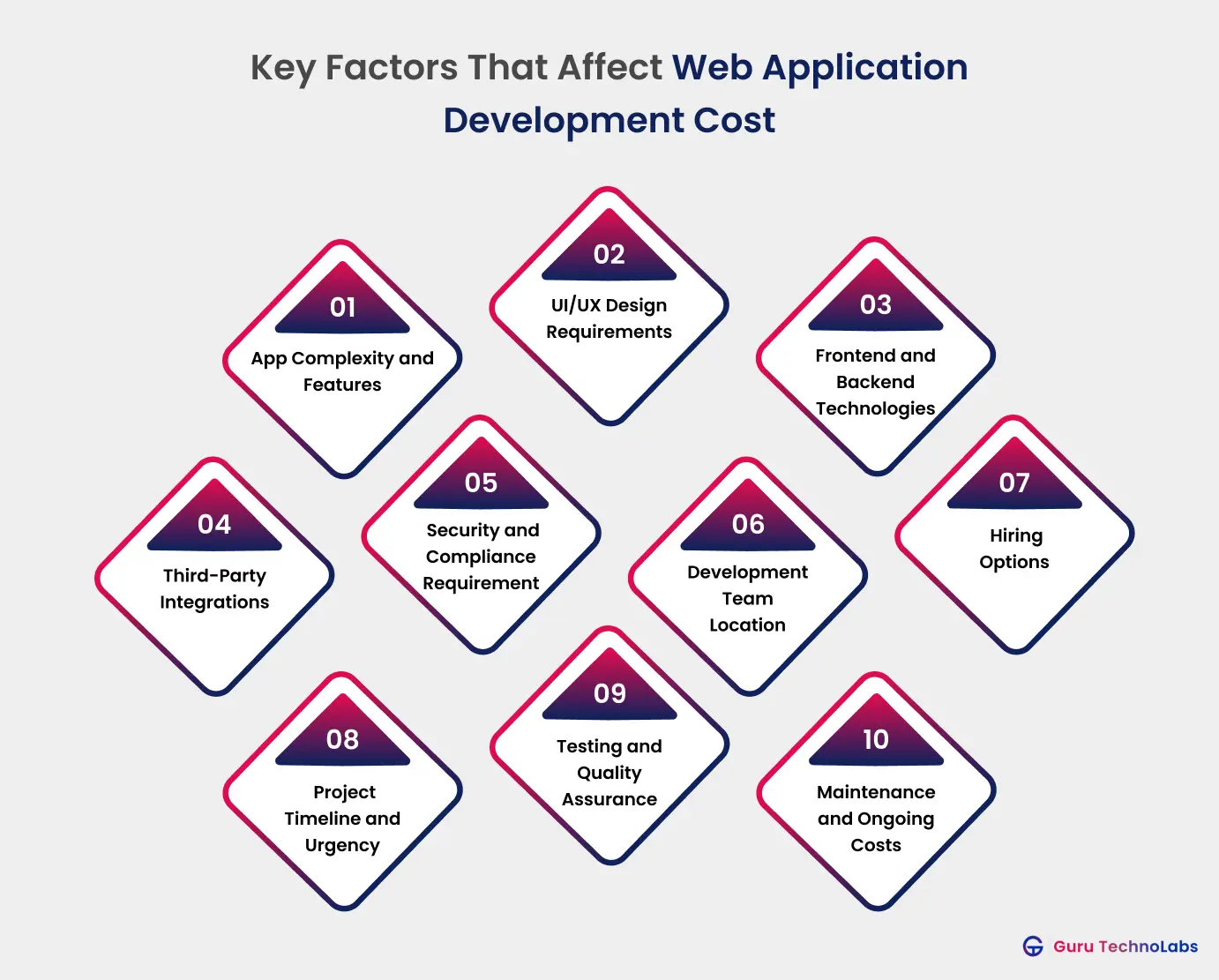
Key Factors That Affect Web Application Development Cost
If you’ve ever wondered why two web apps that look similar can have very different price tags, it usually comes down to a few key factors which we have listed below:
1. App Complexity and Features
This is the biggest factor affecting the cost to develop a web app. Every feature needs to be designed, developed, and tested. A basic web app that only displays information is more affordable. In comparison, apps with real-time chat, online payments, dashboards, or AI features require more time and increase the cost of custom web app development.
Affordable Web Application Development for Your Business
Looking for quality web application development without breaking the bank? Ask our
team how we can deliver a cost-efficient solution for your business.
2. UI/UX Design Requirements
Today, users expect web apps to be simple and easy to use. A good web application design requires research, planning, and testing to ensure users can navigate the app without confusion. A well-designed experience improves engagement but also adds to the overall web application development costs.
Get the Right Functionalities for Your Web Application
Ensure your web application stands out from the competition with the right set of functionalities. Reach out to us to discuss your requirements.
3. Frontend and Backend Technologies
The frontend is what users see and interact with, while the backend handles data, logic, and performance. Choosing modern and widely used technologies can support cost-effective web app development because developers can work faster and use proven tools instead of building everything from scratch.
Invest Wisely in Your Web Application
Find out how you can optimize your budget while developing a high-quality web app. Talk to us and understand the cost breakdown and make an informed decision.
4. Third-Party Integrations
Many web apps rely on external services such as payment gateways, maps, or email tools. Integrating these services saves development time, but it still requires setup, testing, and maintenance. This is an important part of any web application pricing guide.
5. Security and Compliance Requirements
Web apps used in industries like healthcare, finance, or legal services require strong security controls and strict regulatory compliance. These added safeguards increase development time and overall custom web app development cost, especially when sensitive user data is involved. Being aware of common web application vulnerabilities helps explain why regular security audits, testing, and preventive measures are a necessary part of the development process.
6. Development Team Location
The location of your development team has a major impact on web application development prices. Teams based in major US cities typically charge more. Many businesses choose offshore or nearshore teams to balance quality and achieve more cost-effective web app development.
7. Hiring Options
There are three common hiring models:
- Freelancers: Lower cost but higher risk if availability changes
- In-house teams: Full control, but higher long-term expenses
- Agencies: A balanced option offering a full team at a fixed cost
Each option affects the overall cost to develop a web app differently.
8. Project Timeline and Urgency
A shorter deadline usually increases the price. When a project needs to be delivered faster, more developers or longer working hours are required, which directly impacts web application development prices.
9. Testing and Quality Assurance
Testing ensures your app works smoothly under real-world conditions. This includes performance testing, security checks, and user testing. Investing in quality assurance reduces post-launch issues and supports long-term reliability.
10. Maintenance and Ongoing Costs
Web apps require regular updates, performance monitoring, and security patches. Typically, businesses should plan to spend 15–20% of the initial development cost each year on maintenance. This ongoing investment is an important part of any realistic web application pricing guide.
Web Application Development Cost Timeline (Phase-by-Phase)
When businesses ask, “How much does it cost to develop a web application?”, they often focus only on the total number. But the smarter question is: where does the budget actually go?
A professional web application is built in structured phases. Each phase has its own purpose, deliverables, and cost share. Understanding this breakdown helps you plan better and avoid surprises.
Below is how web application development cost is typically distributed in 2026.
1. Discovery & Planning Phase
Typical Cost Share: 10% – 15% of Total Budget
This is the foundation of your entire project. Before any code is written, the team works on:
- Business requirement gathering
- Competitor analysis
- Feature prioritization
- Technical feasibility analysis
- Architecture planning
- Risk assessment
- Cost estimation validation
Deliverables usually include:
- Product requirement document (PRD)
- Technical architecture outline
- Feature roadmap
- Project timeline
Example:
If your total project budget is $120,000, you can expect to invest $12,000–$18,000 in discovery.
Why this matters:
Skipping or rushing this phase often leads to scope creep, rework, and higher development costs later. A well-defined discovery phase helps control the budget by setting clear requirements from the start. A detailed guide on how to develop a web application step by step explains why this phase is critical for managing costs effectively.
2. UI/UX Design Phase
Typical Cost Share: 15% – 20% of Total Budget
This phase focuses on how your web application looks and how users interact with it. This include:
- User journey mapping
- Wireframing
- Interactive prototypes
- Visual design system creation
- Mobile responsiveness planning
- Accessibility considerations
Deliverables include:
- Wireframes
- High-fidelity UI mockups
- Clickable prototype
- Design guidelines
Example:
For a $100,000 web application, design may cost $15,000–$20,000.
Why this matters:
Poor design increases user drop-off rates. Investing in UX early reduces future redesign costs and improves customer retention.
3. Development Phase (Frontend & Backend)
Typical Cost Share: 40% – 55% of Total Budget
This is the core build phase where the actual coding happens. It includes:
- Frontend development (what users see)
- Backend development (server logic, database, APIs)
- Feature implementation
- Third-party integrations
- Security setup
- Infrastructure configuration
This is typically the largest portion of your web application development cost.
Example:
For a $150,000 project, development alone may cost $60,000–$80,000.
Why this matters:
Complex business logic, real-time systems, AI integrations, and multi-role systems significantly increase development hours.
4. Testing & Quality Assurance Phase
Typical Cost Share: 15% – 20% of Total Budget
Testing is no longer optional in 2026. It ensures performance, security, and stability. Testing include:
- Functional testing
- Cross-browser testing
- Mobile responsiveness testing
- Performance and load testing
- Security testing
For enterprise applications, this may also include:
- Compliance testing
- Penetration testing
- Automated test scripts
Example:
For a $200,000 enterprise app, QA may cost $30,000–$40,000.
Why this matters:
Fixing bugs after launch costs significantly more than fixing them during development.
5. Deployment & Infrastructure Setup
Typical Cost Share: 5% – 10% of Total Budget
This phase prepares your web app for public launch. It includes:
- Cloud setup (AWS, Azure, GCP)
- Server configuration
- Database deployment
- Domain and SSL setup
- CI/CD pipeline setup
- Final production testing
Although this is a smaller percentage, it is critical for stability.
Example:
On a $100,000 project, deployment may cost $5,000–$10,000.
Why this matters:
Improper infrastructure setup can lead to downtime, slow performance, or security vulnerabilities.
6. Post-Launch Support & Optimization
Typical Cost Share: 10% – 20% Annually
After launch, your web application enters the growth phase. Post-launch costs include:
- Bug fixes
- Security patches
- Performance monitoring
- Minor feature updates
- Server scaling
- Database optimization
Most businesses allocate 15%–20% of the initial development cost annually for maintenance.
Example:
If your app costs $120,000 to build, expect $18,000–$24,000 per year in maintenance and support.
Why this matters:
Technology evolves quickly. Regular updates prevent security risks and performance degradation.
Web Application Development Cost by Features
To help you plan your budget, here is a simple table showing what common features usually add to the cost of developing a web app in 2026:
| Feature Name | How Hard It Is | Estimated Cost (USD) |
|---|---|---|
| User Login (Social & Security) | Medium | $4,000 – $8,000 |
| Payment & Billing Systems | High | $6,000 – $12,000 |
| Admin Control Panel | Medium | $8,000 – $15,000 |
| Real-time Chat & Alerts | High | $7,000 – $14,000 |
| Third-Party App Connections | Medium | $5,000 – $10,000 |
| AI Data & Suggestions | Very High | $20,000 – $50,000+ |
Ready to Start Your Web App Project?
Contact us now to discuss your web app needs and get a detailed
estimate of your web application development cost.
Web Application Development Cost by Industry (2026)
The cost to develop a web application depends largely on the industry you operate in.
Different industries have unique requirements for security, scalability, compliance, and integrations. These needs affect development time and directly impact the overall cost.
Below is a detailed breakdown of web application development cost by industry in 2026.
1. Dating Web Application Development Cost
Estimated Cost: $70,000 – $200,000+
Dating platforms require real-time communication systems and advanced matching algorithms.
Key Cost Drivers:
- User profiles & authentication
- Real-time chat & messaging
- AI-based matching algorithms
- Location-based search
- Subscription & payment systems
- Content moderation systems
- Strong privacy & data protection
Example:
A Tinder-like dating web app with swipe functionality, chat, and premium subscriptions can cost $120,000 – $180,000. AI matching systems and video chat significantly increase development cost.
2. E-commerce Web Application Cost
Estimated Cost: $50,000 – $150,000
E-commerce platforms allow customers to browse, purchase, and manage products securely.
Key Cost Drivers:
- Product catalog & filters
- Shopping cart system
- Secure payment gateway integration
- Inventory management
- Order tracking system
- Customer dashboard
- Admin control panel
Example:
A custom multi-vendor marketplace may cost $100,000 – $140,000. Using Shopify or similar platforms reduces cost, while custom-built e-commerce increases budget.
3. Healthcare Web Application Cost
Estimated Cost: $120,000 – $300,000+
Healthcare apps are among the most expensive due to strict regulatory compliance.
Why Healthcare Costs More:
- HIPAA compliance (USA)
- End-to-end encryption
- Secure patient portals
- Appointment scheduling
- Telemedicine features
- Electronic Health Records (EHR) integration
- Security audits & penetration testing
Example:
A telehealth platform with video consultations and secure patient records may cost $180,000 – $250,000. Compliance and data protection add significant cost layers.
4. Education (EdTech) Web Application Cost
Estimated Cost: $60,000 – $180,000
Educational platforms range from Learning Management Systems (LMS) to full online course marketplaces.
Common Features:
- Student & instructor dashboards
- Course management system
- Video streaming
- Live classes
- Progress tracking
- Certification system
- Payment integration
Example:
A custom LMS platform with quizzes and certification can cost $90,000 – $150,000. AI-driven personalized learning systems increase development costs.
5. Travel Web Application Cost
Estimated Cost: $80,000 – $250,000
Travel platforms often require real-time data integrations and booking systems.
Cost Drivers:
- Flight/hotel API integrations
- Booking engine
- Payment processing
- Real-time availability updates
- User reviews
- Itinerary management
- Map integrations
Example:
A booking web app similar to Expedia may cost $150,000 – $220,000, depending on integrations. Real-time third-party API integrations increase development complexity.
6. Entertainment Web Application Cost
Estimated Cost: $70,000 – $220,000
Entertainment apps include streaming platforms, gaming portals, and content-sharing websites.
Key Cost Factors:
- Video streaming infrastructure
- Content recommendation engine
- Subscription billing system
- Live streaming capability
- CDN setup for performance
- Content moderation tools
Example:
A Netflix-style streaming web app with a subscription model may cost $160,000 – $250,000. High bandwidth usage and scalable infrastructure significantly affect long-term costs.
Quick Comparison:
| Industry | Estimated Cost Range | Complexity Level |
|---|---|---|
| Dating | $70,000 – $200,000+ | High |
| E-commerce | $50,000 – $150,000 | Medium–High |
| Healthcare | $120,000 – $300,000+ | Very High |
| Education | $60,000 – $180,000 | Medium–High |
| Travel | $80,000 – $250,000 | High |
| Entertainment | $70,000 – $220,000 | High |
Hidden Costs in Web Application Development
The initial development cost is rarely the final amount. To avoid unexpected expenses, it’s important to understand the hidden costs that can appear after or during development.
1. Scalability costs: As your user base grows, your application will need more server resources to handle higher traffic and data usage. This can increase hosting and infrastructure expenses.
2. Feature changes: Making changes to features after development has started often leads to additional development time and higher costs. Late changes are one of the most common reasons budgets increase.
3. Performance optimization: As more users and data are added, your application may slow down. Ongoing performance improvements are needed to keep the app fast and reliable.
4. Third-party service costs: Many web applications rely on external services such as payment gateways, maps, or email tools. If these services increase their prices, your monthly operating costs may rise.
5. Marketing and user acquisition: Building the app is only part of the investment. You also need to budget for marketing, promotions, and user acquisition to make sure people actually find and use your application.
How to Reduce Web Application Development Cost Without Compromising Quality
You don’t need a massive budget to build a great app. Here is how to keep your web application development cost under control:
1. Start with an MVP: Focus only on the essential features your users truly need. Once the app gains users or starts generating revenue, you can add advanced features later.
2. Use proven tools and frameworks: Avoid building everything from scratch. Using reliable frameworks and ready-made components helps reduce development time and overall cost.
3. Plan before you build: Clear planning saves time and money. Defining your features and goals early helps prevent rework and unexpected expenses during development.
4. Focus on business value: Every feature should support your business goals. If a feature doesn’t add real value, it’s better to postpone it for a future update.
Web Application Development Cost in the USA vs Offshore Teams
Where your team is located is one of the biggest reasons for the difference in how much it costs to develop web app solutions. Here is the current look at the global market:
The USA Team (Onshore)
- Price: $150 – $250 per hour.
- Pros: They are in your time zone, speak your language, and understand the US market perfectly. This is the gold standard for high-stakes projects.
- Cons: The highest web application development rates you will find.
The Offshore Team (Asia/India)
- Price: $25 – $55 per hour.
- Pros: Very cost-effective web app development. You can get a much larger team for the same amount of money.
- Cons: The time difference can make talking to each other slow. You need a very clear plan so nothing is misunderstood.
The Nearshore Team (Latin America/Eastern Europe)
- Price: $50 – $95 per hour.
- Pros: A great “best of both worlds.” They are closer to your time zone and offer high-quality work at a lower price than the USA.
Why Choose Guru TechnoLabs as Your Web App Development Partner?
Guru TechnoLabs has 12+ years of experience delivering professional web application development services for startups, growing businesses, and enterprises. We have successfully delivered 350+ web and mobile projects across industries such as healthcare, eCommerce, education, travel, and SaaS.
We focus on understanding your business needs before development begins. This helps us provide clear timelines, realistic budgets, and a practical web application pricing guide so there are no surprises later in the process.
Our approach is centered on cost-effective web app development using reliable technologies and proven practices. We build secure and scalable web applications that grow with your business and deliver long-term value.
Frequently Asked Questions
A typical professional web app costs between $60,000 and $150,000. If you are building a very simple version (an MVP), it can be between $15,000 and $45,000.
In 2026, a high-quality MVP usually costs $15,000 to $50,000. This covers the core features needed to prove your idea works.
You are paying for a team of specialists, designers, developers, and testers to spend hundreds of hours making sure your tool is secure, works on every device, and is easy for your customers to use.
The best way is to speak with a development team for a "discovery" meeting. They will help you list your features and give you a detailed price based on those specific needs.
You should budget about 20% of your original build cost every year. This pays for security updates, hosting, and fixing any small issues that pop up.
Freelancers have lower web application development rates, but an agency gives you a full team and a guarantee that the work will be finished. Agencies are often more cost-effective in the long run because they make fewer mistakes.
A simple app takes 3 to 4 months. A medium-sized app takes 5 to 7 months. A very complex enterprise system can take 9 months to a year.
Yes. Using popular technologies like React or Node.js is usually cheaper because it is easier to find developers and there are many free tools available to speed up the work.
No, web application development is not a one-time cost. The initial development covers design, coding, and launch, but ongoing costs include hosting, security updates, bug fixes, and feature improvements. Most businesses spend 15%–20% of the initial development cost annually on maintenance and support.
A website is mainly informational and usually costs less, while a web application includes interactive features, user accounts, databases, and backend logic.Usually a website may cost $3,000–$15,000, whereas a web application typically starts at $15,000 and can go up to $500,000+, depending on complexity.