Top 9 Latest E-Commerce Trends in 2026
E-commerce is no longer just about having an online store, it’s about how intelligently that store operates.
In 2026, the brands that win are not necessarily the biggest, but the ones that adapt faster, personalize better, and remove friction at every step of the customer journey.
For US-based eCommerce entrepreneurs, this shift brings both opportunity and pressure. Customer expectations are rising, competition is global, and users are rewarding personalized experiences.
This guide breaks down the latest eCommerce trends shaping 2026, not as surface-level predictions, but as practical directions you can apply to grow sustainably.
The State of E-Commerce in 2026 Market Growth and Projections
- E-commerce share of retail: 20.1% of all retail purchases occurred online in 2024, climbing to a projected 22.6% by 2027.
- Sales volume: Global online retail is booming – sales grew from $5.8 trillion in 2023 to $6.3 trillion in 2024. The market is forecast to exceed $7.9 trillion by 2027. Online marketplaces (e.g. Amazon, Walmart’s online store, niche platforms) will be especially big: combined global marketplace sales are projected at $8.8 trillion by 2025.
- Social commerce: Consumers spent nearly $992 billion on social media commerce in 2022 and this is expected to surge to ~$8.5 trillion by 2030. Platforms like Instagram, TikTok, and Facebook now include in-app stores and live shopping events, blurring the lines between social browsing and purchasing.
These foundational trends set the stage: e-commerce is growing globally and mobile/social channels are increasingly influential. This evolution is also influencing modern ecommerce business models, from direct-to-consumer to marketplace-led growth. Now let’s explore the trends that matter most.
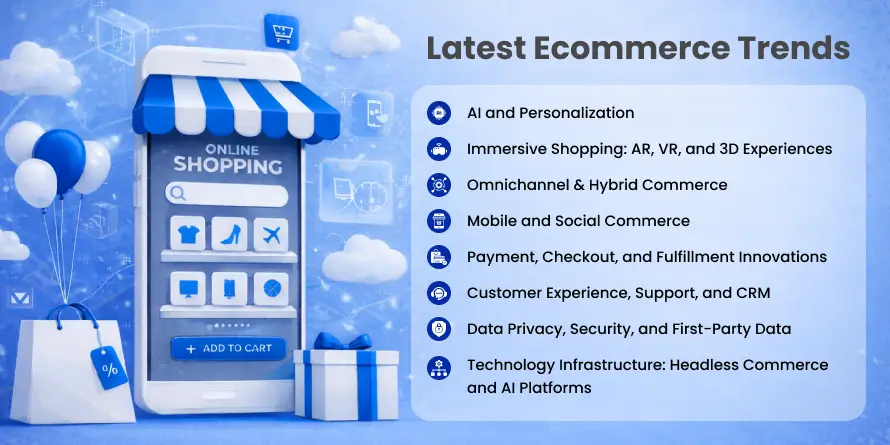
Top 9 Latest E-Commerce Trends
1. AI and Personalization (Agentic Commerce)
Artificial intelligence in ecommerce has moved from experimentation to everyday operations.
In 2026, AI is quietly working behind successful stores by:
- Personalizing product recommendations in real time
- Powering intelligent chatbots for instant support
- Creating optimized product descriptions and ad copy
- Improving on-site search accuracy
What’s changed is expectation. Customers now assume brands understand their preferences. Generic storefronts feel outdated.
A newer evolution, often called agent-led or decision-based commerce, allows AI systems to guide purchases instead of just assisting. This means your product data, pricing, and availability must be structured clearly, not only for humans, but also for AI-driven shopping tools.
What this means for entrepreneurs:
Start small, but start now. Personalization engines, AI search tools, and automated customer support are no longer enterprise-only tools.
2. Immersive Shopping: AR, VR, and 3D Experiences
Online shoppers still hesitate when they can’t fully visualize a product. That’s where immersive experiences are closing the gap.
In 2026, leading stores use:
- 3D product views
- 360-degree images
- Augmented reality previews (especially for furniture, fashion, and beauty)
These tools reduce uncertainty, lower return rates, and increase confidence—especially for high-consideration products.
You don’t need full virtual stores to benefit. Even adding interactive visuals to top-selling products can significantly improve engagement.
Key takeaway:
If customers can “experience” your product digitally, they are more likely to complete the purchase.
3. Omnichannel & Hybrid Commerce
Being everywhere doesn’t matter if the experience feels disconnected.
Modern omnichannel commerce focuses on continuity, allowing customers to move smoothly between:
- Online stores
- Mobile devices
- Marketplaces
- Physical locations (if applicable)
Options like buy online, pick up in-store, easy cross-channel returns, and unified loyalty programs are no longer optional for competitive brands.
Customers often research online and buy offline or discover products on social platforms before purchasing later. Your inventory, pricing, and messaging must stay aligned across these touchpoints.
For growing businesses:
Choose systems that synchronize data automatically. Manual updates lead to errors, delays, and lost trust.
4. Mobile and Social Commerce
Mobile shift aligns closely with broader mobile commerce trends, where smartphones are now the primary entry point for online shopping, not just a supporting channel.
In parallel, social platforms have become discovery engines, not just marketing channels. Consumers are increasingly comfortable browsing, engaging, and even purchasing without leaving social apps.
In 2026, effective brands:
- Design mobile-first experiences
- Reduce page load times aggressively
- Use shoppable social content instead of static ads
- Partner with creators who build trust, not just reach
Live shopping, short-form video, and community-driven content are outperforming traditional promotional messaging.
Simple rule:
If your store works perfectly on desktop but feels slow or cluttered on mobile, you’re losing customers before they even consider buying.
5. Payment, Checkout, and Fulfillment Innovations
Seamless checkout and versatile payments are critical to converting browsers into buyers. Studies show nearly half of cart abandonments (47%) are due to extra costs like shipping or surprise fees, To address this, e-merchants should:
The biggest conversion killers remain:
- Unexpected shipping costs
- Forced account creation
- Limited payment options
- Slow or unclear delivery timelines
In 2026, high-performing stores prioritize:
- Guest checkout and express payments
- Multiple payment options: Customers expect flexibility. Alongside credit/debit cards, offer Buy-Now-Pay-Later (BNPL) plans (e.g. Affirm, Afterpay), digital wallets (Apple/Google Pay, PayPal), and even newer methods like cryptocurrency if appropriate. This meets diverse preferences and can increase average order values.
- Transparent shipping costs early in the process
- Faster, predictable delivery options
You don’t need full virtual stores to benefit. Even adding interactive visuals to top-selling products can significantly improve engagement.
Optimization mindset:
Every extra step at checkout reduces trust. Simplicity wins.
6. Customer Experience, Support, and CRM
Technology attracts customers, but experience keeps them.
In a crowded market, customer experience defines brand value. This includes:
- Fast, helpful support
- Clear communication
- Personalized follow-ups
- Loyalty and rewards programs
Automation helps, but empathy still matters. AI chatbots should handle routine questions, while humans step in for complex issues.
Repeat customers are far more profitable than new ones. Brands that invest in retention consistently with new ecommerce revenue models outperform those focused only on acquisition.
Strategic insight:
Retention strategies often generate higher ROI than paid advertising in mature eCommerce markets.
7. Data Privacy, Security, and First-Party Data
Consumers are more aware of how their data is used and they expect transparency.
With third-party cookies fading, brands must rely on:
- First-party data (purchase behavior, site interactions)
- Zero-party data (information customers willingly share)
Trust is built through:
- Clear privacy policies
- Secure payment systems
- Honest communication about data usage
Businesses that respect data boundaries are more likely to earn long-term loyalty.
Bottom line:
Privacy isn’t a legal checkbox, it’s a competitive advantage.
8. Technology Infrastructure: Headless Commerce and AI Platforms
Behind the scenes, flexible and modern tech stacks empower fast innovation. Headless commerce architectures (decoupling frontend and backend) allow you to update the website or app independently of the e-commerce platform. BigCommerce notes headless setups give “maximum flexibility” for experimenting with new selling channels.
For example, with a headless CMS, you can quickly launch an ecommerce mobile app, often supported by professional ecommerce app development, connect to IoT devices, or prototype a new checkout flow without rebuilding the entire store.
Other infrastructure trends:
- APIs and Integrations: Use standardized APIs to connect inventory, order management, and CRM systems. This ensures real-time syncing across platforms and channels (e.g. auto-updating stock on your website when a POS sale happens in-store).
- Cloud-based Commerce: SaaS e-commerce platforms with cloud hosting ensure scalability during peaks (no crashing on Black Friday).
- Advanced Search and Discovery: AI-powered search (semantic search, visual search) helps customers find products faster. For example, adding images or voice queries as search inputs can capture more intent (see below).
- Automation: Inventory management automation (reordering stock when low), dynamic pricing algorithms (adjusting prices in real time), and predictive analytics (forecasting trends) will differentiate efficient operations.
In practice, stay agile: regularly assess new e-commerce platforms and apps (e.g., chat plugins, recommendation engines) and be ready to integrate what helps your business scale and innovate.
9. Sustainability and Ethical Commerce
Sustainability is no longer limited to niche audiences. Many shoppers actively consider:
- Packaging materials
- Shipping impact
- Ethical sourcing
Brands that communicate their efforts clearly—without exaggeration—stand out.
Even small steps, like eco-friendly packaging or carbon-conscious shipping options, can influence purchase decisions.
Important note:
Authenticity matters more than perfection. Customers value honesty over greenwashing.
Final Thoughts on Latest Ecommerce Trends
The latest eCommerce trends in 2026 point to one clear direction: successful online businesses are experience-driven, data-aware, and customer-first.
Technology enables growth, but strategy sustains it. Entrepreneurs who focus on usability, trust, and adaptability will not only survive algorithm updates, but outperform competitors who rely on tactics alone.
If you treat trends as tools not buzzwords, you position your business for long-term success in an increasingly competitive digital economy.
Frequently Asked Questions
The next big thing in e-commerce is AI-driven, experience-led shopping. In 2026, successful online businesses are using artificial intelligence to personalize product discovery, automate customer support, and streamline purchasing decisions. This shift goes beyond automation, AI is increasingly guiding what customers see, when they see it, and how they buy.
Yes, mobile optimization is critical in 2026. Most shoppers now discover and purchase products on smartphones. A slow or poorly designed mobile experience can lead to lost sales, even if your desktop site performs well.