10 Best Web Application Frameworks to Use in 2026
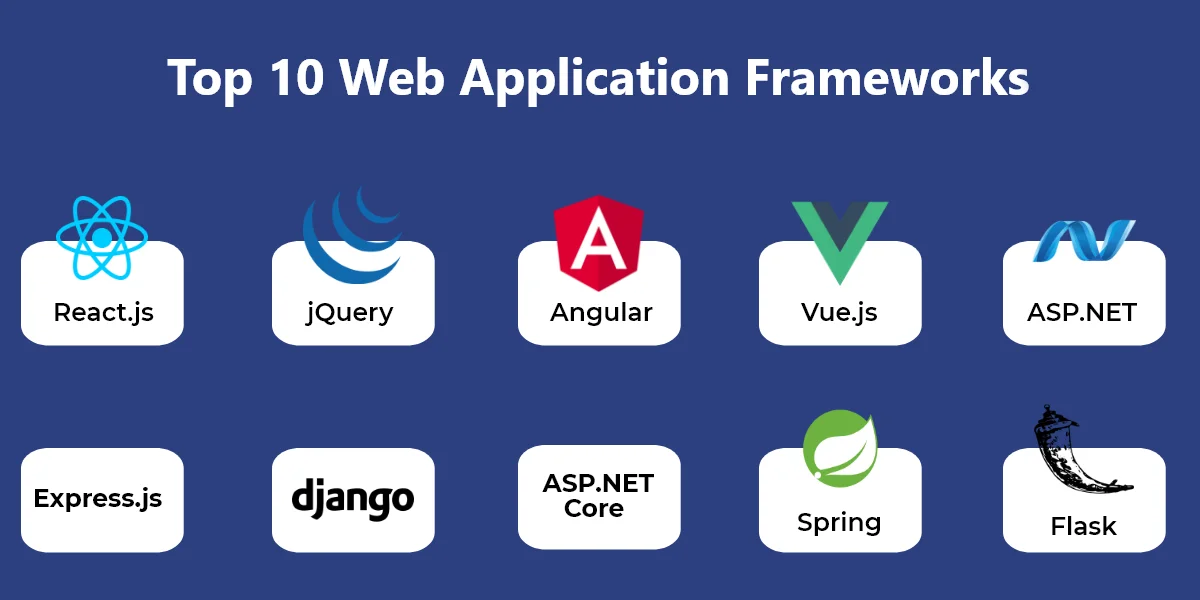
Every web application your business runs sits on a framework. And in most cases, the decision about which framework to use was made by a developer, for developer reasons, speed of coding, personal familiarity, or whatever happened to be trending on GitHub that month.
That’s a problem.
Because the wrong framework choice doesn’t just slow down your developers. It drives up your infrastructure costs, limits how fast you can scale, creates dependency on a niche talent pool, and in some cases, forces expensive rewrites a year or two down the road.
This guide is for who are paying for the application and living with the consequences. By the time you finish reading, you’ll know exactly how to evaluate framework options, and which framework is most likely to support your specific business goals.
Why the Framework Decision Is a Business Decision
Ask development team which framework is recommended, and you’ll almost certainly get a confident answer. What you may not realize is that the confidence often reflects personal expertise, not an objective evaluation of your business needs.
Frameworks differ significantly in:
- Cost of development: some require more specialized (and expensive) developers
- Speed to market: some frameworks are built for rapid deployment, others for long-term scale
- Scalability ceiling: some hit limitations as your user base grows
- Security posture: some have stronger built-in protections than others
- Talent availability: rare framework expertise = slower hiring = higher rates
- Vendor lock-in risk: some frameworks tie you to specific clouds or ecosystems
The Cost of Getting It Wrong
Companies that choose the wrong framework don’t just face technical debt. According to McKinsey’s research on technology-driven transformation, poor platform decisions contribute to project cost overruns averaging 45% beyond initial estimates, with timeline delays of up to 7 months on complex applications. The cost of a full framework migration, rebuilding an application to move from one stack to another, typically runs between $150,000 and $500,000 for a mid-size web application, depending on complexity.
Choosing right the first time isn’t a developer preference. It’s a financial decision.
What Business Owners Actually Need to Know
You don’t need to understand how a framework works under the hood. You need to understand three things:
- What problems does this framework solve best?
- What are the long-term risks and costs of choosing it?
- How does it align with where your business is going, not just where it is today?
What Is a Web Application Framework? (Plain English)
Think of a web application framework as the structural blueprint that your software is built on, like the steel frame of a building before the walls, plumbing, and finishes go in. It determines what’s possible, what’s efficient, and what becomes painful and expensive to change later.
Frameworks provide pre-built solutions for the most common challenges in building web applications: user login, data storage, page routing, security protection, and API connections. Without a framework, developers write all of that from scratch, a process that’s slower, costlier, and introduces more room for error.
Frontend vs. Backend vs. Full-Stack Frameworks, What You’re Actually Buying
When your development partner talks about the “framework stack,” they’re typically referring to two layers, sometimes three:
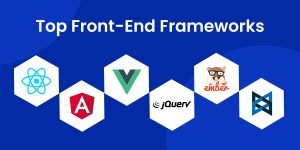
Frontend frameworks (React, Angular, Vue.js, Next.js) control what users see and interact with in their browser. They determine how fast pages load, how smooth the user experience feels, and how easily your UI can be updated.
Backend frameworks (Django, Laravel, Node.js/Express, Ruby on Rails, ASP.NET Core) run the logic behind the scenes, processing data, communicating with databases, enforcing security, and powering integrations.
Full-stack frameworks (Next.js, Nuxt.js, Ruby on Rails in some configurations) combine both layers, allowing a single team to build the entire application.
Most modern web applications use one framework for the frontend and a different one for the backend. The combination you choose shapes everything from hiring costs to deployment complexity.
The 10 Best Web Application Frameworks in 2026 — Ranked for Business Outcomes
1. React – Best for Scalable Customer-Facing Web Apps
React is the world’s most widely used frontend framework, maintained by Meta and backed by one of the largest developer communities on earth. As of 2026, React powers applications at Airbnb, Netflix, Facebook, and thousands of mid-size and enterprise companies.
What makes it a strong business choice: React’s component-based architecture means your UI is built in reusable pieces. That translates to faster development timelines when adding features, easier maintenance, and a massive global talent pool, which means competitive developer rates and faster hiring.
Where it performs best: Customer portals, SaaS dashboards, social platforms, marketplace applications, and any application where the user experience is central to the product value.
Business consideration: React is a frontend library, not a complete solution. You’ll need a complementary backend framework, which adds architectural decisions. For many teams, pairing React with Node.js (Express or NestJS) or Django provides a well-proven full-stack solution.
Talent availability: Excellent. React developers are the most common in the market, keeping rates competitive.
2. Angular – Best for Large Enterprise Web Applications
Angular is Google’s framework and is built with enterprise-scale complexity in mind from day one. It uses TypeScript, which adds a layer of code discipline that reduces bugs in large teams, a significant advantage when you have five or more developers working on the same application.
What makes it a strong business choice: Angular’s “opinionated” structure means developers have fewer ways to do things wrong. In large teams, this consistency reduces rework, lowers QA costs, and makes onboarding new developers faster. Google’s backing means long-term support is virtually guaranteed.
Where it performs best: Internal enterprise tools, ERP systems, complex admin dashboards, financial applications, and healthcare platforms where compliance and auditability matter. Our Angular development services are purpose-built for these environments.
Business consideration: Angular has a steeper learning curve and slower initial development speed than React or Vue. For startups and MVPs, this cost-per-feature overhead often makes it the wrong choice, the structure that protects you at scale becomes friction at small scale.
3. Vue.js – Best for Mid-Size Businesses Needing Flexibility
Vue.js sits in a productive middle ground between the opinionated rigidity of Angular and the decision-heavy flexibility of React. It’s progressive, meaning you can start small and expand it as your application grows. Which makes it an excellent fit for businesses that are scaling but not yet at enterprise complexity.
What makes it a strong business choice: Vue has an exceptionally fast learning curve, which translates to lower development hours for straightforward features. Its growing ecosystem and strong community mean components and integrations are readily available rather than custom-built.
Where it performs best: E-commerce frontends, marketing platforms, content management systems, and B2B SaaS applications. Explore our Vue.js development services to see how we’ve applied it across industries.
Business consideration: While Vue’s community is large, it’s smaller than React’s, which means a slightly thinner talent pool at the very senior level. For most mid-size applications, this rarely presents a real constraint.
4. Next.js – Best for Performance-Critical and SEO-Driven Web Apps
Next.js is a React-based framework that adds server-side rendering, static site generation, and built-in performance optimizations on top of React. In practical terms, this means your pages load faster, rank better on Google, and deliver a better user experience on mobile.
What makes it a strong business choice: If your web application needs to be found through organic search, a marketing site, a product listing page, a content-driven SaaS platform, Next.js delivers a measurable SEO advantage over pure client-side frameworks.
Where it performs best: E-commerce platforms, content-heavy applications, SaaS marketing sites, and any scenario where page speed and search visibility drive revenue.
Business consideration: Next.js requires thoughtful deployment, it works best on Vercel’s platform, though AWS and Google Cloud deployments are viable with proper configuration. Factor hosting strategy into your cost model.
5. Node.js (Express / NestJS) – Best for Real-Time and API-Heavy Applications
Node.js is a backend runtime, not a framework itself. But the Express and NestJS frameworks built on it are among the most widely deployed backend solutions in the world. The defining characteristic of Node.js is its ability to handle a large number of simultaneous connections efficiently, making it the default choice for real-time applications.
What makes it a strong business choice: If your application involves live updates, chat, notifications, live data feeds, collaborative tools. Node.js handles these with significantly lower infrastructure costs than most alternatives. It also shares JavaScript with most frontend frameworks, which can simplify your team structure and reduce the cost of context-switching.
Where it performs best: Real-time collaboration tools, API gateways, streaming platforms, fintech applications, and integration-heavy platforms where multiple systems must communicate at scale. Our Node.js vs. Python comparison goes deeper on this choice for backend-heavy projects.
Business consideration: For data-science-heavy applications or machine learning workflows, Python-based backends (Django or FastAPI) are typically a better fit. Node.js is optimized for throughput, not computation.
6. Django – Best for Data-Intensive and AI-Powered Web Applications
Django is Python’s most established web framework and has become the default choice for applications that work with large volumes of data or integrate machine learning capabilities. Instagram, Pinterest, and Disqus were all built on Django and scaled to hundreds of millions of users.
What makes it a strong business choice: Django’s “batteries included” philosophy means authentication, an admin panel, ORM, and security protections are ready out of the box, reducing the cost of foundational development. More importantly, Python’s dominance in data science and AI means Django applications integrate seamlessly with machine learning models, automation workflows, and AI-powered operational systems, a critical advantage as businesses increasingly build intelligence into their core platforms.
Where it performs best: Data analytics platforms, AI-powered web applications, healthcare data systems, fintech applications, and SaaS products where data processing is a core feature.
Business consideration: Django is slower to serve very high volumes of concurrent requests compared to Node.js, but for the vast majority of business applications, this is never a meaningful constraint.
7. Laravel – Best for Rapid Development and E-Commerce Applications
Laravel is the leading PHP framework and has consistently ranked as one of the most developer-friendly frameworks available. Its elegant syntax and extensive built-in tools, including authentication, job queues, caching, and email, make it a strong choice when development speed and time-to-market are top priorities.
What makes it a strong business choice: PHP developers are among the most abundant in global markets, which makes Laravel projects highly cost-competitive. Laravel’s ecosystem includes pre-built e-commerce solutions (like Bagisto), payment integrations, and CMS tools that dramatically reduce custom development.
Where it performs best: E-commerce platforms, content management applications, subscription-based businesses, small-to-mid-sized SaaS products, and any project where budget efficiency is a primary constraint.
Business consideration: While Laravel scales well, very high-traffic applications (tens of millions of requests per day) may require additional infrastructure optimization. For most business applications, this threshold is never reached.
8. Ruby on Rails – Best for MVP Launches and SaaS Products
Ruby on Rails pioneered the “convention over configuration” philosophy that many modern frameworks have since adopted. GitHub, Shopify, and Basecamp were all built on Rails, three of the most successful SaaS products of the last two decades.
What makes it a strong business choice: Rails is optimized for building fast. Its opinionated defaults mean less decision-making for developers, fewer architectural debates, and a faster path from idea to working product. For founders who need to validate a product concept quickly, Rails remains one of the most time-efficient frameworks available.
Where it performs best: SaaS startups, B2B web applications, MVP launches, and any scenario where time-to-first-customer is the most critical metric.
Business consideration: The Ruby talent pool is smaller than Python, PHP, or JavaScript communities, which can affect hiring speed and rates at scale. Companies that outgrow Rails (like Twitter, famously) often face migration challenges, though this typically occurs at a scale most businesses will never reach.
9. ASP.NET Core – Best for Microsoft-Ecosystem Enterprises
ASP.NET Core is Microsoft’s open-source, cross-platform web framework. If your organization runs on Microsoft Azure, uses Microsoft 365 extensively, or has significant existing investments in .NET infrastructure, ASP.NET Core provides the tightest integration with your existing ecosystem.
What makes it a strong business choice: ASP.NET Core is exceptionally fast, benchmarks from TechEmpower consistently place it among the top-performing frameworks across all languages. Its enterprise-grade security and long-term Microsoft support cycle make it a clow-risk choice for organizations with strict compliance requirements.
Where it performs best: Enterprise internal tools, financial services applications, government systems, healthcare platforms, and any organization with existing Microsoft infrastructure.
Business consideration: .NET developers command higher hourly rates than PHP or Python developers. For organizations that aren’t already in the Microsoft ecosystem, the infrastructure and talent costs may outweigh the technical benefits.
FastAPI – Best for AI-Integrated and High-Performance APIs
FastAPI is the fastest-growing Python backend framework of the past three years, specifically designed for building high-performance APIs. Its automatic documentation generation, type validation, and native support for asynchronous operations make it the framework of choice for AI-powered applications in 2026.
What makes it a strong business choice: If your application integrates with AI models, whether through OpenAI, Anthropic, Google Gemini, or self-hosted models. FastAPI provides the platform architecture to power AI-driven automation workflows and intelligent operational systems. It processes API requests at speeds comparable to Node.js while retaining Python’s AI ecosystem compatibility.
Where it performs best: AI-powered web applications, machine learning model serving, data API layers, and any application where the backend primarily serves as an intelligent data pipeline.
Business consideration: FastAPI is newer, which means a smaller (but rapidly growing) talent pool. Best paired with a React or Next.js frontend for a complete AI-native stack.
Web Application Framework Comparison
| Framework | Best For | Development Speed | Scalability | Security | Talent Pool | Avg. Dev Rate (USD/hr) |
| React | Customer-facing apps, SaaS | Fast | Very High | Good | Very Large | $50–$120 |
| Angular | Enterprise, complex tools | Moderate | Very High | Excellent | Large | $60–$140 |
| Vue.js | Mid-size, flexible projects | Fast | High | Good | Large | $45–$110 |
| Next.js | SEO, performance-critical | Fast | Very High | Good | Large | $55–$125 |
| Node.js (Express/NestJS) | Real-time, APIs | Fast | Very High | Good | Very Large | $50–$130 |
| Django | Data-heavy, AI apps | Moderate–Fast | High | Excellent | Large | $50–$120 |
| Laravel | E-commerce, rapid build | Very Fast | High | Good | Very Large | $35–$95 |
| Ruby on Rails | MVPs, SaaS startups | Very Fast | Moderate–High | Good | Moderate | $60–$140 |
| ASP.NET Core | Enterprise, Microsoft stack | Moderate | Very High | Excellent | Moderate | $65–$150 |
| FastAPI | AI apps, high-perf APIs | Fast | Very High | Good | Growing | $55–$130 |
How to Choose the Right Web Application Framework for Your Business
Choosing a framework isn’t a decision you make once and forget. It’s a decision that you’ll live with for the lifecycle of your product. Here’s a structured approach that doesn’t require any technical background.
Step 1: Define Your Application Type
Start with what your application needs to do. Is it:
- A customer-facing product that users interact with directly? – Prioritize React, Vue.js, or Next.js
- An internal enterprise tool? – Consider Angular or ASP.NET Core
- A marketplace or e-commerce platform? – Next.js or Laravel are strong candidates
- A data dashboard or analytics platform? – Django or FastAPI with React frontend
- A real-time collaboration tool? – Node.js is the natural fit
For a deeper look at application categories and what they require, our guide on types of web applications provides a useful grounding before you start framework conversations.
Step 2: Consider Your Growth Ambitions
Where will your application need to be in 3 years? If you’re expecting 10x user growth, frameworks with strong scalability track records (React, Angular, Next.js, Node.js, Django) provide more headroom than lighter-weight options.
If you’re a startup in validation mode, time-to-market matters more than theoretical scalability limits. Rails, Laravel, or Django with React will get you to your first customers faster.
Step 3: Factor in Your Budget and Timeline
Every week of development costs money. Frameworks that accelerate development (Rails, Laravel, Django) reduce your initial investment. Frameworks that reduce long-term maintenance costs (Angular, ASP.NET Core for enterprise) reduce your total cost of ownership.
Be explicit with your technology partner: ask for a realistic timeline estimate with the proposed framework and one alternative, and compare both total project cost and time to launch.
Step 4: Think About Long-Term Maintenance
The developer who builds your application may not be the developer who maintains it. Frameworks with large talent pools (React, Node.js, Laravel) are easier to hand off, rehire for, and find support on. Niche frameworks, even excellent ones, create vendor dependency risk.
Step 5: Evaluate the Talent Pool and Vendor Risk
Ask your development partner: if you’re unavailable tomorrow, how long would it take us to find another team capable of maintaining this application? The honest answer reveals your vendor dependency risk. The right framework makes that answer short.
Framework Recommendations by Business Scenario
Best Framework for a SaaS Product
For a B2B SaaS product, the combination of React (or Next.js) on the frontend with Node.js or Ruby on Rails on the backend provides the fastest path from concept to paying customers. Rails specifically has an extraordinary track record of SaaS launches, its convention-driven architecture removes weeks of early architectural decisions. Once product-market fit is established, migrating specific performance-critical components to Node.js is straightforward.
If your SaaS product is data-driven or AI-enhanced, Django + React is the superior combination, Python’s AI ecosystem gives you a runway that JavaScript-only stacks can’t match.
Best Framework for Enterprise Web Applications
Enterprise projects almost always benefit from Angular for the frontend and ASP.NET Core or Django for the backend. Angular’s strict structure reduces the defect rate in large teams. ASP.NET Core’s enterprise tooling and Microsoft ecosystem integration eliminate entire categories of infrastructure decisions. Django’s security defaults and admin capabilities reduce internal tool development time significantly. Our web application development services are built around these enterprise-grade stacks.
Best Framework for AI-Powered Web Applications
This is 2026’s most important emerging category. For applications that integrate large language models, computer vision, recommendation engines, or any AI capability, the stack of choice is FastAPI or Django on the backend with React or Next.js on the frontend.
Python is the undisputed language of AI infrastructure. Choosing a non-Python backend for an AI-powered application means introducing a translation layer between your web platform and your AI systems, which adds integration complexity, slows iteration, and increases the long-term cost of maintaining operational coherence across your stack.
Best Framework for E-Commerce and High-Traffic Platforms
Next.js paired with a headless commerce backend (Laravel, Node.js, or a dedicated e-commerce API) is the standard for serious e-commerce builds. Next.js delivers the page speed and SEO performance that directly impact conversion rates. Laravel’s built-in payment handling and queue system handle the operational complexity behind the scenes.
For Progressive Web App e-commerce experiences, our PWA development services extend this stack with offline capability and app-like performance.
Best Framework for MVP and Startup Launches
Speed wins in the startup phase. Ruby on Rails or Laravel get you from zero to functional product faster than any other frameworks. Both have decades of proven patterns for subscription management, user authentication, team accounts, and the other building blocks most SaaS products need. The average well-architected Rails or Laravel MVP can be production-ready in 8–12 weeks with a small focused team.
How Much Does It Cost to Build a Web Application by Framework?
Cost is always context-dependent, your application’s complexity, feature set, integrations, and team location all matter enormously. But frameworks themselves create meaningful cost differences:
| Application Type | Framework Stack | Estimated Cost Range (Offshore) | Estimated Cost Range (US-based) |
| MVP / Starter SaaS | Rails or Laravel + React | $15,000–$40,000 | $60,000–$120,000 |
| Mid-size B2B Application | Node.js + React/Next.js | $30,000–$80,000 | $90,000–$200,000 |
| E-Commerce Platform | Next.js + Laravel | $25,000–$70,000 | $80,000–$180,000 |
| Enterprise Application | Angular + ASP.NET Core | $60,000–$200,000+ | $180,000–$500,000+ |
| AI-Powered Web Application | React + FastAPI/Django | $40,000–$120,000 | $120,000–$350,000 |
Estimates reflect development costs only and exclude hosting, licensing, and ongoing maintenance. Offshore teams at established development firms like Guru TechnoLabs can reduce project costs by 50–70% compared to equivalent US-based teams without sacrificing quality.
What Drives the Cost Difference Between Frameworks?
Three primary factors:
- Developer hourly rates – This varies significantly by framework. .NET and Angular specialists command premium rates. PHP (Laravel) developers are among the most cost-competitive globally.
- Development velocity – Some frameworks require more custom code for common features. Laravel and Rails ship with authentication, email, queues, and admin out of the box. React + Node.js requires assembling more pieces.
- Infrastructure requirements – Next.js and Node.js applications scale on relatively inexpensive cloud infrastructure. Some enterprise frameworks require more expensive server configurations.
What Are the Trending and Emerging Frameworks in 2026?
The framework landscape shifted meaningfully between 2024 and 2026. Here’s what’s genuinely gaining traction among serious development teams:
Bun + Elysia – A JavaScript runtime that’s significantly faster than Node.js, paired with the ultra-fast Elysia framework. Still early for production use in most enterprises, but worth monitoring for API-heavy projects.
Astro – A content-first framework that delivers exceptional page speed by shipping zero JavaScript to the browser by default. Gaining significant adoption for marketing sites, documentation platforms, and content-heavy applications where performance is a competitive advantage.
SvelteKit – Svelte’s full-stack framework has emerged as the highest-developer-satisfaction framework in the Stack Overflow Developer Survey for three consecutive years. The performance characteristics are excellent, but the talent pool remains thin for enterprise-scale hiring.
FastAPI (accelerating) – No longer “emerging,” FastAPI has become the default choice for any new Python API project. Its growth is directly tied to AI adoption, as more applications integrate AI capabilities, FastAPI’s role as the AI-web bridge grows.
Remix – A React-based full-stack framework from the team behind React Router that prioritizes web standards and progressive enhancement. Shopify’s adoption of Remix for their Hydrogen commerce framework has significantly boosted its enterprise credibility.
How Guru TechnoLabs Helps You Choose and Build on the Right Framework
At Guru TechnoLabs, we’ve been building web platforms across these frameworks for over a decade, for growth-stage businesses, mid-size operations, and global enterprises managing complex, integration-heavy systems. Our framework recommendations are shaped by your platform architecture requirements, your scalability strategy, and your long-term operational goals, not by what’s simplest for us to build.
Our process starts before a single line of code is written:
- Discovery and scoping: We map your application requirements to framework capabilities, not the other way around.
- Transparent cost modeling: You get a realistic cost range for your top two framework options before committing.
- Risk assessment: We identify the long-term risks of each option, including maintenance, scalability, and talent availability.
- Expert development: Once you’ve decided with full information, our team builds with frameworks they’ve used at scale, not frameworks they’re learning on your project.
Whether you’re aligning React and Angular for an enterprise dashboard, evaluating Django vs. FastAPI for an AI-powered platform, or auditing the framework architecture your existing application is running on, the right starting point is a scoping conversation grounded in your operational reality, not a framework preference.
Frequently Asked Questions
For web applications that rely on automation workflows, whether that's data synchronization, AI-assisted operations, or system integrations — Django and FastAPI are the most capable options. Both are Python-based, which means they connect directly to automation libraries and AI systems without additional translation layers.
An open source web application framework is one where the underlying code is publicly available, free to use, and continuously improved by a global developer community. React, Angular, Vue.js, Next.js, Django, Laravel, and Node.js are all open source. For most businesses, open source frameworks are the practical standard they carry no licensing fees, benefit from constant security updates, and are backed by large communities that reduce vendor dependency risk.