DoorDash Business Model and Revenue Model Explained
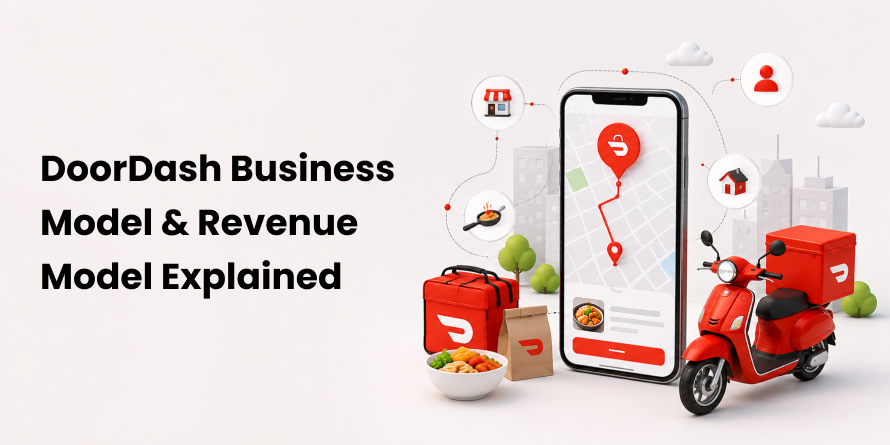
Table of Contents
- What Is DoorDash’s Business Model?
- How Does the DoorDash Business Model Work?
- How Does DoorDash Make Money?
- DoorDash Revenue Model and Unit Economics
- How DoorDash for Business and DoorDash Enterprise Work
- Why Does the DoorDash Business Model Work?
- Is DoorDash Profitable?
- DoorDash Business Model Canvas
- What Businesses Can Learn From DoorDash’s Business Model
- What Does It Take to Build a Food Delivery Platform Like DoorDash?
- Frequently Asked Questions
DoorDash operates a three-sided on-demand marketplace connecting consumers, merchants (restaurants, grocery, convenience, and retail), and independent delivery workers called Dashers. It generates revenue through five main streams: merchant commissions, consumer delivery and service fees, DashPass subscriptions, in-app merchant advertising, and enterprise and white-label logistics services through DoorDash Drive. DoorDash keeps roughly 13% of the total order value flowing through its platform as revenue.
In simple terms, DoorDash sits at the center of the ecosystem, connecting demand with merchants and delivery capacity while monetizing each transaction. Its pricing plans, DashPass subscription, advertising business, and enterprise logistics services all build on the same foundation: attract demand, manage delivery, and generate revenue from the coordination.
This article breaks down how the DoorDash business model works, how each revenue stream contributes, who pays what, and whether the model is profitable. It also looks at what businesses can learn from DoorDash when planning and building a food delivery platform of their own.
For businesses evaluating a similar platform, understanding how DoorDash combines marketplace operations, logistics, and monetization provides a practical starting point for planning the right product and technology strategy.
What Is DoorDash’s Business Model?
DoorDash operates a three-sided online marketplace and logistics platform that connects consumers, merchants, and independent delivery workers called Dashers. Its merchant network spans restaurants, grocery stores, convenience stores, and retail businesses. DoorDash does not cook food, own restaurants, or employ delivery drivers as staff. Instead, it provides the technology and logistics infrastructure that helps merchants, couriers, and consumers transact reliably at scale while taking a share of the value generated through each transaction.
The three sides of the marketplace are:
- Consumers, who browse, order, and pay through the DoorDash app or website.
- Merchants, including restaurants, grocery stores, convenience stores, and retailers, who list their products and fulfill customer orders.
- Dashers, the independent contractors who accept delivery offers and handle the last mile.
To grasp how DoorDash works, it is better to think of it as a local commerce platform rather than simply a “food delivery app.” The distinction matters. An app is a product interface; a platform is an entire economic system. DoorDash’s core technology matches orders with Dashers, manages delivery routes, determines pricing, and balances supply and demand across thousands of local markets.
This is the foundation of DoorDash’s business model. The company does not rely on a single transaction type to generate revenue. Instead, it monetizes the coordination between consumers, merchants, and delivery workers while continually adding new ways to capture value as the platform grows.
How Does the DoorDash Business Model Work?

At a high level, the DoorDash business model follows a simple flow:
Customer → DoorDash → Merchant → Dasher → Delivery → Payment settlement
A customer places an order and pays through the DoorDash app. DoorDash routes the order to the merchant, uses its dispatch system to match the delivery with an available Dasher, and tracks the order through each stage. Once the delivery is completed, the platform settles the transaction across the ecosystem — the merchant receives its share, the Dasher receives their earnings and applicable tip, and DoorDash retains its commissions and fees.
The flow itself is straightforward. The real complexity lies behind it.
DoorDash has to coordinate thousands of orders across different locations while keeping delivery times predictable, maintaining enough Dasher supply in each market, and ensuring that individual orders remain economically viable. This requires real-time matching, route optimization, demand forecasting, pricing, and operational monitoring.
That coordination is a core part of the DoorDash business model. The company is not simply connecting customers with restaurants; it is managing the technology and logistics layer that allows a local marketplace to operate efficiently at scale.
How DoorDash Works for Customers
For customers, DoorDash acts as a discovery, ordering, and delivery platform. Users can browse nearby restaurants, grocery stores, convenience stores, and retailers, compare options, customize their orders, make payments, and track deliveries in real time.
The typical customer journey looks like this:
- Browse: Customers search for merchants based on location, category, cuisine, ratings, delivery time, and other factors.
- Select and customize: They choose products or meals, add preferences, and review the order.
- Place and pay: The customer pays for the order along with applicable delivery and service fees.
- Track: DoorDash provides order status updates and real-time delivery tracking.
- Receive: A Dasher picks up the order and completes the delivery.
The value proposition is built around convenience, selection, and predictable delivery. The more useful the platform becomes, the more frequently customers are likely to return.
This is also where DashPass fits into the model. By offering eligible members reduced or waived delivery fees and other benefits, DoorDash encourages higher order frequency and creates a recurring subscription relationship rather than relying entirely on individual transactions.
How DoorDash Works for Restaurants
For restaurants, DoorDash functions as both a customer acquisition channel and delivery infrastructure.
A restaurant can list its menu on the platform, receive orders through DoorDash or a point-of-sale integration, prepare the food, and hand the completed order to a Dasher for delivery. In exchange, the restaurant pays DoorDash a commission based on its selected plan and applicable services.
The trade-off is primarily reach versus margin.
Restaurants gain access to a large pool of customers who are already looking to order, along with delivery infrastructure that would otherwise require significant investment to build and operate. DoorDash can also provide merchants with tools for promotions, advertising, order management, analytics, and customer discovery.
However, restaurants give up a portion of each transaction in exchange for that reach and infrastructure. They may also have less control over the direct customer relationship compared with orders placed through their own website or app.
This trade-off is an important part of the merchant side of the DoorDash business model. Restaurants have to weigh commission costs against incremental sales, delivery coverage, customer acquisition, and operational convenience when deciding how deeply to rely on the platform.
How DoorDash Works for Dashers
For Dashers, DoorDash operates as a flexible delivery and earning platform. Dashers can sign up as independent contractors, choose when they want to work, receive delivery offers, and accept assignments that fit their preferences.
The typical Dasher workflow involves:
- Receiving a delivery offer with relevant order and earnings information
- Accepting the delivery
- Picking up the order from the merchant
- Following navigation to the customer’s location
- Completing the delivery
- Receiving earnings and applicable customer tips
The Dasher side is what transforms DoorDash from a simple marketplace or restaurant listing platform into a real-time logistics network.
Maintaining enough delivery capacity in each market is critical. If there are too few Dashers, delivery times can increase. If demand is lower than expected, Dasher utilization can fall. DoorDash therefore needs to continuously balance delivery supply with customer demand across different locations and time periods.
How DoorDash Coordinates All Three Sides
The real strength of the DoorDash model comes from how these three sides work together.
Customers create demand. Merchants provide products. Dashers provide delivery capacity. DoorDash coordinates the entire transaction through its technology and logistics infrastructure.
Its matching and dispatch systems determine how orders are assigned, while pricing, incentives, routing, and demand forecasting help maintain marketplace efficiency.
This creates a network effect at the local-market level. More customers can attract more merchants, more merchants increase selection, and greater order density can create better opportunities for Dashers. As the marketplace becomes denser, DoorDash can potentially improve delivery efficiency while increasing the value of the platform for each participant.
That balance is one of the biggest operational challenges in the DoorDash business model. If customer demand, merchant availability, or Dasher supply falls significantly in a particular market, the entire ecosystem can feel the impact.
In other words, DoorDash’s core business is not simply delivering food. It is coordinating demand, supply, and logistics in real time and monetizing that coordination at scale.
How Does DoorDash Make Money?

DoorDash makes money primarily through merchant commissions and consumer delivery and service fees. It then adds higher-margin revenue through DashPass subscriptions, advertising, and business-to-business logistics services. The strength of the model comes from how these revenue streams work together rather than from any single source.
Here is how each stream works.
Merchant Fees and Commissions
Merchant commissions are DoorDash’s primary revenue source. In the U.S., restaurants pay a percentage of their order subtotal based on the selected Partnership Plan:
| Plan | Delivery commission | What it offers |
| Basic | 15% | Smaller delivery radius and standard visibility |
| Plus | 25% | Larger delivery radius and access to DashPass customers |
| Premier | 30% | Largest radius, priority placement, and Growth Guarantee |
Pickup orders carry a 6% commission across the plans, while DoorDash’s direct online ordering product for restaurant-owned websites starts at 0% marketplace commission, with payment processing still applying. Rates can change, so businesses should refer to DoorDash’s current merchant pricing when evaluating the model.
The strategic point is that DoorDash turns commissions into more than a delivery charge. Higher tiers can provide greater reach and visibility, making the commission a form of customer acquisition and marketing spend for merchants.
Customer and Delivery Fees
Customers typically pay delivery and service fees on marketplace orders, with a small-order fee sometimes added when the order falls below a certain threshold. These charges are separate from merchant commissions.
Tips are different. They are passed through to Dashers and are not a DoorDash revenue source.
Consumer fees generate direct transaction revenue while also creating an incentive for frequent customers to consider DashPass. This connects DoorDash’s transactional revenue with its subscription model.
DashPass Subscription Revenue
DashPass is DoorDash’s consumer membership program. Subscribers pay a recurring monthly or annual fee in exchange for benefits such as reduced or waived delivery fees and lower service fees on eligible orders.
The bigger value of DashPass is not simply the subscription payment. It is the change in customer behavior. Once customers have paid for membership, they have more incentive to order frequently, which can increase order volume and create additional opportunities for merchant commissions, consumer fees, and advertising revenue.
In this sense, DashPass functions as a retention and order-frequency engine that supports several parts of DoorDash’s revenue model at once.
DoorDash Advertising Revenue
Advertising has become an increasingly important and high-margin part of DoorDash’s business. Merchants and brands can pay for sponsored placements, promoted listings, and greater visibility within search and discovery experiences.
The advantage for DoorDash is the level of purchase intent behind its audience. Someone searching for a restaurant, grocery item, or product is already close to making a purchase. That gives merchants a strong reason to pay for visibility at the point of decision.
Once the advertising infrastructure is established, additional impressions can be served at relatively low incremental cost. This allows advertising revenue to contribute disproportionately to margins compared with transaction-based revenue.
DoorDash Drive and Business Services
DoorDash also monetizes its logistics infrastructure outside its consumer marketplace.
DoorDash Drive is its white-label delivery service. A merchant can accept orders through its own website or app while DoorDash handles the delivery in the background through its Dasher network and dispatch technology. Drive can integrate with APIs and supported point-of-sale and commerce platforms, with merchants paying a per-order fee.
The strategic value is straightforward: DoorDash can turn infrastructure it already built for its marketplace into a separate service that other businesses can buy.
For merchants, this provides access to delivery capabilities without building their own courier network. For DoorDash, it creates another revenue stream while increasing the utilization of its existing logistics infrastructure.
This is a key lesson for businesses building a marketplace: infrastructure does not always have to remain a cost center. When designed as a reusable platform capability, it can become a product and an additional source of revenue.
Planning a Multi-Revenue Delivery Platform?
Your monetization model directly affects payments, subscriptions, merchant tools, advertising, and backend architecture. Guru TechnoLabs can help you map these requirements before development begins.
DoorDash Revenue Model and Unit Economics
DoorDash’s revenue represents only a portion of the money flowing through its platform. Two metrics are important to keep separate: Marketplace Gross Order Value (GOV), which represents the total value of orders placed through the platform, and revenue, which is the amount DoorDash recognizes as its own revenue.
In Q2 2026, DoorDash reported $33.1 billion in Marketplace GOV and $4.45 billion in revenue, resulting in a net revenue margin of roughly 13%. For full-year 2025, the company reported $13.7 billion in revenue on approximately $102 billion in Marketplace GOV. DoorDash Investor Relations
The takeaway is important: DoorDash keeps a relatively modest share of the value flowing through its marketplace. Its economics therefore depend heavily on order volume, delivery efficiency, and the ability to generate additional revenue from the same customer and merchant relationships.
What Happens Financially When an Order Is Placed?
When a customer places an order, several financial flows happen at the same time. The customer pays for the order, applicable delivery and service fees, and any tip. DoorDash collects the transaction, deducts its applicable commission and fees, pays the merchant its share, and pays the Dasher their earnings.
DoorDash also carries costs associated with processing and supporting the transaction, including payment processing, insurance, customer support, refunds, credits, and technology infrastructure.
What remains after variable order-related costs contributes toward the company’s broader operating expenses and, ultimately, profitability.
A Simple Unit Economics Example
Consider a hypothetical $30 food order placed through a restaurant on the 25% Plus plan.
DoorDash would receive a $7.50 merchant commission on the $30 subtotal. The customer may also pay delivery and service fees and add a tip. From the revenue it recognizes, DoorDash still has to account for delivery costs, payment processing, insurance, support, and other operating expenses.
The exact economics vary by order, market, distance, demand, merchant plan, and other factors, so this should be treated only as an illustration—not as DoorDash’s reported per-order economics.
Planning to Build a Food Delivery Platform?
A profitable delivery platform depends on more than commission rates. Your app needs the right payment flows, delivery logic, merchant tools, and scalable architecture to keep the economics sustainable as order volume grows.
Guru TechnoLabs can help you define the right features, technology architecture, integrations, and development scope based on your business model.
Why Order Density Matters
This is where DoorDash’s scale becomes important.
Order density directly affects delivery economics. When multiple orders are concentrated within a relatively small geographic area, DoorDash can use routing and batching to make better use of delivery capacity. Shorter distances and higher Dasher utilization can reduce the cost associated with each completed order.
A sparse market presents the opposite challenge. If a Dasher has to travel farther for each delivery, the platform has fewer opportunities to combine orders, increasing the cost of fulfillment.
This is why density is more than a growth metric for a delivery marketplace. It is one of the core levers behind sustainable unit economics.
For businesses building a similar platform, the lesson is straightforward: profitability does not necessarily come from charging more for every order. A stronger model combines higher order frequency, local marketplace density, efficient dispatch and routing, and additional high-margin revenue streams such as subscriptions and advertising.
That combination allows a delivery platform to build stronger economics without placing the entire burden on transaction fees.
How DoorDash for Business and DoorDash Enterprise Work
DoorDash’s business model extends beyond individual consumers. DoorDash for Business serves organizations with use cases such as employee meals, group ordering, catering, gift cards, and centralized expense management. This gives companies a way to manage business-related food and delivery needs through DoorDash’s existing marketplace.
For larger organizations and merchant partners, enterprise services provide deeper integrations with DoorDash’s ordering and logistics infrastructure. Services such as DoorDash Drive allow businesses to use DoorDash’s delivery network while keeping orders within their own digital channels.
These offerings strengthen the broader DoorDash business model in two ways. First, they diversify demand beyond individual consumers and can generate more predictable order volume. Second, enterprise integrations can make DoorDash part of a business’s day-to-day operations rather than simply another delivery marketplace.
For a platform business, that distinction matters. Recurring corporate demand and embedded logistics services can create more stable revenue while increasing the value of infrastructure that already exists.
Why Does the DoorDash Business Model Work?
Many companies have entered food delivery, but relatively few have built the scale and infrastructure needed to make the model sustainable. The reason DoorDash works is not one feature or revenue stream. It is the way its marketplace, logistics network, and monetization model reinforce one another.
Three-Sided Network Effects
Each side of the marketplace makes the others more valuable. More consumers attract more merchants, while greater merchant selection attracts more consumers. Together, they create more delivery demand, supporting a larger Dasher network and better delivery availability.
Once this cycle becomes established in a local market, competing becomes harder because a new entrant has to build all three sides at the same time.
Marketplace Liquidity and Delivery Density
Network effects only work when there is enough supply and demand to keep the marketplace moving efficiently. In delivery, this liquidity is largely geographic.
When many customers, merchants, and Dashers operate within the same area, DoorDash can match orders more efficiently, reduce delivery distances, and make better use of its delivery network. Density therefore becomes an important driver of both customer experience and unit economics.
Multiple Revenue Streams
DoorDash does not depend on commissions alone. Consumer fees, DashPass, advertising, and logistics services monetize different parts of the ecosystem.
This diversification also makes the model more resilient. If one revenue stream faces pressure, such as restrictions on merchant commissions, other streams can help support overall revenue and margins.
DashPass and Customer Retention
DashPass turns occasional users into more frequent customers. Once members pay for a subscription, they have a stronger incentive to use the platform often enough to justify the cost.
That can increase order frequency, customer lifetime value, and overall marketplace activity while making demand more predictable.
Advertising and Merchant Monetization
Advertising gives DoorDash another way to monetize merchants without simply raising commission rates. Merchants can pay for greater visibility and sponsored placements, while DoorDash benefits from a relatively high-margin revenue stream.
It also expands DoorDash’s role beyond delivery into local commerce and digital advertising, creating more value from the same merchant relationships.
Expansion Beyond Food Delivery
DoorDash has extended its infrastructure into grocery, convenience, retail, and additional international markets. The acquisition of Deliveroo in October 2025 further expanded its geographic reach.
The important point is that DoorDash can reuse much of its existing technology, logistics, and marketplace infrastructure across categories. The same coordination engine can support a restaurant order, a grocery basket, or a retail delivery.
That repeatability is one of the model’s biggest strengths: more categories and markets can generate additional volume without requiring an entirely new operating model each time.
Is DoorDash Profitable?
Yes. DoorDash is profitable, although its profitability is relatively recent and margins remain modest compared with its revenue. DoorDash achieved its first full year of GAAP net profitability in 2024, with profitability improving further in 2025.
Here is the relevant financial context:
- Full-year 2025: Revenue reached $13.717 billion, up roughly 28% year over year, with GAAP net income of about $935 million and a net profit margin near 7%, compared with roughly $123 million in net income in 2024. (source)
- Second quarter 2026: Revenue reached $4.45 billion, up 36% year over year, while Marketplace GOV reached $33.1 billion. Adjusted EBITDA rose 40% year over year to $914 million. GAAP net income was $200 million, affected by acquisition-related costs and continued investment.
The key point is that DoorDash’s improving profitability comes from greater logistics efficiency, higher order density, and growing advertising revenue, rather than simply increasing delivery fees.
For businesses studying the model, the lesson is simple: a profitable delivery platform needs efficient operations and multiple revenue streams, not just high order volume.
DoorDash Business Model Canvas
A Business Model Canvas provides a quick view of how DoorDash creates, delivers, and captures value. Here is a condensed version with practical analysis.
| Building block | What it looks like for DoorDash | Analysis |
| Customer segments | Consumers; restaurants and other merchants; Dashers; business and enterprise clients | A multi-sided model where each segment contributes value to the ecosystem |
| Value proposition | Convenience and selection; customer demand and delivery; flexible earnings; delivery infrastructure | Different needs are served through one shared platform |
| Channels | Consumer app and website; merchant portals and POS integrations; Dasher app; Drive APIs | Digital channels allow DoorDash to manage interactions at scale |
| Customer relationships | Self-service apps, DashPass, ratings, support, incentives | DashPass encourages repeat usage and stronger customer retention |
| Key activities | Matching and dispatch, logistics, marketplace management, payments, advertising | Dispatch and routing remain central to platform operations |
| Key resources | Technology, Dasher network, merchant catalog, consumer base, data | Data supports both logistics optimization and advertising |
| Key partners | Restaurants, retailers, Dashers, payment processors, POS and integration platforms | Partners provide much of the marketplace’s supply and delivery capacity |
| Cost structure | Dasher payments, support, insurance, processing, refunds, technology, marketing | Delivery efficiency is a major factor in controlling costs |
| Revenue streams | Merchant commissions, consumer fees, DashPass, advertising, Drive and business services | Transaction revenue is supported by recurring and higher-margin streams |
The key insight is simple: DoorDash owns the technology, coordination, and data rather than the physical assets. It does not need to own restaurants or delivery vehicles to capture value from each transaction.
This asset-light structure, combined with logistics and data-driven coordination, gives DoorDash a scalable model while creating operational complexity that competitors must overcome.
What Businesses Can Learn From DoorDash’s Business Model
For growth-stage food delivery businesses, entrepreneurs, and product leaders, DoorDash offers several lessons worth adapting rather than simply copying.
Marketplace economics reward density, not price: Order density improves routing efficiency and unit economics. Build strong demand in defined markets before expanding too broadly.
Diversify monetization early: Relying on one transaction fee creates risk. DoorDash layers subscriptions and advertising onto commissions, creating additional revenue without rebuilding the core platform.
Logistics is a product, not just a cost: DoorDash turns its delivery network into Drive and sells it as a service. Reliable logistics can become a revenue-generating capability rather than just an operating expense.
Subscriptions drive frequency and retention: Memberships that reduce ordering costs can encourage repeat purchases and increase customer lifetime value.
Merchant experience determines supply: Merchants are more willing to pay commissions when the platform delivers incremental demand. Connecting pricing tiers with visibility can make commissions feel like a growth investment rather than simply a cost.
Data compounds: Purchase-intent data can improve dispatch, personalization, and advertising. Building strong data capabilities early can create a valuable long-term asset.
Scalability is architectural: DoorDash reuses its technology and logistics infrastructure across food, grocery, and retail. Designing for reuse makes expansion easier without rebuilding the platform.
The honest warning is that DoorDash operates at a massive scale with years of investment behind it. For a growth-stage business, the better question is not “How do we become DoorDash?” but “Which mechanics fit our market, and how should we sequence them?”
What Does It Take to Build a Food Delivery Platform Like DoorDash?
If there is one thing this breakdown makes clear, it is that a DoorDash-style platform is not just a mobile app. It is a multi-sided technology ecosystem. The consumer app is only one part of the system. A competitive platform requires multiple connected products working together in real time.
At minimum, a food delivery platform requires:
- Customer app: Browsing, ordering, payments, and live tracking.
- Merchant platform: Menu management, order acceptance, status updates, and POS integration, making it closer to restaurant app development than a simple listing page.
- Dasher/driver app: Delivery offers, navigation, earnings, and proof of delivery.
- Admin panel: Operations, support, pricing, and marketplace management.
- Payment system: Transaction splitting, refunds, tips, commissions, and reconciliation.
- Order and dispatch system: Efficient order assignment, routing, and batching.
- Real-time tracking: Location and delivery updates across the platform.
- Analytics: Demand forecasting, marketplace density, and unit-economics monitoring.
- Notifications: Updates throughout the order lifecycle.
- Third-party integrations: Maps, payment gateways, POS systems, and messaging.
- Security and scalability: Infrastructure capable of handling traffic spikes while protecting payment and location data.
The difficult part is not building the screens. It is building the systems behind them the dispatch logic, pricing engine, real-time communication, and architecture that keeps everything reliable as order volume grows.
At Guru TechnoLabs, we have worked on marketplace and location-based platforms where similar challenges arise. In our Neighbours Gate project, a marketplace connecting people to buy, sell, or exchange produce, we handled challenges around supply and demand matching, GPS-based discovery, multi-party transactions, and real-time messaging.
If you are planning a food delivery or on-demand platform, the practical starting point is an architecture discussion around your three user groups, dispatch requirements, integrations, and scalability before designing a single screen. Our complete guide to food delivery app development covers the process, features, and cost considerations in greater detail.
If you’re planning a delivery or marketplace platform, talk to our food delivery app development team to map the architecture, integrations, and scalability requirements for your market.
Build a Food Delivery Platform That Can Scale
Build a scalable DoorDash-like platform with real-time delivery, secure payments, smart dispatch, and merchant integrations. Get a tailored development scope and cost estimate from Guru TechnoLabs.
Frequently Asked Questions
DoorDash operates a three-sided marketplace connecting consumers, merchants, and Dashers. It generates revenue through merchant commissions, consumer fees, DashPass subscriptions, advertising, and logistics services.
DoorDash primarily earns through merchant commissions and consumer delivery and service fees. It also generates revenue from DashPass, advertising, and DoorDash Drive's white-label logistics services.
DoorDash's U.S. marketplace delivery commissions are 15% for Basic, 25% for Plus, and 30% for Premier. Pickup is 6% across the plans. Direct online ordering starts at 0% marketplace commission, with payment processing still applying.
Customers typically pay delivery and service fees, with a small-order fee sometimes applying. Fees vary by market, order, and merchant. Eligible DashPass members can receive reduced or waived fees.
DoorDash collects the customer's payment, deducts applicable commissions and fees, and sends the remaining amount to the restaurant according to its settlement schedule.
DoorDash Drive is a white-label delivery service. Merchants accept orders through their own website or app while DoorDash handles delivery through its Dasher network and logistics technology.
DoorDash's business and enterprise services support organizations and large merchant partners with use cases such as employee meals, catering, centralized ordering, and logistics integrations.
Customers place an order through DoorDash and collect it directly from the merchant. The merchant pays a 6% commission, while no Dasher is required for delivery.
Yes. DoorDash connects three primary groups: consumers, merchants, and Dashers. Each side contributes to the value and activity of the marketplace.
Both use three-sided delivery marketplaces and similar monetization models. DoorDash has a strong U.S. position, while Uber Eats benefits from Uber's broader mobility ecosystem. Competition ultimately depends heavily on local market density, merchant selection, pricing, and delivery efficiency.