How to Start a Handyman Business in 2026?
This is a situation that is most likely to sound familiar. Your phone rings all day. Customers demand quotes, rescheduling, and confirmations. You are commuting to work, your assistant is too much on the phone, and yet a double-booking gets through. You have earned good money by Friday, but you are so tired, and you realize that this cannot continue.
This is the point at which a larger percentage of handyman businesses face a dead end. Not due to a shortage of ability or demand. The operations are still being operated using phone calls, spreadsheets, and gut instincts, hence this.
A mobile application transforms that completely.
It takes booking, scheduling, communication, and payment to a system that will work even when you are at work. And by 2026, large companies will not be luxurious by having an app. It is the most feasible move that a handyman business can make in order to expand beyond the management capability of an individual.
Everything you need to know is covered in this guide:
- The optimal business model, based on the position of your business today,
- The features your handyman app really requires,
- The approximate cost to build it, and
- What can you do to attract customers with the app?
Why is the Handyman Industry Booming Right Now?
The handyman business is no longer a side business or local service. It has now become an expanding economy, worldwide, in the provision of services, driven by the transformation in lifestyle, aging of houses, and the emergence of on-demand services.
The business prospects are larger than ever before in businesses that are in this space. There is a rising demand, faster service is being demanded by the customers, and technology is changing the way jobs are booked and handled.
This is the factor behind this growth.
- The first one can be explained by the very fact that the market is massive and growing rapidly.
- In 2023 alone, the handyman services market in the United States received more than 50 billion dollars in revenue.
- The market is estimated to be more or less 58 billion by 2026.
- The market of handyman services is projected to rise by more than 12 – 16 percent per year in the next decade all over the world.
- The U.S. alone already has 300,000+ handyman businesses, and it employs over 500,000 workers.
To property owners and managers, the outsourcing of small repairs through specialized contractors is inefficient. Handymen offer one service point to dozens of maintenance tasks that maintain the demand constant.
It is just that modern homeowners do not have enough time to do everything on their own.
Urban life, dual-income families, and hectic schedules have instilled the desire to outsource household maintenance chores.
Customers are no longer willing to spend their weekends attending to issues since they have the option of employing professionals to handle several jobs within a short time.
The takeaway is clear:
The handyman business is on fire – and the winners will be those businesses that blend skilled labor with intelligent systems and technology.
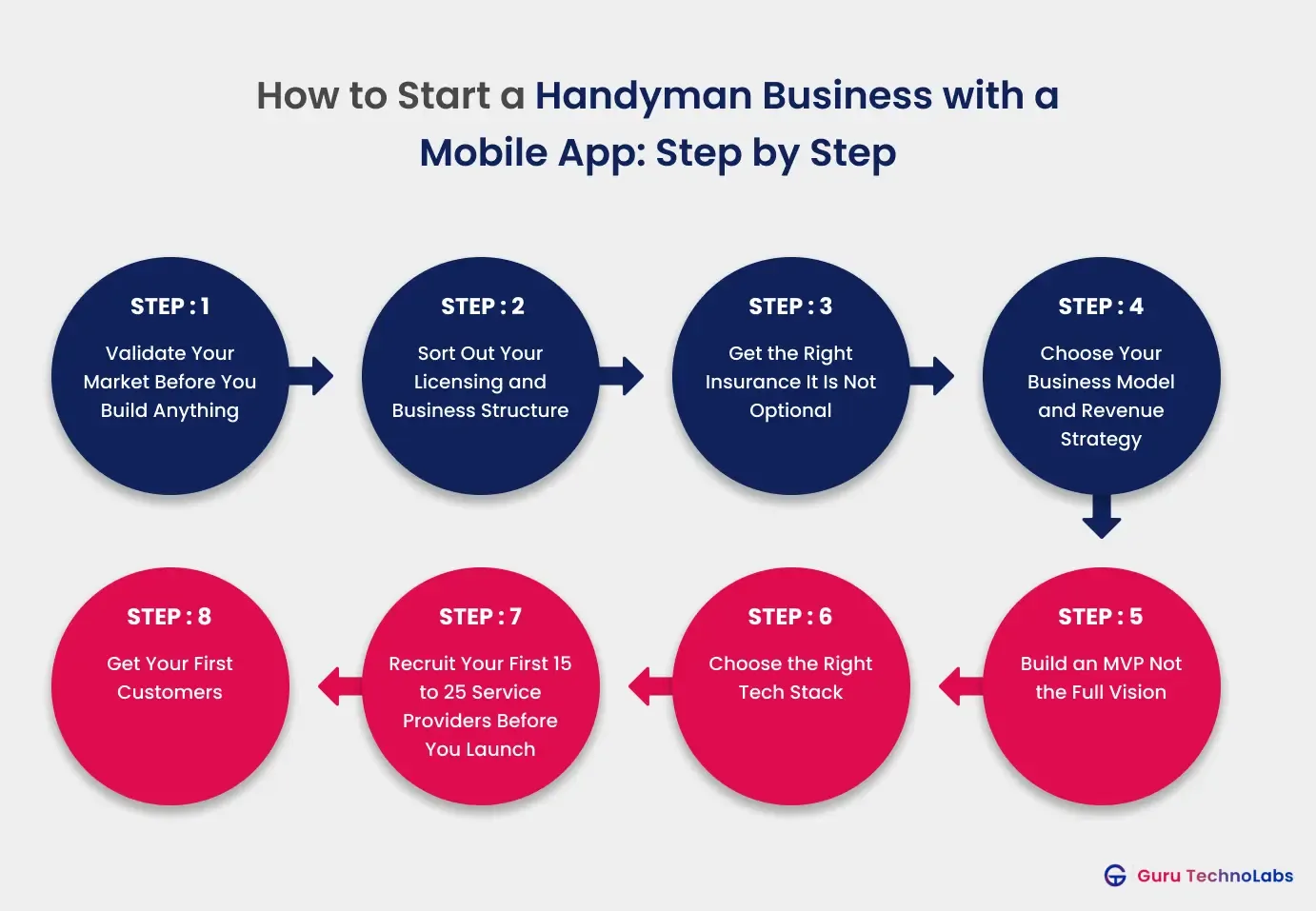
How to Start a Handyman Business with a Mobile App: Step by Step
Since we now realize that the handyman industry is expanding at a very high rate, the second big question is: where exactly do you start? There are a lot of professionals who know how to do it, but it is necessary to take the proper steps to organize those skills into a business that can be scaled.
Whether it is choosing the appropriate business model to implement, or creating a mobile app to do booking, scheduling, and payments, it would be way easier when you have a roadmap.
In the following section, we are going to take a tour of the main steps to begin and expand a handyman business with a mobile app.
Step 1: Validate Your Market Before You Develop Anything
Before you spend money on development, spend at least two or three weeks chatting with the real people.
Talk to 20 potential customers.
- What chores do they continue to put off, as they do not have a trusted handyman? Establish contact with 10-15 service providers in your locality.
- Would they accept jobs via an application?
- Which features do they dislike about the current platforms they are using?
Their response will determine your list of features, your prices, and your line of services more than any market research report.
Step 2: Figure Out Your Licensing And Business Structure
Incorporate your business into an LLC or an S-Corp. This puts your personal finances and business liabilities apart, which is crucial when you are the one sending workers to the homes of people.
Different states and various trades have different licensing requirements. Certain state licenses are required by electricians and plumbers. Only jobs with a certain threshold might require a local business license for general handyman. When onboarding any service providers on your platform, make sure you check with your state licensing board.
Step 3: Get the Right Insurance – It Is Not Optional
This is more important when you run an app since you are not only insuring yourself, but are also liable for the outcome when an accident is caused by one of your proxies.
You require general liability cover for your own business. And all the service providers you have on board must have at least $1 million general liability insurance before their profile is publicly visible.
One of the most powerful trust indicators that you can send to customers is the display of those insurance badges on their profiles.
Step 4: Choose Your Business and Revenue Model
In the section above, the business model, select your approach. Write it down and dedicate it to paper before you brief a developer, as the model you select is what defines what capabilities you do get on day one.
- In the case of a commission model, part of the payment is required to be shared between the platform and the pro.
- A subscription business requires periodic billing.
- A hybrid model needs both. The failure to do so will cost a lot of rework in the future.
Step 5: Develop an MVP, not a Full Vision
The leanest version of your app, which can actually be used by real people, is called MVP (Minimum Viable Product). In the case of a handyman app, it will be customer registration, service browsing, booking and scheduling, in-app messaging, and payment processing.
AI equivalent, loyalty programs, sophisticated analytics, and multi-language support can be introduced in version 2.
Ship fast, get actual user feedback, and create what people actually request instead of what you thought they requested.
The biggest reason why handyman apps take too long and cost too much is an attempt to add everything to the app before launch. Keep version 1 lean and operational. You can always add more.
Step 6: Choose a Suitable Tech Stack
It does not require you to be a developer to appreciate this decision. It would also be worth researching mobile app development best practices before making any final decision, so as to know what makes apps that achieve success and those ones that fail.
The practical summary of a handyman app would be as follows:
| What You Need | Recommended Choice | Why |
|---|---|---|
| Mobile app (iOS + Android) | Flutter or React Native | One codebase for both platforms saves 30–40% of development cost |
| Backend/server | Node.js or Python | Both handle real-time features well; Python is better if you want AI features |
| Payments | Stripe Connect | Built specifically for marketplaces, handles splits between platform and pros |
| Maps and tracking | Google Maps Platform | Industry standard for proximity matching, routing, and ETA |
| Real-time chat/notifications | Firebase | Fast, reliable, and well-documented for mobile apps |
| Cloud hosting | AWS or Google Cloud | Auto-scales when you get a surge in bookings |
Step 7: Hire your First 15 to 25 Service Providers Before You Launch
Do not launch a dead market. Those customers who open your app and find no pros available in their locality will trash it right away, and they will never return.
Before the launch of your app, identify local handymen by reaching out to them directly via trade groups, Craigslist, and local Facebook groups. Give your initial batch of professionals zero-commission in their first 90 days. They receive free employment; you receive the supply base you must have to launch in reality.
Step 8: Get Your First Customers
There is no need to spend a lot of money on launch marketing. Such channels are effective in particular with local home service apps.
- Nextdoor and local Facebook Groups: The most trusted word-of-mouth marketing channel for home services. An authentic post or recommendation, in this case, is better than any advert.
- Google Business Profile: Free. A profile of real photos and reviews is optimized, which generates a constant flow of local search traffic.
- Hyper-local Google Ads: Focus on your zip codes with your service + location keyword (plumber booking app [city]). The initial budget needed is as low as 10 to 20 dollars a day.
- Team up with property managers and real estate agents: A single referral partnership with a property management company would result in 20 to 30 regular bookings each month.
- In-house referral system: Provide current clients with a discount on their second booking whenever they refer a new customer to the company. Incentive-based word-of-the-mouth disseminates more quickly.
Which Business Model Fits Where You Are Right Now?
The biggest mistake that people make when considering a handyman app is that it can only be done in one way. In fact, there are four different models, and the correct one is all about where your business is today.
The Solo Operator Model
When you are either a one-man handyman or a small group of two to three individuals, then this is your starting point. You create a plain-vanilla branded application (or a white-label solution) that allows a customer to book you without calling. They select the service, schedule a time, pay in advance or on completion, and leave a comment.
It is cheap, quick to implement, and the payback is instant: fewer no-shows, fewer dirty bookings, and a professional image that warrants a higher charge.
The Multi-Service Aggregator Model
When you already operate a team of plumbers, electricians, carpenters, and painting, and so on, you must have an app that is representative of it. Customers must be capable of selecting any category, being assigned the appropriate pro in your team, and tracking the job booking to completion.
This model applies to a business that has five or more service providers. Manual coordination at this scale is truly unsustainable, and the app recovers its cost within the first few years in saved time spent in the administration.
The Marketplace Model
This is the do-it-yourself TaskRabbit model. You do not simply place your own team on the app, but open the platform to independent service providers in your locality. They join, are vetted, and begin to get jobs via your platform. You earn a commission on each booking completed, usually 10- 20%.
The upside is massive revenue potential and no payroll. The challenge is that you need to onboard enough pros before the app has real value for customers. This model requires more investment upfront, but it has the highest ceiling.
The Subscription Model
This is an underutilized and potent one. You do not charge per job, but rather, you offer homeowners a monthly or yearly home maintenance subscription of, say, $35 a month in return for booking priority, discounts, as well as scheduled seasonal checkups.
Steady monthly income, retention of customers, and reduced poor months in winter. In most service businesses, this is added to their normal booking as an additional revenue stream.

| Model | Best For | Revenue Source |
|---|---|---|
| Solo Operator App | 1–3 person teams | Service fees per booking |
| Multi-Service Aggregator | Teams with 5+ service types | Job fees + possible monthly pro listings |
| Marketplace Platform | Entrepreneurs / Platform builders | Commission (10–20%) per completed job |
| Subscription Model | Businesses with loyal repeat customers | Monthly/annual membership fees |
White-Label vs Custom Handyman App: Which App Type Fits Your Growth Stage?
Whether to go white-labeled or go full-custom built app depends on your budget and business maturity, and long-term scalability goals, and knowing the difference allows you to make a wise investment without wasting your money on over-building and overspending.
White-Label App: The Middle Ground Smart
A white-label handyman app is an existing application that you use as your brand. You have your logo, colors, and your business name, and it is ready to do business in 2 to 6 weeks at a fraction of the cost of having to build it.
It is not as customizable as all, but in most cases, with solo operators and small teams, it includes everything that you really need. The price usually varies between 3000 and 15000 dollars.
Custom App: When You Are Ready to Own Everything
When your model is proven and you are bringing in revenue, you can go to the next level and have complete control through custom software development. The code, customer data, the user experience, and all features are yours. You are able to create what your business requires and not what a template provides.
It is a larger investment (20,000-80,000+, depending on complexity) and is the groundwork for the business growing to a level of 100 service providers and higher.
| Path | Time to Launch | Cost Range | Best For |
|---|---|---|---|
| White-label app | 2–6 weeks | $3,000 – $15,000 | Solo ops / small teams launching fast |
| Custom app | 3–9 months | $20,000 – $80,000+ | Businesses ready to scale seriously |
What Does a Handyman App Actually Need in 2026?
The difference between what sounds good in a pitch deck and what happens to be used is huge. When you hire a handyman app development company to work on it, insist on the following division at the very first stage: three interfaces: customer, service provider, and admin panel.
Features to Integrate in Customer App
- Simple registration: Google/ Apple/Phone number. People go away if it takes them longer than 30 seconds to get an account.
- Search and order by category: The customers must be able to search and order by category, leaky faucets repair, or furniture assembly in 2 tabs.
- Availability calendar in real-time: Enable the customers to get into the specific time slot they desire, not to call you to confirm.
- Authenticated profiles of professionals: Photos, star ratings, the number of jobs done, background checks, badges, and insurance. This is the trust layer that transforms browsers into bookers.
- Front-end clear pricing: The cause of customers leaving a booking is pricing uncertainty, the largest. Present an apparent estimate before checkout.
- Live GPS positioning: Your pro is 8 minutes away saves an enormous amount of where are they text messages.
- Direct chat with customers: One-on-one messaging. No longer are customers calling your main line asking a simple question.
- Multiple payment gateways: Card, Apple Pay, Google Pay. There is no sure backup of cash in 2026.
- Ratings and reviews: The post-job review prompts are to be automatic and delivered within 30 minutes of the job completion.
Features Your Service Providers Need
Jobs request notifications with earnings preview: Pros choose to take faster jobs when earnings preview is available to them before committing.
- Inbuilt navigation: Route optimization because professionals can process 4 to 5 jobs per day, and not only 2 to 3.
- Earnings dashboard: Openness regarding payouts is the leading retention motivator of independent service providers.
- Availability calendar: Pros control their calendar. Reduced no-shows, reduced double bookings.
- Digital invoicing: Auto-invoicing of customers upon completion of the job. No paperwork, no disputes.
The AI Features That Are Becoming Standard
These were luxuries a year ago. They are being built as a standard on the best platforms in 2026.
- Smart job matching, the app automatically pairs a customer’s request with the best available pro based on skill, proximity, and past job type.
- Chatbot for first-line support handles booking changes, FAQs, and refund requests without a human needing to step in.
- Photo-based job estimation: Customers upload a photo of a broken cabinet or damaged wall, and the app generates an instant cost estimate.
- Predictive scheduling anticipates when demand will spike (weekends, storm season, post-holiday) and prompts pros to mark themselves available.
How Much Does It Cost to Build a Handyman App in 2026?
One of the first questions most businesses ask before investing in technology is simple: how much will it cost?
The truth is, the cost of building a handyman app can vary widely depending on the features you need, the complexity of the platform, and whether you want a basic booking app or a full marketplace solution. For example, an app designed for a single handyman business will cost much less than a platform that connects multiple service providers and customers.
In 2026, most handyman apps will include features like online booking, job scheduling, real-time notifications, secure payments, and customer management. The more advanced the functionality, the higher the development cost.
Below is a general breakdown to help you understand what businesses typically invest when building a handyman mobile app.
Estimated Cost to Build a Handyman App
| App Type | Features Included | Estimated Cost (2026) | Development Time |
|---|---|---|---|
| Basic App | Appointment booking, service listing, notifications, simple admin panel | $8,000 - $20,000 | 2-3 months |
| Standard App | Booking system, payments, user profiles, ratings & reviews, scheduling dashboard | $20,000 - $50,000 | 3-5 months |
| Advanced Marketplace App | Multi-vendor system, real-time tracking, in-app chat, analytics, automated scheduling | $50,000 - $120,000+ | 5-8 months |
In short, building a handyman app in 2026 is an investment, but it is also one of the most effective ways to automate operations, improve customer experience, and grow beyond manual scheduling and phone-based bookings.
How to Grow Your Handyman Business After Launch
It feels great to make the first 50 bookings. It takes more than effort to get to 500. This is what such a system looks like.
Automate as Much as You Can
- This can be automated in your app in booking confirmation, appointment reminders, payment collection, review requests, and follow-up messages.
- Whenever you eliminate a manual step, you save time and minimize the possibility of human error.
- When you have more than five to ten service providers in your team, consider incorporating a Field Service Management (FSM) tool.
- Jobber or Housecall Pro can be used to integrate with your app to dispatch and receive job status updates automatically.
- Companies that apply dispatch automation always indicate a 30 to 40 percent increase in revenue per technician.
Add a Subscription Tier
- After gaining a base of repeat customers, provide them with a membership.
- Offering customers a good incentive to stay loyal through a basic low-cost home maintenance plan of $30-60 per month, which comes in terms of priority booking, a slight discount on each job, and a free seasonal checkup every quarter, will give you a predictable monthly income that is not pegged on something going wrong.
Allow Your App Data to Inform You Where To Grow
- Your app will know what services are most in demand, which zip code is the most demanded, and what time slot is always overbooked.
- Make decisions based on that data: what new lines of service should be introduced, where to target marketing investment, and what kind of professionals to bring on board.
- It is one of the intelligence advantages that standard businesses that operate on phone calls will never possess.
Final Thoughts
The process of opening or growing a handyman business using a mobile application is not as complex as it may appear, but it involves making the correct decisions in the correct sequence.
Choose your business model, do not build before you know it. Start simple and then add complexity as you go. Before you can go on to customers, prepare your supply side. And position the app, not like a tech project, but as the core of your business.
Those businesses that are currently winning in the field of home services may not necessarily be the most skilled workers. They are those that are readily available, easy to reserve, and to trust. An app gives you all three.
|
If you are ready to move from phones and spreadsheets to a real digital operation, the best time to start is now. The market is growing, customer expectations are rising, and the gap between businesses with an app and those without it is widening every month. |
Frequently Asked Questions
Yes. You need a business license as a platform operator. Beyond that, any service provider working through your app needs to hold the required trade licenses for their specific work. Electricians and plumbers face state-specific requirements. Always get legal advice before launching a marketplace to ensure your contractor terms are airtight.
Trust is the most important thing. Every design decision verified badges, transparent pricing, real reviews, and live tracking needs to communicate that your platform is safe and accountable. Apps that nail the trust layer outperform technically superior apps that feel uncertain or opaque.
A basic MVP ranges from $8,000 to $20,000. A full-featured app runs $35,000 to $65,000. A full marketplace platform can cost $60,000 to $150,000 or more. White-label options start from $3,000.