Microservices vs Monolith: What Growing Businesses Get Wrong About System Architecture

Table of Contents
- What Is a Monolithic Architecture?
- What Are Microservices?
- Key Differences Between Monolith and Microservices
- Why Growing Businesses Consider Microservices
- What Growing Businesses Get Wrong About System Architecture
- When a Monolithic Architecture Is the Better Choice
- When Microservices Actually Make Sense
- Monolith vs Microservices: A Practical Comparison
- The Hybrid Approach: Best of Both Worlds
- How to Choose the Right Architecture for Your Business
- Common Transition Strategies (Monolith to Microservices)
- Key Takeaways: Avoiding Costly Architecture Mistakes
- Conclusion: Focus on Business Needs, Not Trends
- FAQs (People Also Ask)
A SaaS company hits $5M ARR. Traffic doubles in six months. Latency spikes during peak hours, deployments take longer, and a small bug in the billing module delays a release for the entire product. The recommendation comes back from leadership: “We need to move to microservices.”
Eighteen months later, the company is paying three times the cloud bill, running a fragile distributed system, and shipping features slower than before. The original problem performance under load was never about the monolith. It was about a poorly indexed database and a missing caching layer.
This story repeats across hundreds of growth-stage businesses every year. The microservices vs monolithic debate has become a cultural one, driven by conference talks and the assumption that “modern” means “distributed.” Most teams adopt architecture patterns without understanding the trade-offs that shape them.
In this article, you’ll learn how to choose the right architecture, avoid costly mistakes, and build systems that scale without unnecessary complexity.
This article cuts through that noise to explain what monolithic vs microservices architecture actually means at a system level, where each one fits, the mistakes growing companies make, and how to choose an architecture your team can sustain.
What Is a Monolithic Architecture?
A monolithic architecture is a single, unified codebase where all functions of an application, user management, business logic, data access, and integrations live and run together as one deployable unit.
Think of an e-commerce platform where the product catalog, cart, checkout, payment, and order management all sit inside one application, sharing the same database, memory, and deployment pipeline.
Key characteristics:
- Single deployable unit: One build, one release, one server group.
- Shared database: All modules read and write to the same data store.
- Tightly coupled components: Functions communicate through internal calls, not network requests.
- Centralized governance: One team typically owns the full system.
Monoliths are often dismissed as “legacy,” but most successful products in their early years run on them. Shopify operated as a Ruby on Rails monolith well into its scaling phase, and significant portions still do.
What Are Microservices?
Microservices architecture breaks an application into small, independently deployable services. Each service owns a specific business capability and communicates with others through APIs, typically REST, gRPC, or asynchronous messaging.
In the same e-commerce example, you’d have separate services for catalog, cart, checkout, payment, inventory, and notifications. Each runs in its own process, scales independently, and often has its own database.
Key characteristics:
- Decentralized system: Services are loosely coupled and developed independently.
- Independent deployments: Each service can be released without redeploying the entire system.
- Polyglot freedom: Different services can use different languages, frameworks, or databases.
- Distributed by design: Communication happens over the network, introducing latency and failure modes that don’t exist in a monolith.
Microservices solve specific scaling and organizational problems, but they introduce a category of complexity that didn’t exist before.
Key Differences Between Monolith and Microservices
The difference between monolithic vs microservices is not about which is “better.” It’s about which set of problems you’re willing to take on.
| Dimension | Monolithic Architecture | Microservices Architecture |
|---|---|---|
| Deployment | Single deployment unit | Independent service deployments |
| Scalability | Scale the whole application | Scale individual services |
| Development Speed | Faster to start, slows at scale | Slower to start, faster at scale |
| Complexity | Low operational complexity | High operational complexity |
| Database | Usually, one shared database | One per service (typically) |
| Failure Impact | One bug can affect everything | Failures isolated by design |
| Team Structure | One team, one codebase | Multiple autonomous teams |
| Infrastructure Cost | Lower | Higher (containers, orchestration, observability) |
Why Growing Businesses Consider Microservices
Before discussing the mistakes, it’s worth understanding why microservices look so attractive to scaling teams. The reasoning is rarely irrational; it’s just often incomplete.
The Promise of Scalability
When user load grows unevenly across modules, scaling the entire monolith feels wasteful. Microservices let you scale only the services that need it say, the search service during peak hours, without provisioning capacity for everything else. For high-traffic SaaS platforms, this targeted scaling translates directly into infrastructure efficiency.
Faster Development Across Teams
A 50-engineer team in one repository starts to feel friction. Merge conflicts pile up. Releases get blocked behind unrelated changes. Microservices allow teams to own services end-to-end and deploy on their own cadence.
Flexibility in Technology Choices
A data-heavy analytics service might benefit from Python and a columnar database. A real-time messaging service might run better on Go with Redis. Microservices let teams pick the right stack per problem instead of forcing one set of tools across the board.
Real-World Influence (The Big Tech Trend Effect)
The hardest factor to admit: most companies adopt microservices because Netflix, Uber, and Amazon do. But these companies operate at a scale that justifies and demands that complexity. They also have hundreds of platform engineers maintaining the infrastructure underneath.
Copying the architecture of a 10,000-engineer organization when you have 25 engineers is a category error. The decision is being driven by aspiration, not analysis.
What Growing Businesses Get Wrong About System Architecture
Most architecture failures don’t come from bad technology choices; they come from misunderstanding the problem you’re trying to solve.
Key Insight: Microservices don’t fix scaling issues by default; they introduce a different layer of complexity that only pays off under the right conditions.
Before jumping into microservices, it’s important to understand where most teams go wrong. These mistakes show up consistently across growth-stage companies and often lead to slower development, higher costs, and fragile systems.
In short: Businesses don’t fail because they chose a monolith; they fail because they scaled the wrong problems.
Mistake #1: Assuming Microservices Are Always Better
The most common myth is that microservices are the “modern” choice and monoliths are something to escape from. The reality: microservices solve a narrow set of problems, such as organizational scale, independent deployment, and fault isolation.
If your business doesn’t have those problems, microservices add cost without benefit. A clean, well-structured monolith almost always outperforms a poorly designed distributed system.
Mistake #2: Ignoring Operational Complexity
A monolith has one log stream, one deployment pipeline, and one database to monitor. A microservices setup introduces dozens of moving parts, including distributed tracing, service-to-service communication, orchestration, and failure handling.
Debugging becomes significantly harder, especially when a single user request touches multiple services across different systems.
Key Insight: As you move to microservices, you’re not reducing complexity, you’re redistributing it into operations.
Mistake #3: Moving Too Early Without Product-Market Fit
Some companies attempt the migration before their product and domain boundaries are stable. As a result, services need constant restructuring, which defeats the purpose of decomposition.
Microservices assume your system has clearly defined domains. Without that, you’re building on shifting foundations.
In short: If your product is still evolving, your architecture should stay flexible, not fragmented.
Mistake #4: Underestimating Infrastructure Costs
The cloud bill is where reality hits. Each service requires compute, networking, monitoring, logging, and deployment pipelines. Add orchestration tools and observability layers, and costs can grow 2–4x compared to a monolith.
Without proactive cost control, microservices can quietly erode your margins.
Key Insight: Microservices don’t just cost more to build; they cost more to run every single day.
Mistake #5: Lack of Skilled Team and Processes
Microservices demand mature engineering practices, automated testing, CI/CD, infrastructure as code, observability, and incident response.
Without these, teams struggle to manage complexity, leading to unstable releases and slower delivery.
In short: If your team can’t reliably deploy a monolith, scaling to microservices will amplify the problem, not solve it.
Making These Same Architecture Mistakes?
Small decisions today can turn into expensive problems tomorrow. Contact us to get a clear, expert review of your architecture before it impacts performance and cost.
When a Monolithic Architecture Is the Better Choice
There’s a clear set of conditions where the benefits of monoliths vs microservices favor the monolith often by a wide margin.
Early-Stage Startups and MVP Development
When you’re searching for product-market fit, speed matters more than scalability. A monolith lets a small team build, deploy, and iterate quickly without spending engineering time on service boundaries.
Small Teams with Limited Resources
If your engineering team is under 20 people, the coordination cost of microservices usually outweighs the benefits. One codebase, one CI pipeline, one deployment process keeps cognitive load manageable.
Applications With Stable, Simple Requirements
Internal tools, content platforms, and B2B portals with predictable traffic rarely need independent scaling. A monolith handles them efficiently for years.
Cost-Sensitive Projects
When infrastructure budget is a constraint, monoliths win. They consume fewer resources, require less tooling, and have lower DevOps overhead, the kind of cost discipline that funds the next stage of growth.
When Microservices Actually Make Sense
Microservices are the right answer in specific, identifiable conditions, not as a default.
Rapidly Scaling Applications
When traffic patterns are uneven, and certain modules need to scale independently, a recommendation engine handling 10x the requests of the rest of the system microservices gives you targeted scaling that monoliths can’t match.
Large Teams Working on Different Modules
Once you cross 50-75 engineers, coordination overhead in a single codebase becomes painful. Independent services let teams own their domain and ship without stepping on each other.
Complex Systems With Multiple Domains
Platforms spanning genuinely distinct business domains, such as payments, logistics, marketplace, and identity, benefit from clear architectural boundaries, with services aligned to bounded contexts.
Need for High Availability and Fault Isolation
If a failure in one part of the system cannot be allowed to cascade, say, search going down should never affect checkout microservices, which provide the isolation that monoliths cannot enforce architecturally.
Not Sure If Microservices Are Right for You?
Choosing the wrong architecture can slow your growth. Contact us to evaluate your system and get a recommendation tailored to your business stage.
Monolith vs Microservices: A Practical Comparison
A side-by-side view of the trade-offs, focused on factors that actually drive decisions:
| Factor | Monolith | Microservices |
|---|---|---|
| Development Speed | Faster initially | Slower setup, faster at scale |
| Scalability | Vertical, whole-app scaling | Independent, per-service scaling |
| Complexity | Low | High |
| Deployment | Simple, single pipeline | Complex, per-service pipelines |
| Cost | Lower infrastructure spend | Higher cloud and tooling costs |
| Maintenance | Easier early, harder at scale | Harder early, easier at scale |
| Team Coordination | Tight, single team | Loose, autonomous teams |
| Failure Isolation | Limited | Strong, by design |
| Observability Needs | Standard | Distributed tracing required |
| Hiring Profile | Generalist friendly | Requires platform/DevOps depth |
The pattern is clear: monoliths front-load simplicity, microservices front-load complexity in exchange for long-term flexibility.
The Hybrid Approach: Best of Both Worlds
Most successful scaling stories aren’t pure monoliths or pure microservices. They’re somewhere in between, evolved deliberately over time.
What Is a Modular Monolith?
A modular monolith keeps the deployment simplicity of a single application but enforces strong internal boundaries between modules. Each module has a clearly defined interface, owns its data, and could in principle be extracted into a service later.
You get most of the benefits of microservices (clear ownership, separation of concerns) without the operational tax. For many companies, a modular monolith is the right architecture for years, not just a stepping stone.
Gradual Migration Strategy
When extraction does become necessary, it should be incremental. Identify the modules with the strongest scaling, deployment, or team-ownership pressure. Extract those first. Leave the rest in the monolith until they earn their way out, an evidence-based approach that mirrors how mature teams migrate legacy system workloads to the cloud.
Benefits of the Hybrid Architecture
- Complexity stays bounded to where it’s earned.
- Engineering teams gain experience with distributed systems before betting the company on them.
- Cost grows linearly with capability, not as a step function.
How to Choose the Right Architecture for Your Business

Choosing between microservices vs monolithic architecture isn’t about trends, it’s about aligning architecture with your business stage, team capability, and scaling needs.
Key Insight: The right architecture is the one your team can build, operate, and scale without slowing down the business.
1. Evaluate Your Business Stage
Your growth stage should directly influence your architecture choice.
- Pre-product-market fit: Prioritize speed and iteration. Monolith is ideal
- Growth stage (scaling users, features): Introduce modular boundaries. A modular monolith works best
- Mature stage (multiple products/domains): Independent scaling + team ownership – Microservices make sense
2. Analyze Team Size and Engineering Maturity
Architecture should match your team’s ability to operate it.
- Small team (<20 engineers): Monolith keeps coordination simple
- Mid-size team (20–50 engineers): Modular monolith reduces friction without heavy overhead
- Large team (50+ engineers): Microservices enable autonomy but require strong DevOps practices
Key Insight: Microservices are as much an organizational decision as a technical one.
3. Understand Your Scalability Needs
Not all systems need microservices-level scaling.
Ask:
- Is traffic uneven across modules?
- Do certain features require independent scaling?
- Are performance bottlenecks isolated or system-wide?
- If NO: A monolith can scale efficiently with optimization
- If YES: Microservices may be justified for specific components
4. Assess Budget and Infrastructure Readiness
Microservices require significant investment beyond development.
Consider:
- Container orchestration (e.g., Kubernetes)
- Observability (logging, tracing, monitoring)
- CI/CD pipelines per service
- Platform engineering support
In short: If you’re not ready to invest in infrastructure, microservices will create more problems than they solve.
5. Ask These Critical Questions Before Deciding
Before committing to any architecture, validate your decision:
- What exact problem are we trying to solve?
- Have we exhausted simpler solutions (caching, DB optimization, refactoring)?
- Do we have the team and processes to manage distributed systems?
- What’s our rollback plan if this fails?
Key Insight: If these answers aren’t clear, the architecture decision is premature.
Quick Summary: What Should You Choose?
- Choose Monolith – If you need speed, simplicity, and lower cost
- Choose Modular Monolith – If you’re scaling but want to avoid complexity
- Choose Microservices – If you have real scaling, team, and domain complexity
The goal isn’t to pick the most advanced architecture, it’s to pick the one that keeps your team moving fast without breaking your system or budget.
Common Transition Strategies (Monolith to Microservices)
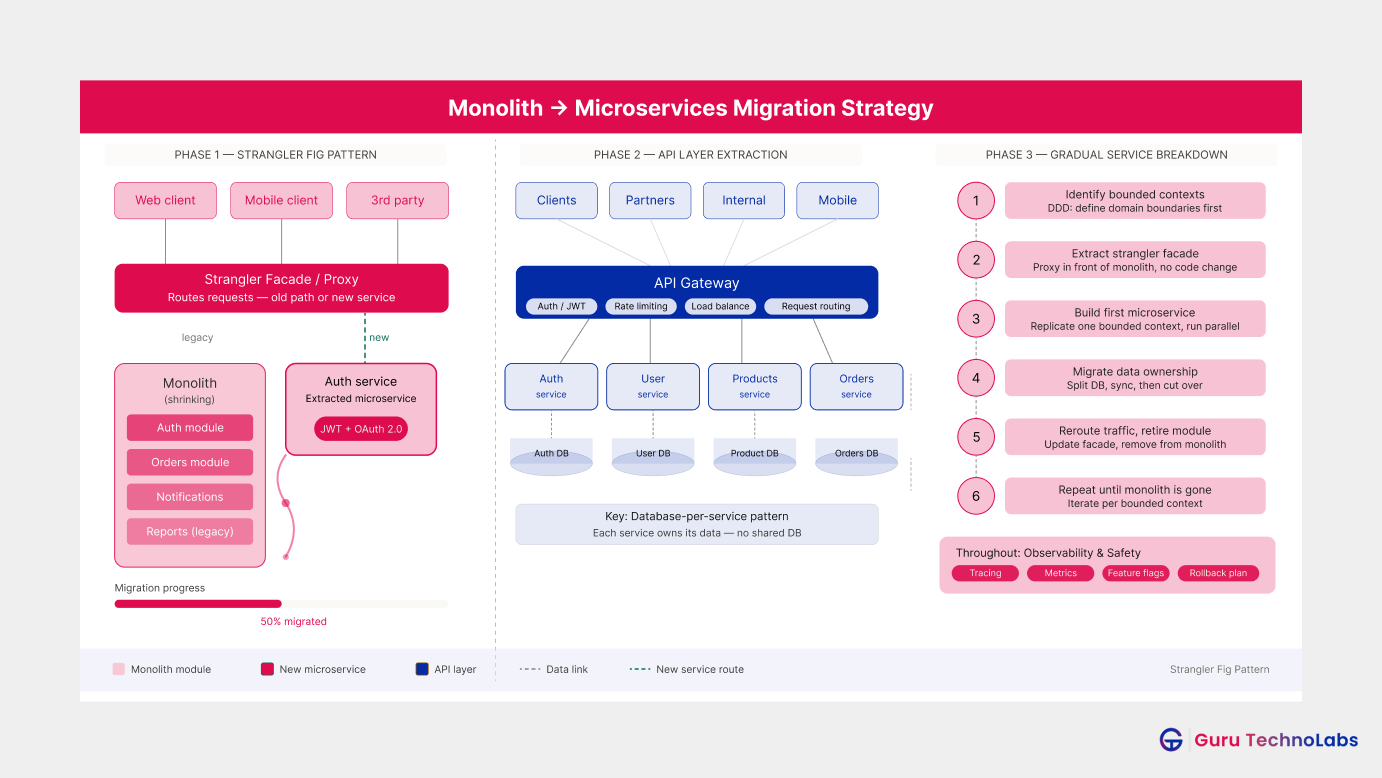
When the move is justified, the path matters as much as the destination. The migration is, fundamentally, a cloud migration strategy problem, choosing a sequence, protecting uptime, and managing data continuity. Several patterns have emerged from real-world migrations, and they share one principle: incremental extraction, never a rewrite.
Strangler Fig Pattern
Coined by Martin Fowler, the strangler fig pattern means you don’t replace your entire system at once. Instead, you slowly move parts of your monolith into new services over time. New requests are handled by the new services, while the remaining requests still go through the monolith until it is no longer needed.
This approach keeps your system stable and reduces risk, because you can test and roll back changes step by step. The bigger decision is how you move, whether you simply shift your system as it is, make small improvements, or redesign parts of it. Choosing the right approach plays a major role in how successful your migration will be.
API Layer Extraction
Introduce a clear API boundary between the front end and the monolith. Once the contract is stable, extract services behind that API one at a time. The front end doesn’t need to know which calls hit the monolith and which hit a new service.
Database Decomposition Challenges
The hardest part of any migration is the data layer. Splitting a shared database means handling distributed transactions, eventual consistency, and data ownership questions that didn’t exist before. Most teams underestimate this by an order of magnitude.
Patterns like the saga pattern, change data capture, and outbox tables exist for exactly this reason. Most of the real challenges in migrating legacy systems live here the data, not the code, is what makes the migration hard.
Planning a Monolith-to-Microservices Migration?
Avoid downtime, rework, and rising cloud costs with the wrong approach. Contact us to build a phased migration plan that keeps your system stable and scalable.
Key Takeaways: Avoiding Costly Architecture Mistakes
A few principles to anchor any decision:
- Microservices are not always the right choice. They solve specific problems and create new ones.
- Monoliths are not outdated. A well-structured monolith often outperforms a poorly designed distributed system.
- The decision should be driven by business needs, team capability, and growth stage, not by what large tech companies do.
- Start simple. Add complexity only when the cost of not having it exceeds the cost of managing it.
- Most successful systems evolve gradually. A modular monolith today can become a service-oriented architecture tomorrow, on your terms.
Conclusion: Focus on Business Needs, Not Trends
The microservices vs monolith debate is often framed as old vs new, simple vs scalable, legacy vs modern. None of these framings helps with actual decision-making.
Architecture is a tool. Its only job is to solve a business problem reliably, affordably, and in a way the team can sustain. A monolith that ships features every week and serves users well is a better architecture than a microservices system that takes six months to add a feature and burns through budget.
The companies that scale well pick architecture based on where they are, what their team can operate, and what their business genuinely needs, not on what’s fashionable in engineering circles. If this decision has real consequences for your roadmap, treat it as the strategic call it is. Pressure-test the assumptions, and design a cloud architecture that can evolve with your business, because no system is ever final.
FAQs (People Also Ask)
Microservices are not universally better than monolith architecture. Microservices work best for large teams, complex systems, and applications that require independent scaling and high flexibility. In contrast, monoliths are better suited for most businesses, especially in early or growth stages, because they offer faster development, lower costs, and simpler management. The right choice depends on your team size, system complexity, and operational maturity.
When specific, measurable pain points justify it: coordination overhead from a large engineering team, uneven scaling needs, fault isolation requirements, or domain boundaries that have stabilized. Switching because of trend pressure or generic "scalability" goals usually backfires.
Speed and simplicity. Startups need to ship features, validate ideas, and pivot quickly. A monolith lets a small team move fast without infrastructure overhead.
Operational complexity, distributed system debugging, data consistency across services, infrastructure cost, and the engineering culture required to sustain it. Most failed microservices migrations don't fail because of code; they fail because the operating model wasn't ready.
Choosing between microservices and monoliths depends on your business stage, team size, and scalability needs. A monolith is ideal for early-stage products and small teams because it allows faster development and simpler management. Microservices make more sense when you have multiple teams, complex systems, and a need to scale different parts independently. In most cases, it’s better to start with a monolith and move to microservices only when clear scaling or coordination challenges arise.
A monolithic architecture is often better for small teams because it is easier to build, deploy, and maintain. With a single codebase and shared system, teams spend less time managing infrastructure and more time delivering features. It also simplifies debugging, testing, and deployment. For small teams with limited resources, a monolith reduces operational complexity and helps maintain development speed.
Microservices architecture comes with several disadvantages, especially for growing businesses without strong DevOps maturity. It increases operational complexity by introducing multiple services, deployments, and communication layers. Debugging becomes more difficult in distributed systems, and managing data consistency across services is challenging. Additionally, microservices require higher infrastructure investment, making them more expensive to build and maintain compared to a monolith.
The main difference between microservices and monoliths lies in how the application is structured and deployed. A monolith is a single, unified application where all components share the same codebase and database. In contrast, microservices break the application into smaller, independent services that communicate through APIs and can be deployed separately. While monoliths are simpler to manage, microservices offer greater flexibility and scalability.
Monoliths and microservices each have their own pros and cons depending on the use case. Monoliths are simple, cost-effective, and faster to develop initially, but they can become harder to scale and maintain as the system grows. Microservices allow independent scaling, better fault isolation, and faster development for large teams, but they introduce significant complexity, higher costs, and require advanced infrastructure and DevOps practices. The right choice depends on your team size, system complexity, and long-term scalability needs.