Multi-Tenant vs Single-Tenant: What Growth-Stage SaaS Businesses Should Choose
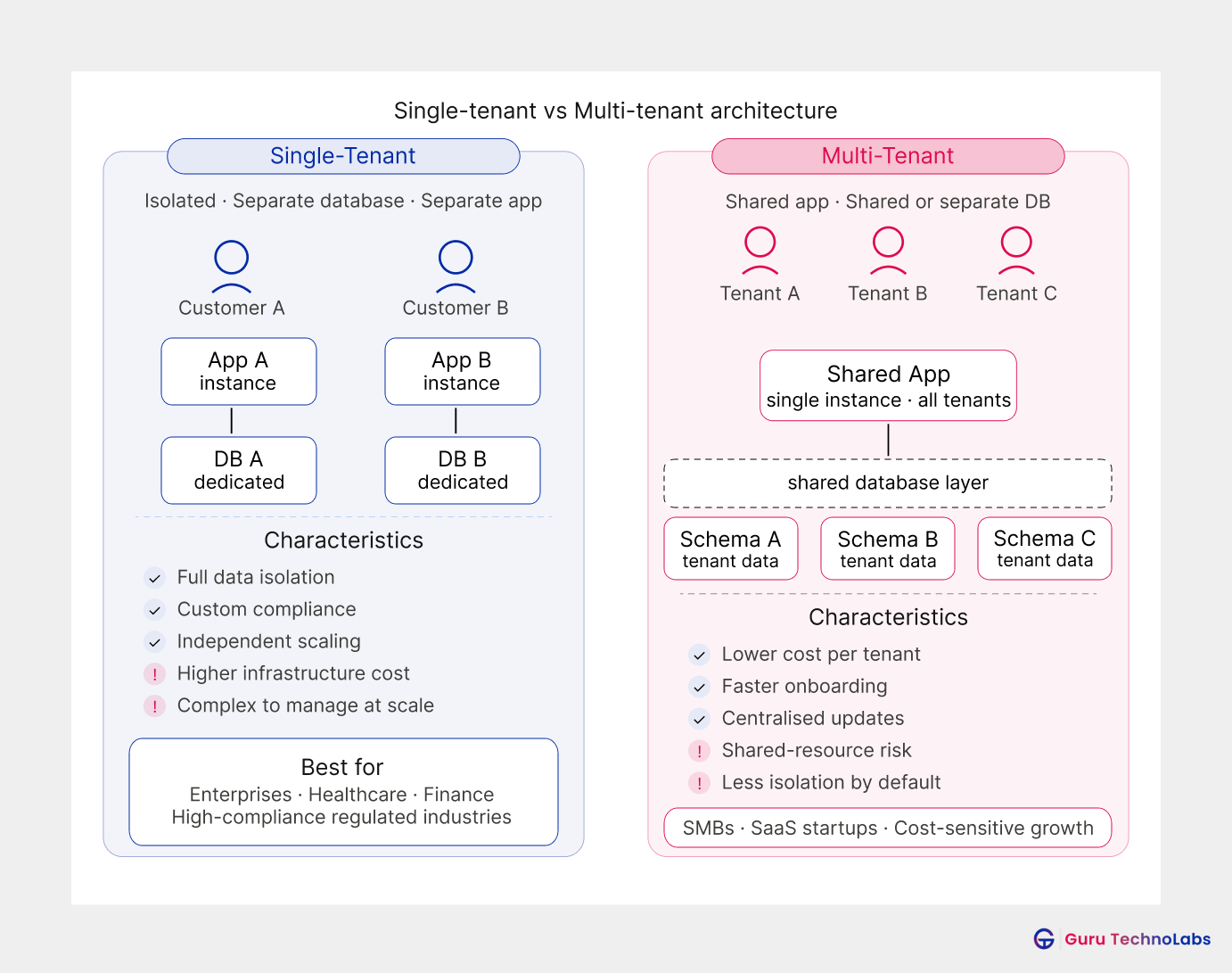
Table of Contents
- What Is Multi-Tenant Architecture in SaaS?
- What Is Single-Tenant Architecture in SaaS?
- Multi-Tenant vs Single-Tenant: Key Differences That Actually Matter
- Why This Decision Becomes Critical at the Growth Stage
- When Multi-Tenant Architecture Starts Breaking Down
- When Single-Tenant Architecture Becomes a Bottleneck
- Multi-Tenant vs Single-Tenant: Pros and Cons for Growing SaaS
- The Hybrid Approach: What Most Growth-Stage SaaS Companies Actually Choose
- How to Choose the Right Architecture for Your SaaS
- Key Factors to Consider Before Making the Decision
- Common Mistakes SaaS Businesses Make in Architecture Decisions
- Can You Switch Between Multi-Tenant and Single-Tenant Later?
- Final Verdict: What Should Growth-Stage SaaS Businesses Choose?
- Frequently Asked Questions
Somewhere between your 500th and 5,000th customer, SaaS architecture stops being a pure engineering decision and starts influencing core business outcomes. Infrastructure costs begin scaling faster than revenue. Larger customers start requesting isolated environments, stronger data control, and regional hosting guarantees. Meanwhile, performance issues that were never visible in early testing suddenly surface in real customer usage.
This is the point where the discussion around multi-tenant and single-tenant architecture moves beyond theory and becomes a practical growth decision.
Early-stage products are usually designed for speed, simplicity, and rapid iteration. That approach is ideal during MVP and early traction. But once product-market fit is established, the constraints shift. Systems that once enabled agility can begin introducing operational and financial friction. Architecture decisions made earlier—sometimes implicitly—start to directly impact margins, scalability, and enterprise readiness.
What once felt efficient can become costly. What once felt flexible can become limiting. And without revisiting those assumptions, the underlying system design can quietly dictate how far the product can scale and what kind of customers it can realistically support.
This guide focuses on a structured way to evaluate architectural direction for the next stage of growth. Instead of treating tenancy models as a purely technical comparison, it reframes the decision as a balance between cost structure, scalability, operational complexity, and market requirements.
Before diving into the framework, it is important to clarify how multi-tenant and single-tenant architectures are commonly understood in modern SaaS environments, as definitions often vary depending on implementation context.
What Is Multi-Tenant Architecture in SaaS?
Multi-tenant architecture means a single instance of your application serves multiple customers (tenants) simultaneously. All customers share the same codebase, infrastructure, and often the same database, with tenant isolation handled at the application or schema level. IBM describes multi-tenant software as a foundational model for modern cloud SaaS precisely because it enables the unit economics that single-tenant deployments cannot.
Think of it like an apartment building. Every tenant has their own locked unit and privacy, but they share the building’s plumbing, electrical system, and maintenance staff. When the landlord upgrades the boiler, every apartment benefits at once.
In practice, multi-tenancy can be implemented through:
- Shared database, shared schema (tenant ID in every table)
- Shared database, separate schema per tenant
- Separate databases per tenant, but shared application layer
Most modern SaaS products targeting SMB and mid-market customers use multi-tenancy. Tools like CRM platforms, project management software, and marketing automation suites almost universally run on multi-tenant foundations.
The defining characteristics are resource sharing, centralized updates (deploy once, everyone gets the feature), and economies of scale that drive cost per user down as you grow.
What Is Single-Tenant Architecture in SaaS?
Single-tenant architecture gives each customer their own dedicated instance of the application, with isolated infrastructure, a separate database, and often separate deployment pipelines. In the cloud, single-tenant vs multi-tenant is not a binary ideological choice — it is a deployment pattern that shapes cost, compliance, and customization independently.
Back to the real estate metaphor: this is a private house. Your customer owns the entire property, controls what gets built on it, and doesn’t share anything with neighbors. They also pay the full cost of maintenance.
Single-tenant software deployments are common in:
- Enterprise SaaS serving Fortune 500 clients
- Healthcare platforms bound by HIPAA
- Financial services software subject to regional data residency laws
- Defense, government, and regulated industries
The defining characteristics are full data isolation, customization flexibility at the infrastructure level, and stronger control over performance and compliance. A well-designed cloud architecture for single-tenant systems typically includes per-tenant monitoring, backup, and scaling policies, which drives up operational overhead but delivers predictability.
In cloud environments, both multi-tenant and single-tenant architectures are common, and most major cloud providers support both models. The real difference lies in how your application, infrastructure, and customer data are organized. In a cloud multi-tenant setup, multiple customers share the same underlying resources while their data remains securely isolated.
A cloud single-tenant setup, on the other hand, gives each customer a dedicated environment with greater control over performance, customization, and compliance. The right approach ultimately depends on your business goals, customer expectations, and regulatory requirements.
Multi-Tenant vs Single-Tenant: Key Differences That Actually Matter
Before comparing costs, scalability, or security, it’s important to understand the difference between single-tenant and multi-tenant architecture. In a multi-tenant architecture, multiple customers share the same application infrastructure while their data remains logically isolated. In a single-tenant architecture, each customer has a dedicated application instance along with its own infrastructure. The differences go well beyond these basic definitions.
They directly influence how a SaaS product scales, serves enterprise customers, controls costs, and meets compliance requirements. In cloud environments, the distinction becomes even more nuanced because major cloud providers support both deployment models on the same underlying infrastructure. As a result, the decision is driven less by the cloud platform and more by your architectural and business requirements.
| Factor | Multi-Tenant | Single-Tenant |
|---|---|---|
| Cost Structure | Low cost per tenant; economies of scale | High per-customer infrastructure cost |
| Scalability | Scales horizontally across tenants | Scales vertically per tenant |
| Performance | Subject to noisy neighbor issues | Predictable, isolated performance |
| Data Isolation | Logical isolation (application/schema) | Physical isolation (infrastructure) |
| Customization | Limited, config-driven | Deep, code-level customization possible |
| Deployment | Single pipeline, all tenants updated | Per-tenant pipelines, staggered rollouts |
| Compliance | Harder for strict regulatory requirements | Easier to meet HIPAA, GDPR, SOC 2, etc. |
| Maintenance | Centralized, lower DevOps overhead | Distributed, higher DevOps complexity |
| Onboarding Speed | Minutes (self-serve) | Days to weeks (dedicated setup) |
What this table hides is that the “right” choice depends less on these individual factors and more on how they interact with your customer segment and growth trajectory. A 20% cost advantage is irrelevant if you can’t close enterprise deals without data isolation.
Why This Decision Becomes Critical at the Growth Stage
A growth-stage SaaS business has moved past product-market fit. In real-world scenarios, we consistently see this shift happening as SaaS platforms expand into enterprise segments, where architectural limitations start directly impacting sales, pricing, and retention. You have paying customers, repeatable sales motions, and a roadmap driven by market pull. Usually, you’re somewhere between $1M and $20M ARR, hiring aggressively, and facing three simultaneous pressures.
Performance bottlenecks appear: The architecture that served 1,000 users fine starts showing cracks at 50,000. Database queries slow down. Background jobs pile up. P99 latency creeps up in ways your monitoring missed until customers complained.
Infrastructure costs start compounding: What was a rounding error in your P&L becomes a material cost. CFOs start asking questions about gross margins. Engineering leaders get pulled into cost optimization reviews they never expected.
Enterprise buyers arrive with different expectations: They want SSO, audit logs, dedicated environments, custom DPAs, and proof of compliance. Your SMB-focused architecture wasn’t designed for this, and retrofitting it is painful.
The architectural decisions you made during MVP were optimized for speed and learning. Those decisions may not survive growth, and the cost of changing them compounds with every new customer. Many teams at this stage also re-evaluate their broader cloud migration roadmap to align infrastructure with where the business is heading, not where it was.
Planning Your Next Architecture Phase?
Scaling beyond MVP requires more than adding servers. It requires designing for the business you are becoming.
When Multi-Tenant Architecture Starts Breaking Down
Multi-tenancy is elegant until a few specific pressures start to accumulate. In practice, many scaling SaaS products encounter these challenges once high-value customers begin demanding customization and stricter isolation guarantees. Understanding why multi-tenancy fails in SaaS products at scale matters more than understanding why it works, because the challenges of multi-tenant SaaS architecture usually show up as failure modes that drain engineering quarters that most growth-stage teams cannot afford.
Customization demands from high-value clients: A single enterprise customer paying 10x your average contract value asks for a feature that conflicts with how every other tenant uses the product. Your codebase resists. Your team starts adding feature flags, tenant-specific branches, and configuration tables that accumulate technical debt fast.
The noisy neighbor problem: One tenant runs a batch job that consumes shared database resources and slows down every other customer. You add rate limits, tenant quotas, and resource isolation logic, but you’re essentially rebuilding single-tenancy on top of multi-tenant infrastructure. This usually means implementing workload isolation strategies such as queue-based processing, per-tenant throttling, and database-level partitioning to prevent one tenant from consuming disproportionate resources.
Complex data isolation logic: Every new feature requires careful tenant-scoping. Every new developer has to internalize it. A single bug that leaks data across tenants can become an existential incident.
Enterprise onboarding friction: Security questionnaires from enterprise buyers ask about data segregation, encryption keys per tenant, and compliance boundaries. Explaining “logical isolation” to a CISO who wants physical isolation is a sales cycle killer.
The insight most growth-stage teams learn the hard way: what worked for 1,000 users may fail at 100,000. Multi-tenancy is not inherently less secure, but the engineering discipline required to keep it secure at scale is non-trivial.
When Single-Tenant Architecture Becomes a Bottleneck
A common question from teams evaluating enterprise deployments is whether single-tenant architecture scales well. It scales vertically per tenant, but not efficiently at a business level. Single-tenant just trades multi-tenant’s problems for different ones. We often see teams adopt single-tenancy for enterprise readiness, only to later face cost and operational inefficiencies as their customer base grows.
Infrastructure costs scale linearly with customers: Every new customer means a new database, a new set of services, and a new monitoring footprint. At 100 customers, your ops bill dwarfs what a comparable multi-tenant business would spend.
Deployments slow down: Rolling out a feature to 200 isolated environments is fundamentally harder than deploying once. You need orchestration tooling, staggered rollouts, and rollback procedures per tenant. This often requires CI/CD pipelines designed for multi-environment deployments, release management tools, and automated rollback mechanisms that can handle failures at the tenant level without affecting others.
Resource utilization is poor: Most single-tenant environments run at 10-20% utilization. You’re paying for capacity that sits idle because you can’t share it across tenants. This is where teams often need to optimize cloud cost through auto-scaling, right-sizing, and reserved capacity strategies.
Operational complexity explodes: Patching, upgrading, and debugging across hundreds of environments requires mature DevOps practices that many growth-stage teams haven’t built yet.
The insight here: control increases, but efficiency drops. Single-tenancy trades operational efficiency for isolation, and the math only works if your customers are paying enough to justify it.
Multi-Tenant vs Single-Tenant: Pros and Cons for Growing SaaS
Understanding the single-tenant vs multi tenant pros and cons helps SaaS businesses make architecture decisions based on business priorities rather than assumptions. While multi-tenancy generally offers lower operational costs and easier scalability, single-tenancy provides stronger isolation and greater flexibility for enterprise customers. The advantages and disadvantages below highlight the trade-offs that matter most for growing SaaS companies.
Advantages of Multi-Tenant
- Lower cost per user. Shared infrastructure means you amortize fixed costs across your entire customer base.
- Faster product velocity. Ship features once, everyone gets them. Fewer environments to test and deploy to.
- Simpler operations. One production environment to monitor, patch, and secure.
- Efficient resource utilization. Unused capacity for one tenant is available for another.
Disadvantages of Multi-Tenant
- Customization constraints. Hard to deviate from the “standard product” without polluting the codebase.
- Shared risk surface. An outage affects everyone. A security breach potentially exposes all tenants.
- Architectural complexity at scale. Proper tenant isolation, quota management, and performance fairness require serious engineering investment.
- Harder compliance positioning. Regulated industries often default to distrust logical isolation.
Advantages of Single-Tenant
- Strong isolation guarantees. No data leakage risk between customers. Easier to pass security audits.
- Customization flexibility. You can tailor configuration, features, and even code per customer if needed.
- Predictable performance. No noisy neighbors. Each tenant gets what they pay for.
- Easier compliance narrative. HIPAA, GDPR, and data residency requirements are simpler to satisfy.
Disadvantages of Single-Tenant
- High infrastructure cost. Linear scaling means your costs grow with your customer count.
- Maintenance overhead. Every tenant is a mini-production environment that needs patching, monitoring, and support.
- Slower innovation cycles. Deploying across tenants takes time, and customization creates version drift.
- Engineering tax. Your team spends more time on operations and less on product differentiation.
The Hybrid Approach: What Most Growth-Stage SaaS Companies Actually Choose

Here’s the pattern we see repeatedly with growth-stage SaaS companies that have matured past the binary debate: they run both models.
A hybrid tenancy model typically looks like this:
- Multi-tenant by default for SMB and mid-market customers who value speed and price
- Single-tenant instances for enterprise customers, regulated industries, or customers willing to pay a premium for isolation
- Shared control plane that manages both deployment types from a common orchestration layer
This is how many mature SaaS platforms structure their enterprise tier. Most large-scale platforms across CRM, collaboration, and ERP categories follow this hybrid approach to balance cost efficiency with enterprise requirements.
The benefits of a hybrid model:
- You capture SMB market share efficiently with multi-tenancy
- You unlock enterprise deals that require dedicated deployments
- You can price-discriminate by deployment type, improving unit economics
- You serve compliance-heavy segments without forcing every customer into a more expensive model
The trade-off is engineering complexity. You need infrastructure-as-code maturity, automation to provision and manage single-tenant instances, and a product architecture that supports both modes without forking the codebase. In practice, this typically involves tools like Terraform or CloudFormation, automated provisioning pipelines, and tenant-aware deployment orchestration that can spin up isolated environments on demand.
How to Choose the Right Architecture for Your SaaS
There is no universally correct answer, but there is a correct answer for your specific business. The real question reframes as: when should you use multi-tenant architecture, when does single-tenant pay off, and when is hybrid worth the engineering investment? Here is a decision framework.
Choose Multi-Tenant If:
- Your primary customer segment is SMB or mid-market
- Your product is largely standardized with config-based customization
- Cost efficiency and fast time-to-value are competitive differentiators
- You need to scale customer count rapidly without scaling infrastructure linearly
Choose Single-Tenant If:
- Your customers are in the enterprise, government, or regulated industries
- You face strict compliance requirements (HIPAA, GDPR, data residency)
- Deep per-customer customization is part of your value proposition
- Customers are willing to pay a premium for dedicated environments
Choose Hybrid If:
- You serve both SMB and enterprise segments
- You are scaling fast and need architectural optionality
- Pricing tiers map naturally to different deployment models
- You want to avoid forcing every customer into the same trade-offs
The hybrid path is harder to build but more valuable long-term. It gives you the cost efficiency of multi-tenancy where it matters and the isolation of single-tenancy where it commands a premium.
Key Factors to Consider Before Making the Decision
Before locking in a direction, run your decision against these five lenses.
Customer segment and buyer expectations
If you’re selling to SMBs, tenancy rarely comes up in conversations. But the moment you move upmarket, enterprise buyers will ask about data isolation, deployment models, and compliance in the first meeting.
Your architecture should reflect not just who you serve today, but who you plan to sell to in the next 12–24 months.
Compliance and security requirements
Regulations like HIPAA, PCI DSS, and GDPR directly influence your architectural choices. While many of these can be supported in multi-tenant environments with the right controls, the burden of proof is significantly higher.
Cloud providers like Amazon Web Services and Microsoft Azure provide detailed guidance on tenant isolation and multi-tenant SaaS design, but implementing these patterns correctly requires strong engineering discipline.
Expected scale
Architectural decisions that work today can become constraints at scale if growth isn’t planned early. Project out at least 3 years: expected customer count, data volume per customer, and traffic patterns.
An architecture built for 1,000 customers storing 10GB each is fundamentally different from one supporting 100 customers storing 10TB each; each scenario introduces different trade-offs in performance, cost, and system design.
Operational maturity
If your team is still manually deploying to a handful of environments, scaling to hundreds of tenant environments will quickly become unmanageable and error-prone.
Single-tenancy demands strong DevOps practices to handle this complexity. This typically includes automated infrastructure provisioning, centralized monitoring across environments, configuration management, and alerting systems that track performance and failures at the tenant level.
Product complexity and customization
Highly configurable products typically work best with multi-tenant architecture, where customization can be handled through configuration rather than code changes.
In contrast, products that require deep, code-level customization for each customer are better suited for single-tenant setups, where changes can be isolated without affecting other users.
Common Mistakes SaaS Businesses Make in Architecture Decisions
Over years of advising growth-stage SaaS teams, these are the mistakes we see repeatedly.
Choosing a single-tenant too early: Startups sometimes deploy a single-tenant because it feels “safer” or more enterprise-ready. Then they try to sell to SMBs and discover their unit economics don’t work. You cannot SMB-price a single-tenant deployment.
Ignoring future scalability in the MVP phase: Teams optimize the MVP for launch speed and never revisit the architecture. Two years later, they are refactoring under pressure while trying to ship new features.
Overestimating security risks in multi-tenancy: Multi-tenancy is not inherently insecure. Google Cloud’s Well-Architected Framework and mainstream SaaS case studies both show how disciplined organizations achieve strong tenant isolation on shared infrastructure. The risk is weak implementation, not the model itself.
Not planning for a hybrid future: Teams treat the decision as binary. When enterprise demand shows up, they scramble. Building hybrid-ready from day one costs slightly more and saves significantly later.
Treating architecture as a one-time decision: Architecture decisions have half-lives. Schedule an architectural review at each major growth inflection point.
Avoiding Costly Architectural Rewrites
The most expensive SaaS architectures are the ones teams built fast and never revisited. A strategic review now can save years of rebuilding later.
Can You Switch Between Multi-Tenant and Single-Tenant Later?
Yes, but it is one of the more complex migrations a SaaS company can undertake.
Going from single-tenant to multi-tenant requires merging isolated data stores, building tenant-scoping logic into every query, and migrating customers without downtime. It is essentially rebuilding the application.
Going from multi-tenant to single-tenant is slightly easier but still non-trivial. You need automated provisioning, data extraction per tenant, and a strategy for maintaining both models during the transition.
Either direction requires careful data migration, significant architecture redesign, DevOps restructuring, and a clear rollback strategy. In practice, teams rely on phased migration strategies, data replication pipelines, containerization, and blue-green or canary deployments to minimize downtime and reduce risk during the transition. Teams that successfully navigate these transitions often first modernize their foundation, whether by migrating legacy systems to the cloud or containerizing existing workloads to make tenancy changes more mechanical and less architectural.
The practical takeaway: plan early. A modest investment in architectural flexibility at the growth stage is dramatically cheaper than a forced migration under enterprise-customer pressure.
Final Verdict: What Should Growth-Stage SaaS Businesses Choose?
The real question is rarely which is better, multi-tenant or single-tenant SaaS, in absolute terms — it is which model fits your current customer mix and next 24 months of growth. Based on how modern SaaS platforms evolve, the most successful companies treat tenancy as a strategic decision that adapts with their customer mix, rather than a one-time architectural choice. There is no universal answer, but there is a clear pattern.
If you are scaling SMB customers and optimizing for cost efficiency, multi-tenant is the default for a reason. It is operationally simpler, economically efficient, and proven at scale across thousands of SaaS products.
If you are serving enterprise, regulated, or high-compliance customers, single-tenant is often non-negotiable. The premium pricing justifies the operational overhead, and the isolation satisfies buyer requirements that logical separation cannot.
If you are doing both, build toward a hybrid architecture deliberately. Make tenancy a deployment-time decision, not a hardcoded assumption. Invest in the automation and tooling that let you run both models from a shared platform.
The right architecture is the one that aligns with your customers, not just your code.
Ready to Architect for Your Next Growth Phase?
Choosing between multi-tenant, single-tenant, or hybrid is a business decision with engineering consequences. Get it right with experienced architects.
Frequently Asked Questions
Multi-tenant architecture can be highly secure when implemented correctly. Many SaaS platforms serving enterprise and Fortune 500 companies operate on multi-tenant infrastructure with strong security practices in place. Security depends on how well tenant isolation, encryption, access controls, and monitoring are implemented—not on the model itself. In most cases, risks arise from poor implementation rather than the architecture, which is why disciplined engineering and regular audits are critical.
Multi-tenant architecture is generally more cost-effective because infrastructure and operational costs are shared across multiple customers. This allows businesses to reduce cost per user as they scale. In contrast, single-tenant architecture requires dedicated resources for each customer, causing costs to grow linearly. As a result, the cost gap between the two models increases significantly over time, especially for SaaS companies targeting SMB and mid-market segments.
Yes, many mature SaaS platforms use both architectures through a hybrid model. In this approach, multi-tenant environments are used for standard or SMB customers, while single-tenant deployments are offered to enterprise clients who require greater isolation or customization. This setup allows companies to balance cost efficiency with enterprise requirements, but it requires strong automation and a flexible architecture that supports both models without code duplication.
You should consider moving to single-tenant architecture when a significant portion of your customers requires strict compliance, data residency, or performance guarantees that are difficult to achieve in a shared environment. This shift is usually driven by enterprise demand rather than internal technical preference. It only makes sense when customers are willing to pay a premium that justifies the additional infrastructure and operational overhead.
A hybrid tenancy model combines both multi-tenant and single-tenant approaches within the same platform. Typically, SaaS companies use multi-tenancy for cost-sensitive customers and single-tenancy for enterprise clients who need dedicated environments. This model is managed through a shared control plane and relies on automation to provision and maintain different deployment types from a single codebase, allowing flexibility without sacrificing efficiency.
For startups, multi-tenant architecture is usually the best choice because it is simpler, more cost-effective, and easier to scale quickly. As SaaS companies grow and begin targeting enterprise customers, their requirements often evolve to include compliance, customization, and isolation. At this stage, many businesses transition toward a hybrid model to support both SMB and enterprise segments without compromising scalability or cost efficiency.
Neither is universally better it depends on your business model and customer needs. Multi-tenant SaaS is typically better for companies targeting SMB and mid-market customers because it offers lower costs and easier scalability. Single-tenant SaaS is preferred by enterprise customers who require stronger data isolation, compliance, and customization. Many growing SaaS businesses adopt a hybrid approach to balance both.
Choosing between multi-tenant and single-tenant SaaS depends on factors like customer segment, compliance requirements, cost structure, and customization needs. Multi-tenancy works well for standardized products with high scalability needs, while single-tenancy is better for enterprise use cases that require dedicated environments. The right decision should align with your current users and your growth strategy over the next few years.
Multi-tenant SaaS architecture can face challenges such as the noisy neighbor problem, complex data isolation, and limitations in customization. As the system scales, ensuring fair resource usage and maintaining strict tenant boundaries becomes more difficult. Enterprise customers may also raise concerns about data segregation, which can impact sales if not addressed properly.