15 Best Web Portal Examples for Inspiration (2026)
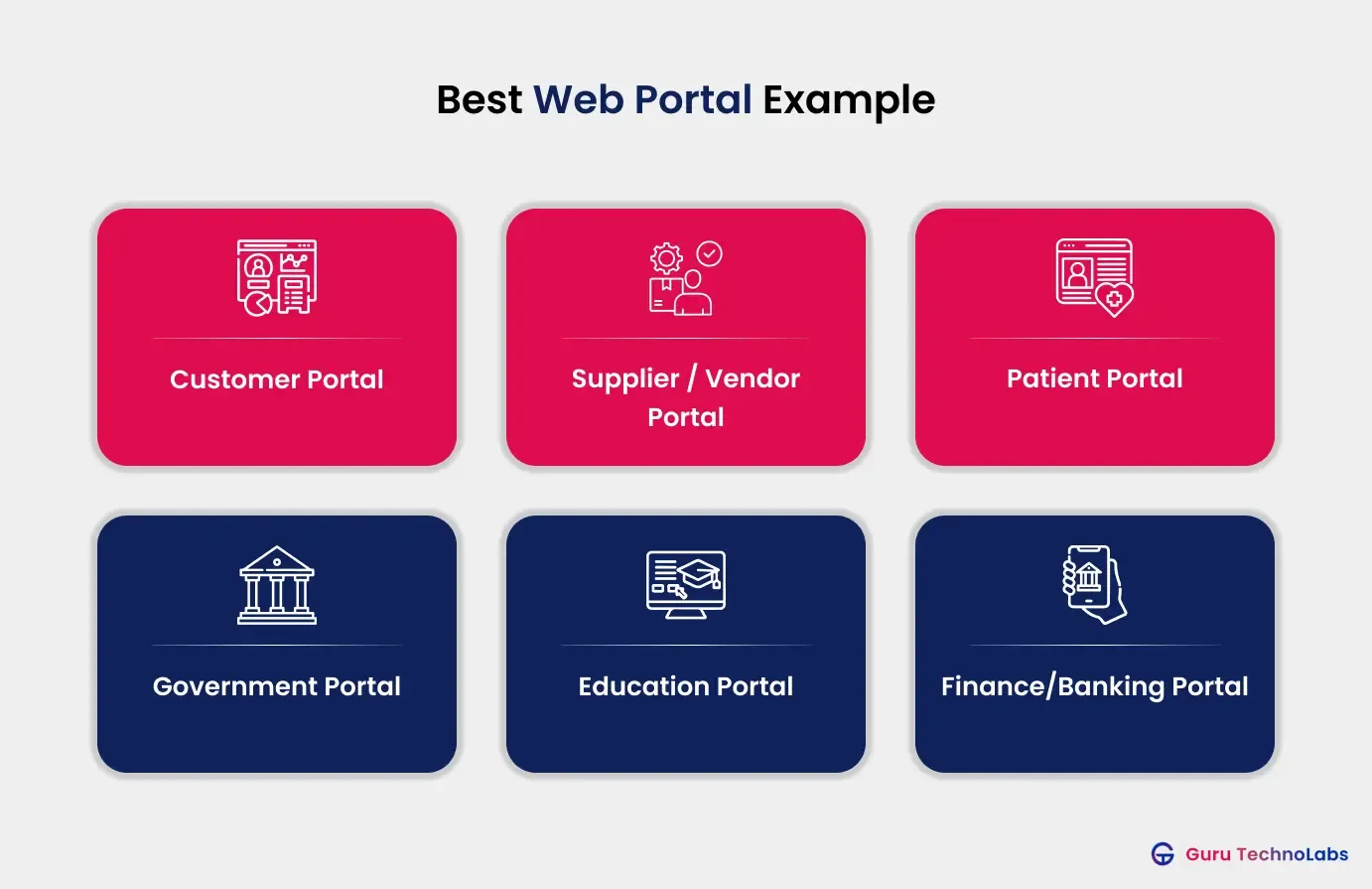
Table of Contents
- Web Portal Examples at a Glance – Business Outcomes by Category
- 1. Customer Portal Examples
- 2. Supplier & Vendor Portal Examples
- 3. Patient & Healthcare Portal Examples
- 4. Government Web Portal Examples
- 5. Education Portal Examples
- 6. Finance & Banking Portal Examples
- Final Thoughts
- Frequently Asked Questions
- A customer calls support to check their billing status – something they could’ve found in seconds online.
- A supplier sends an email asking about a purchase order that’s already sitting in your system.
- A patient picks up the phone to ask about lab results that have been ready for two days.
Sound familiar?
These aren’t rare situations or one-off issues – they’re everyday occurrences, and that’s exactly where web portals come in. The real problem isn’t the questions themselves, but the lack of easy access to information.
Research from Forrester shows that organizations that invest in digital self-service via web portals can reduce support costs by up to 40%. Some companies are already seeing the impact – Advanced Energy generated over $1.5 million in estimated savings with a supplier portal, while Embasa saves around $20,000 every month from a single customer portal. But numbers alone don’t decide for you.
To really understand the value, you need to see what effective portals actually look like in the real world – across different industries, use cases, and organizations. That’s exactly what this guide is here to help you do.
New to web portals? Start with the basics.
Read: What Is a Web Portal? Definition, Types & Key Benefits
Web Portal Examples at a Glance – Business Outcomes by Category
Before diving into specific examples, here’s a quick-reference overview of each portal type and the examples covered in this guide, matched to their best-fit industries and proven ROI.
| Portal Type | Best For | Core Capability | Proven Business Outcome |
| Customer Portal | SaaS, services, retail, banking | Self-service + account management | 66% fewer support clicks (Broadcom); $20K/month saved (Embasa) |
| Supplier / Vendor Portal | Manufacturing, retail, FMCG | Procurement + onboarding + collaboration | 50% faster onboarding (Douglas); $1.5M+ savings (Advanced Energy) |
| Patient Portal | Hospitals, clinics, pharma | Records, appointments, prescriptions | Reduced admin workload + improved care compliance |
| Government Portal | Public agencies, municipalities | Citizen services + e-forms + information | Lower email volume, faster service delivery |
| Education Portal | Schools, universities, ed-tech | LMS + course management + progress tracking | Higher student engagement, accessible remote learning |
| Finance/Banking Portal | Banks, insurance, FinTech | Account management + secure transactions | 30% customer growth (Gulf Insurance) |
1. Customer Portal Examples
A customer portal provides your clients with just one, authenticated place to deal with all of their relationships with you – to check orders, retrieve documents, solve problems, and change account details – without calling or emailing your support team. It is always one of the greatest ROI investments in digital infrastructure.
Broadcom- Self-Service Customer Support Portal
Broadcom is an international market leader in semiconductors and infrastructure software, with a large, technically challenging customer base. Their previous support model was not able to scale effectively.
The new customer portal was created as an all-encompassing center – offering its clients the ability to access self-service to documentation, licensing management, knowledge bases, educational materials, and either an AI-driven virtual assistant or live support through one interface.
The outcomes were impressive: The level of customer satisfaction increased, the number of support tickets decreased, and the number of clicks needed to solve a standard problem decreased by 66%.
Key Features: AI virtual support agent, license management, knowledge base, SSO, product line-specific content, and multi-channel access to support.
Embassy Municipal Sanitation Customer Portal
Embasa has over 350 municipalities and offers sanitation services, and their situation was not new: they had more calls and emails than they could attend to due to routine requests, which could be done by the right equipment by the customer. Their portal customizes the experience according to the location of the property of a customer – their citizens can request the service, see billing history, and follow the progress of their cases without calling an agent.
The number of requests being processed monthly grew by 750 per cent. Embasa will save 20,000 dollars monthly in operating expenses of customer support.
The main characteristics are: Location-based personalization, ability to request services on your own, billing, tracking cases, and mobile-friendly design.
Carrefour Bank – Financial Customer Self-Service Portal
The customer base was expanding very fast in Carrefour Bank, and the previous portal was not able to handle it. The new self-service portal will provide users with the financial statements and account management tools, debt and credit arrangement negotiating capabilities – all under one roof.
The portal was deployed on cloud infrastructure and scales under load, launches new financial products several times faster, and can be deployed in less than 10 minutes.
Key Features: Autoscaling on cloud, account and statement management, debt management options, fast product publishing, manage authenticated.
2. Supplier & Vendor Portal Examples
Supplier portals eliminate fragmented communication, email threads, faxes, and telephone calls with an integrated platform on which businesses and suppliers work together in real time on orders, contracts, forecasts, and compliance. The efficiency improvements in the cases below are always measured in the millions.
Douglas-European Retail Supplier Portal
Douglas is the most successful beauty retailer in Europe with more than 800 suppliers. The process of onboarding a new supplier was cumbersome, paper-intensive, and reliant on email back-and-forth. Their supplier portal consolidates all processes – the first stage of onboarding and contract management, product data sharing, and continuous communication – into a single platform that serves as a point of shared truth.
Time to onboard suppliers was reduced by half, and communication quality across the network improved.
Key Benefits: Digital onboarding solutions, contracts, product data interchange, order tracking, and real-time supplier notifications.
Manufacturing Supplier Portal- Advanced Energy
The internal communications mix of fax, email, and phone was replaced with a centralized supplier portal that supports purchase orders, demand forecasting, and scale-based procurement collaboration. It is not only a time-saving platform – it has already saved more than 1.5 million dollars annually by eliminating manual procedures and shortening the procurement cycle.
Key features: PO management, demand forecasting, document exchange, ERP integration, and supplier collaboration workspace.
SAP Ariba – Global Procurement Portal
SAP Ariba is a widely used supplier management solution globally and one of the fastest-growing business models, linking buyers and suppliers across industries on a single collaborative platform. It unites sourcing, contract management, catalog management, and spend analytics into a single environment – providing procurement teams with real-time access to supplier performance and organizational spend.
Some of the important features include: Supplier collaboration, contract automation, catalog management, spend analytics, guided buying workflows, and multi-region support.
3. Patient & Healthcare Portal Examples
Patient portals ease the burden on medical personnel and provide individuals with direct, secure access to their personal health records as they make appointments, read test results, and communicate with their care team. With accuracy and timeliness directly impacting the outcome, a robust portal will deliver real value on both ends.
MyChart by Epic Systems
One of the most popular patient portals in the world, MyChart is implemented by hospitals and health systems of all scales. Patients can review laboratory results immediately they are available, request prescription refills, secure communication with their physician, make appointments, and access health education content, all through a single, consistent interface.
MyChart is built on Epic’s EHR infrastructure and reflects real-time clinical data, which makes the patient experience a useful tool rather than a decoration.
Important Features: Include access to lab results, prescription management, secure provider messaging, appointment scheduling, health record download, and patient education resources.
Pharmacy Benefit Management Portal-MedImpact
MedImpact operates pharmacy benefit plans for hundreds of organizations, each with its own mix of services for its members. The issue was to integrate authentication and user management across dozens of independently built sites into a single, compliant experience.
Their portal consists of centralized SSO and custom portals to ease program access by members and provide MedImpact with granular control of every program, lowering operational expenses and reinforcing compliance management.
Key Features: SSO, multi-program control, custom portlets, self-service, pharmacy integration, compliance control.
Patient Access-UK Primary Care Portal
Patient Access is also used by GP surgery systems throughout the United Kingdom, enabling patients to make appointments, order repeat prescriptions, see test results, and send a message to their practice – without calling. The portal also supports payments, geolocation-based service discovery, and push notifications to remind you of appointments and display results.
Key Features: GP-built-in booking, prescription, secure test results, direct messaging, payment processing, geolocation search, notifications.
4. Government Web Portal Examples
The government portals can be considered one of the most complicated portal projects – they should accommodate millions of users with a range of digital literacy, comply with the strict accessibility and compliance requirements, and, frequently, include legacy systems that have been constructed over the centuries.
The finest of them simplify and bring the complexities of public administration closer.
United Kingdom Government Portal
GOV.UK is the international standard of government online service. It integrates hundreds of content and transactional service departments into one user-friendly interface.
Citizens can apply for benefits, renew passports, pay taxes, and access other policy details without having to navigate multiple departmental websites. Its straightforward design, architecture-oriented toward accessibility, and iterative user research have elevated it to a standard of reference in global public-sector digital transformation.
Key Features: Single-point access to 500+ government services, simple language, accessibility in line with WCAG, service application forms, and a multi-departmental CMS.
India.gov.in- Indian National Government Portal
India.gov.in is the hub for online access to government services in a nation of 1.4 billion people. The portal links people to services for birth and death certificates, pension management, welfare scheme applications, government information, a national news centre, Webcast services, and a connection to hundreds of official ministry resources. It is among the largest-scopes government service portals in the world.
Key Features: Access to a wide range of services, welfare schemes, redressing of complaints, news feeds, WebCast services, mobile app directory, and multilingual support.
City of Vienna – Intranet Portal Identity of the Municipal Government
The City of Vienna used a portal to connect employees across all municipal departments and facilitate internal processes. The quantitative results: the level of internal emailing decreased significantly, policy distribution became quicker and more frequent, and cooperation between departments became easier without the need to expand staff.
The portal’s self-service tools relieved administrative personnel of the daily routine of handling requests, allowing them to focus on more important tasks.
Key Features: Central content management, cross-department collaboration tools, self-service HR, news and announcements hub, and user-managed CMS.
5. Education Portal Examples
Education portals unite students, teachers, and administrators on a common platform – running course delivery, assignment workflow, grading, tracking student progress, and communicating with parents. The finest education portals do not simply computerize current processes, but help to make learning more accessible and quantifiably exciting.
Moodle – Learning Management Portal Open-source
The most popular open-source LMS in the world is Moodle, which educational institutions and corporate training programs deploy in more than 160 countries. Schools and universities are developing tailor-made learning systems in Moodle – quizzes, discussion boards, assignment submission, progress dashboard, mobile learning, and other features – on a system that can support one classroom to a multi-campus university system.
Key Features: Course builder and management, student learning tracking, collaborative learning, 160+ language support, mobile application, and a large library of plugins.
Blackboard – Portfolio, Course Management
Blackboard is widely used in universities to organize courses, tests, and communication between students and teachers at scale. It provides virtual learning environments, assessment automation, content archives, and mobile accessibility, enabling institutions to build a complete on-campus and distance education platform without installing multiple independent applications.
Major Features: Course management, assessment and grading tools, virtual classrooms, mobile accessibility, content libraries, and SIS integration.
Multi-Role School Portal, New South Wales Department of Education
NSW operates three parallel portals – for students, parents, and teachers – each delivering entirely different content, yet sharing the same platform architecture. The portals are used by more than 1.2 million students, their families, and thousands of teachers to access timetables, academic reports, administrative tools, and leave management daily.
It is a good example of creating a single technology base that provides truly distinct experiences for three distinct user communities.
Key Features: The role-based access with three types of users, access to timetable and reports, teacher HR and leave management, parent-school communication, and real-time updates.
6. Finance & Banking Portal Examples
Financial portals need to strike a balance between user experience with no friction and high security and regulatory standards. The best ones make large and complex financial administration feel natural while still meeting the data controls, audit trails, and encryption requirements mandated by compliance.
Gulf Insurance Group – Insurance Self-Service Portal
Gulf Insurance Group serves various markets and has developed a self-service portal that allows customers to buy policies, file claims, request quotes, and even manage endorsements online. The company was moving 100 percent of its product line online, supported by SSO capabilities and a digital-first design.
The result: 30% growth in the customer base after launch and a significant decrease in total cost of ownership.
Key Features: Policy purchase and management is online, claims are submitted online, quote requests, SSO, endorsement management, and a fully digital product catalog.
Bank of America – Online Banking Portal
One of the most widely used financial portals in the world is Bank of America’s online banking portal. It provides its customers with account management, bill payment, mobile check deposit, wire transfers, security notifications, and artificial intelligence-based financial information – all in a reliable, consistent experience on the web and on mobile.
This is due to the level of self-service capability, which means most basic banking requirements are met without contacting a branch or agent.
Key features: Complete account management, bill payments, mobile check deposit, money transfers, real-time fraud alerts, and AI-powered financial information and budgeting tools.
Revolut – Digital Banking Platform Portal
Revolut has set the stage for the expectations of what the banking portal should look like. Its mobile-first platform combines a multi-currency account, real-time spending notifications, cryptocurrency management, peer-to-peer payments, and detailed budgeting analytics into one interface. By opening an account, users can exchange between 30+ currencies, send money abroad in minutes, and view all transactions in real time.
Key Features: Multi-currency accounts, real-time spending insights, P2P payments, crypto management, budgeting analytics, global ATM access, business account tools.
Want to explore which portal type actually fits your business?
Read: Types of Web Portals – A Complete Guide for 2026
Final Thoughts
In this blog, we’ve walked through some of the best web portal examples and the different types you can build. The key takeaway is simple – a well-designed web portal can completely change how your business interacts with customers, partners, and employees.
It makes everything smoother, more organized, and far more personalized, which naturally leads to better engagement and growth.
Whether you’re planning a customer portal, a supplier platform, or an internal hub for your team, the impact really comes down to how well it’s built and executed. And if you already have an idea in mind, this is the right time to act on it. With the right support and a user-first approach, you can turn that idea into a powerful web portal that’s built to grow with your business.
If you are looking for professional help in building an advanced, feature-loaded web portal, don’t hesitate to contact us, as we have built many web portals and platforms across multiple domains.
Frequently Asked Questions
For most growing businesses, a customer portal delivers the fastest ROI by reducing support workload and improving customer experience. As you scale, supplier portals become equally valuable. Start with the area causing the most operational friction.
Costs vary based on complexity. Simple portals start around $15,000 - $40,000, mid-level projects range from $40,000–$150,000, and enterprise solutions go higher. A clear scope helps avoid unexpected costs.
Basic portals can launch in 2 - 4 months. More complex builds take 4 - 9 months, while enterprise solutions may take up to 18 months. Many businesses launch in phases to see value sooner.
Yes - and it should. The best portals connect with your CRM, ERP, payments, and other tools to provide real-time data in one place without switching systems.
A web app focuses on one task (like payments or booking). A web portal brings multiple tools and data into one place, personalized for different users.
It lets users find information and complete tasks on their own. This means faster resolutions for users and lower support costs for your business.
Common technologies include React, Angular, or Vue for frontend; Node.js, Python, or Java for backend; and cloud platforms like AWS or Azure for hosting and scalability.
If your team handles repetitive queries, relies heavily on emails, or users struggle to access information, you’re likely ready. These are clear signs a portal can add immediate value.